OV2640 Camera Module: 2MP Ultra Wide Angle 160° CMOS for Surveillance
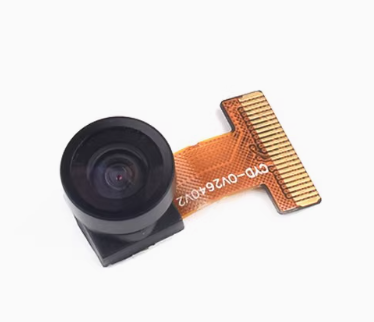
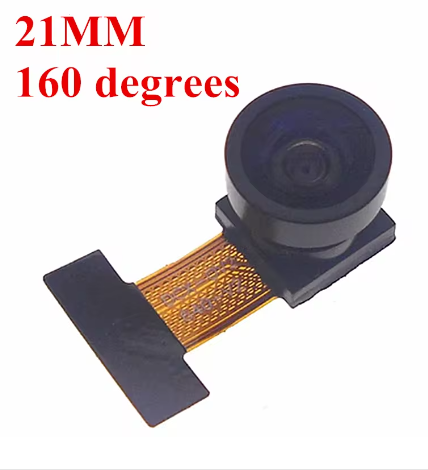
The OV2640 Camera Module is a specialized imaging solution designed for surveillance, robotics, and monitoring applications where a broad field of view is essential. This variant features the popular 2-megapixel OmniVision OV2640 sensor paired with a high-quality, 160° ultra-wide-angle fish-eye lens.
This wide field of view allows a single camera module to cover significantly more area than a standard lens, reducing blind spots in monitoring applications. It retains all the core functionality of the OV2640 chip, including maximum resolutions up to 1600×1200 (UXGA) and crucial onboard JPEG compression support. This compression capability is vital for use with microcontrollers like the STM32 or ESP32, enabling efficient data transfer and storage onto an SD card module with minimal host memory requirements.
Key Features
Ultra Wide-Angle Lens (160°): Captures a vast field of view, ideal for room monitoring, panoramic views, or robotic navigation where situational awareness is key.
High Resolution: Features a 2-megapixel sensor, delivering images up to 1600×1200 pixels (UXGA).
Onboard JPEG Encoding: Compresses image data internally, simplifying integration with microcontrollers that have limited RAM and processing power.
Integrated Image Processing: Built-in AEC, AGC, and AWB functions ensure optimal image quality across various lighting conditions.
3.3V Logic Compatibility: Operates at 3.3V logic levels, compatible with many modern MCUs like the STM32 and ESP32.
Standard Interface: Uses the familiar 8-bit parallel data bus and 2-wire I2C (SCCB) configuration interface.
Technical Parameters (Specifications)
Parameter
Value/Description
Image Sensor
OmniVision OV2640 CMOS Sensor (1/4 inch)
Effective Pixels
Max 1600 x 1200 (2MP)
Lens Field of View (FOV)
Approximately 160 degrees
Operating Voltage
3.3V DC (I/O levels are 3.3V tolerant)
Power Consumption
~125mA typical (active in JPEG mode)
Output Formats
JPEG, YUV/YCbCr 4:2:2, RGB565/555, Grayscale
Interface Type
8-bit Parallel Data Bus, SCCB (I2C compatible)
Max Frame Rate
Up to 15 FPS (UXGA), 30 FPS (SVGA)
Dimensions
Typically 28mm x 28mm (PCB size)
Usage Instructions
This module requires a host microcontroller capable of handling a significant number of I/O pins and managing the data streaming process.
Hardware Connection Notes:
Voltage Safety: This module is a 3.3V logic device. Connecting directly to 5V MCUs (like Arduino Uno/Mega) will cause permanent damage. Use a 3.3V microcontroller (STM32, ESP32) or appropriate logic level converters.
Interface Pins: Connections include Power (3.3V, GND), SCCB (SIO_C, SIO_D), Clock (XCLK, PCLK), Sync signals (VSYNC, HREF), and 8 Data Pins (D0-D7).
Data Handling: The high-resolution and wide-angle capture necessitates a fast MCU (like the STM32F4) to process the data stream effectively, usually with code that writes the data directly to external storage like a Micro SD card module.
Software & Programming:
I2C Configuration: Initialize the sensor via the I2C interface, sending specific register values to enable the wide-angle lens settings, desired resolution, and JPEG output.
Parallel Interface Driver: Utilize microcontroller drivers (often available for STM32 CubeIDE or Arduino/ESP32 platforms) that manage the timing of the parallel data capture.
Storage/Transmission: Once the JPEG data is captured, the MCU must store it to external memory (SD card) or transmit it over a network (Wi-Fi/Ethernet).
Q: Can I replace the ultra-wide-angle lens with a standard lens?
Yes, the module uses a standard M12 lens mount, allowing you to unscrew the existing lens and screw in other compatible M12 lenses with different focal lengths or fields of view.
Q: Is this camera suitable for night vision surveillance?
This specific module typically includes an IR-cut filter for accurate daytime color representation. For night vision, you would need a variant without the IR-cut filter that also incorporates external IR LEDs.
Q: Will the 160° lens cause significant image distortion?
Yes, a 160° ultra-wide-angle or fish-eye lens will inherently cause barrel distortion (curved lines). This is a normal characteristic of such wide fields of view and is often acceptable in surveillance or robotics applications where maximum coverage is prioritized over perfect geometric accuracy.
Q: I am a business buyer. How does this compare to standard security cameras?
This module offers flexibility for embedded integration at a lower cost than finished commercial products. It requires software development to function as a surveillance system (storage, networking, streaming). Its main advantage is customizability and form factor for specialized IoT/embedded monitoring solutions.