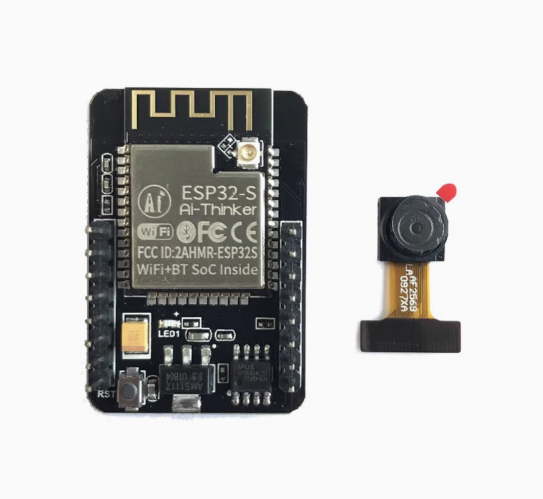
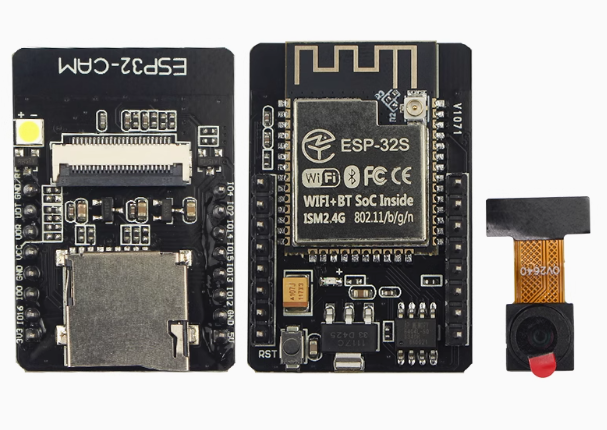
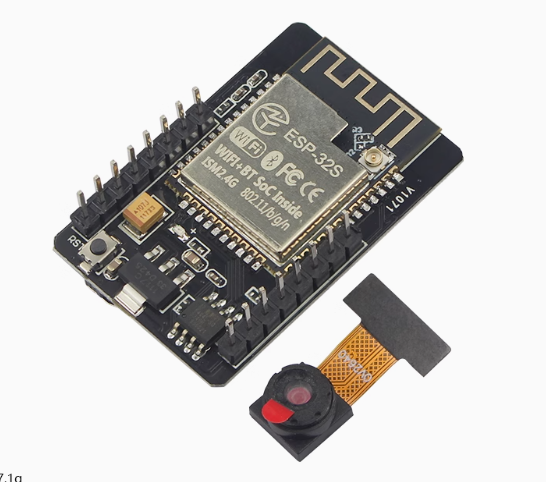
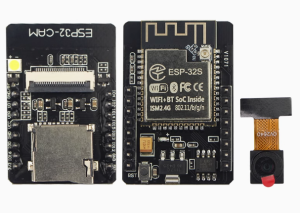
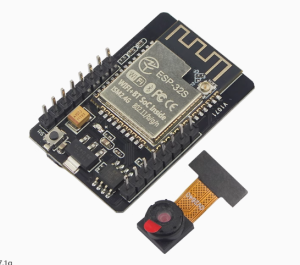
WiFi+Bluetooth module ESP32 serial to WiFi/ESP32-CAM development board [AI-Thinker]

SKU: FA1053-2
CPU

Xtensa® Dual-core 32-bit LX6 up to 240MHz

Memory

520 KB Internal SRAM + 4 MB External PSRAM

Flash

Default 32 Mbit (4 MB)

I/O Ports

9 GPIO pins

Working Voltage

4.75V – 5.25V (5V recommended)

Image Output

JPEG (OV2640 only), BMP, GRAYSCALE

UART Rate

Default 115200 bps

The AI-Thinker ESP32-CAM is a widely utilized, low-cost development board that integrates a powerful ESP32-S microcontroller with a compact camera module and microSD card slot. It is a versatile choice for DIY enthusiasts, hobbyists, and businesses for rapid prototyping of wireless imaging applications. 
Product Features
  • Integrated Vision: Comes standard with an OV2640 2MP camera sensor but also supports OV7670 modules.
  • Dual-Core Processing: Powered by the ESP32-S chip with dual 32-bit LX6 CPUs, reaching speeds up to 240 MHz.
  • Wireless Connectivity: Standard Wi-Fi (802.11 b/g/n) and dual-mode Bluetooth (Classic + BLE 4.2).
  • Expandable Storage: Features a built-in microSD card slot (supporting up to 4GB) for local image and video storage.
  • Low Power: Includes multiple sleep modes, with deep-sleep current consumption as low as 6mA.
  • Compact Design: Small DIP-16 package (approx. 27 x 40.5 mm) suitable for discreet surveillance or compact IoT devices. 
Technical Parameters
Parameter  Specification
CPU Xtensa® Dual-core 32-bit LX6 up to 240MHz
Memory 520 KB Internal SRAM + 4 MB External PSRAM
Flash Default 32 Mbit (4 MB)
I/O Ports 9 GPIO pins
Working Voltage 4.75V – 5.25V (5V recommended)
Image Output JPEG (OV2640 only), BMP, GRAYSCALE
UART Rate Default 115200 bps
Usage Scenarios
  • Smart Home & Security: Wireless video doorbells, remote wildlife monitoring, and discreet home surveillance.
  • Industrial IoT: QR code identification, wireless industrial control, and system positioning signals.
  • AI Vision & Tracking: Real-time object tracking, facial recognition (TinyML), and flood/fire detection using lightweight AI models.
Q: How do I program the ESP32-CAM?

Since it lacks a built-in USB-to-Serial converter, you must use an external FTDI adapter or a dedicated ESP32-CAM-MB programmer shield. To flash code, connect GPIO 0 to GND and reset the board

Q: Why does my board show a "Brownout detector was triggered" error?

This is usually due to an insufficient power supply. The board requires stable 5V power, especially when Wi-Fi and the flash LED are active. Using a high-quality 5V power source or adding a capacitor for filtering can resolve this

Q: Can I use the flash LED for other purposes?

Yes, the onboard flash LED is connected to GPIO 4. However, note that GPIO 4 is shared with the microSD card slot; the LED may blink when the card is accessed

Q: What is the maximum resolution for video streaming?

While the OV2640 supports up to 1600×1200 (UXGA), smooth Wi-Fi streaming is typically most stable at 640×480 (VGA) or 800×600 (SVGA)

Q: Is it suitable for commercial production?

Yes, many commercial products utilize the ESP32-CAM for low-cost visual monitoring. For large-scale production, the DIP-16 package allows it to be plugged directly into custom backplanes