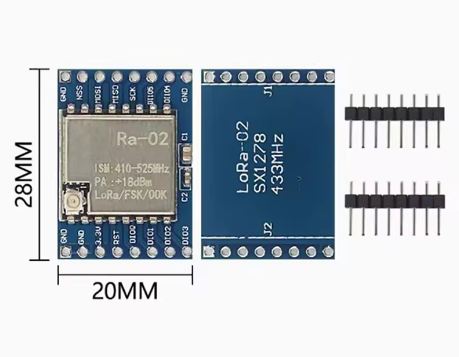
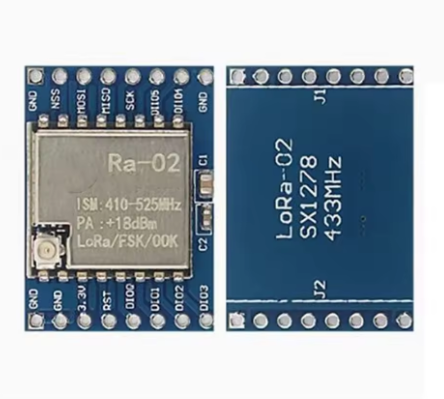
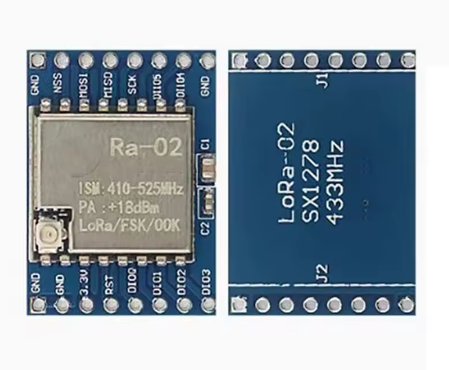
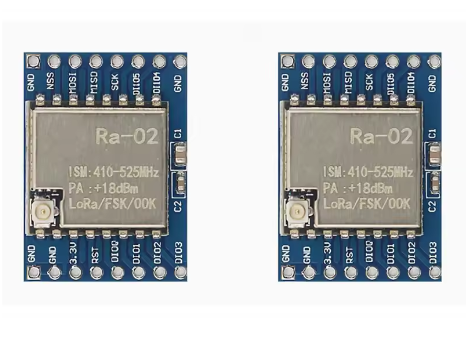
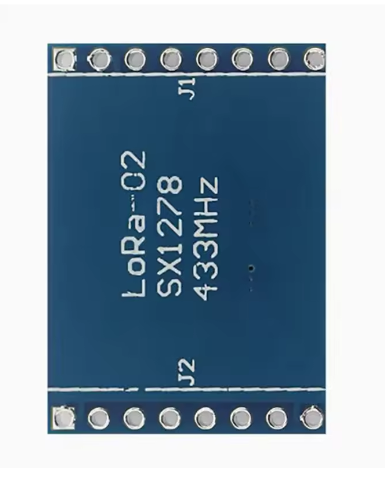
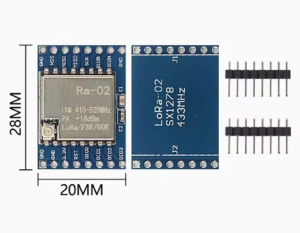
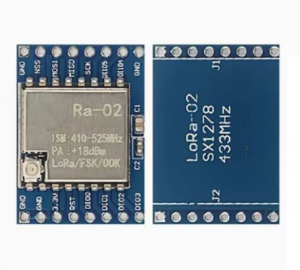
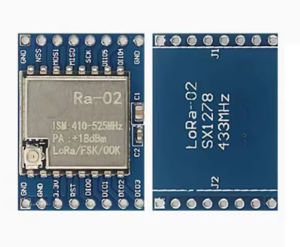
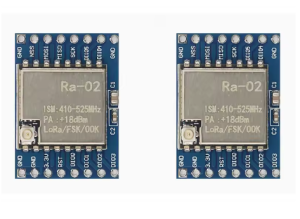
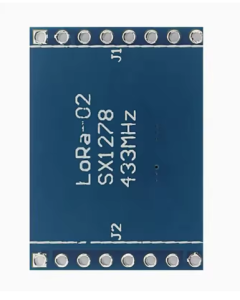
Ai-Thinker SX1278 LoRa RA-02 Wireless UART Transceiver Module – Long Range Communication

SKU: FA1067-1
RF Chip

Semtech SX1278

Frequency Range

410MHz – 525MHz (Typical: 433MHz)

Interface

SPI

Max Transmit Power

20dBm (100mW)

Receiver Sensitivity

-148dBm

Operating Voltage

1.8V – 3.7V (Typical 3.3V)

Operating Current

120mA (TX), 12mA (RX), 0.2uA (Sleep)

Modulation

LoRa / FSK / GFSK / MSK / GMSK / OOK

Antenna Connector

IPEX / U.FL

The Ai-Thinker Ra-01/Ra-02 remains one of the most widely deployed LoRa modules globally. Specifically, the Ra-02 is the version featuring the IPEX (U.FL) antenna connector, making it ideal for professional enclosures and high-gain antenna setups. 
Long Product Description
The Ai-Thinker Ra-02 is a high-performance wireless transceiver module based on the Semtech SX1278 chip. Operating in the 433MHz frequency band, it utilizes patented LoRa™ spread spectrum technology to achieve communication distances exceeding 10km in open areas—surpassing traditional FSK and GFSK modules. 
Designed for the Internet of Things (IoT), the Ra-02 excels in environments where long range, high interference immunity, and low power consumption are critical. Unlike standard “transparent” serial modules, the Ra-02 uses an SPI interface, providing developers with granular control over RF parameters such as Spreading Factor (SF), Bandwidth, and Error Correction Coding. Its compact SMD package and integrated shielding make it a reliable choice for both industrial-grade production and sophisticated hobbyist projects like Meshtastic nodes or remote sensor networks. 
Key Features
  • LoRa™ Spread Spectrum Technology: Offers superior anti-interference capabilities and stable long-range data transmission.
  • Constant RF Power Output: Maintains consistent +20dBm – 100mW power output even when battery voltage fluctuates.
  • High Sensitivity: Exceptional receiver sensitivity as low as -148dBm, allowing for the reception of signals below the noise floor.
  • Half-Duplex SPI Communication: High-speed interface compatible with almost all microcontrollers (Arduino, STM32, ESP32, Raspberry Pi).
  • Flexible Packet Handling: Supports automatic CRC hardware detection and features a 256-byte payload FIFO.
  • Ultra-Low Power: Ideal for battery-powered applications with a deep sleep current of less than 1uA.
Usage Instructions
  1. Antenna Connection: Mandatory. Always connect a 433MHz antenna to the IPEX port before powering on. Powering the module without an antenna (dry firing) can destroy the RF power amplifier.
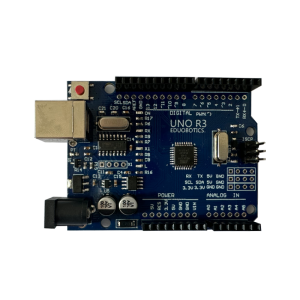
  2. Logic Level Shifting: The Ra-02 operates at 3.3V. If using with a 5V microcontroller (like an Arduino Uno), you must use a logic level shifter for the SPI pins to avoid damaging the module.
  3. Wiring: Connect the SPI pins (MOSI, MISO, SCK, NSS/CS) and control pins (RESET, DIO0). DIO0 is crucial as it triggers an interrupt when a packet is received.
  4. Software Setup: Use the popular RadioLib or LoRa Library by Sandeep Mistry in the Arduino IDE for quick deployment
Q: What is the difference between Ra-01 and Ra-02?

The Ra-01 uses a spring antenna that must be soldered to the board, while the Ra-02 features an IPEX (U.FL) connector, allowing you to use an external high-gain antenna via a pigtail cable

Q: Can this module connect to a LoRaWAN gateway (like The Things Network)?

Yes. While the Ra-02 is a node-level transceiver, it can be programmed to use the LoRaWAN protocol via software libraries like MCCI LMIC. Note that 433MHz LoRaWAN coverage is less common than 868/915MHz

Q: Is it suitable for business/industrial purchasing?

Absolutely. Ai-Thinker is a globally recognized manufacturer. These modules are CE/RoHS certified and produced in high volumes, making them suitable for large-scale industrial IoT deployments.

Q: How many Ra-02 modules can I have in one network?

Theoretically, thousands. By using unique addresses and different frequency channels or spreading factors, you can create massive star or mesh networks.

Q: Why can't I get the maximum 10km range?

The 10km+ range is “line-of-sight.” In urban environments with buildings and interference, the range may drop to 1–2km. To increase range, lower the Air Data Rate and increase the Spreading Factor (SF12) in your software settings