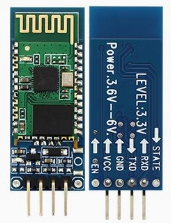
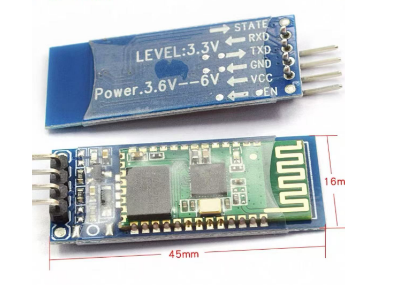
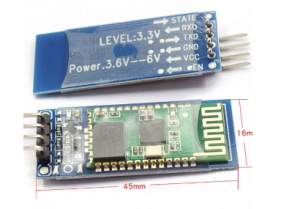
HC-06 4pin BT Bluetooth Module with Button (Compatible versions Type-A)

SKU: FA2040-1
Bluetooth Protocol

Bluetooth V2.0 + EDR (Classic)

Operating Voltage

3.6V – 6.0V DC

Operating Current

~35mA (Pairing); < 10mA (Connected)

Logic Level (I/O)

3.3V TTL (VCC is 5V compatible)

Communication Interface

UART (Universal Asynchronous Receiver/Transmitter)

Default Baud Rate

9600 bps

Default Pairing PIN

1234

Frequency Band

2.4GHz ISM Band

Transmission Range

~10 Meters (Class 2)

Operating Temperature

-20°C to +70°C

Product Description
The HC-06 (Compatible Type-A) is a highly popular Bluetooth 2.0+EDR (Enhanced Data Rate) slave module designed for seamless wireless serial communication. Engineered as a “Slave-only” device, it is specifically intended to be discovered and controlled by “Master” devices such as Android smartphones, tablets, or PCs.
The Type-A Compatible version is optimized for high-performance “plug-and-play” integration. It acts as a transparent wireless bridge: once a connection is established, data sent to the module’s RX pin is instantly transmitted wirelessly and appears at the paired device’s terminal. With its compact 4-pin interface (VCC, GND, TXD, RXD), it is the standard choice for adding wireless capabilities to ArduinoRaspberry Pi, and Industrial PLC systems with minimal wiring complexity.
Key Features
  • Dedicated Slave Operation: Pre-configured as a “set-and-forget” peripheral, offering fast discovery and stable pairing for a smooth user experience.
  • Transparent Serial Bridge: No specialized Bluetooth protocol knowledge is required; it functions exactly like a wireless RS232 cable for TTL serial data.
  • High Compatibility: Optimized firmware ensures stable performance across a wide range of platforms, including various Android versions and Windows-based systems.
  • Broad Voltage Support: The integrated 4-pin breakout board includes a 3.3V LDO regulator, allowing the module to be safely powered by 3.6V to 6.0V DC.
  • Low Latency Transmission: Designed for efficient data throughput, making it ideal for real-time sensor monitoring and wireless control signals.
  • Visual Status LED: Features a bright onboard LED: fast flashing indicates it is ready to pair, while a steady light indicates a successful connection.
Usage Scenarios
  • Hobbyists & Makers: Wireless smartphone control for DIY robotics, remote-controlled LED lighting, and wireless data logging from environmental sensors.
  • Business & Commercial: Wireless serial debugging for factory machinery, cable-free point-of-sale (POS) terminal connectivity, and wireless diagnostic interfaces for HVAC or automotive tools.
Q: Can the HC-06 connect to an iPhone or iPad?

No. The HC-06 uses Bluetooth Classic (2.0). Apple iOS devices only support “Bluetooth Low Energy” (BLE 4.0+) for serial data communication. This module is fully compatible with Android, Windows, macOS, and Linux.

Q: What is the difference between the HC-06 and the HC-05?

The HC-05 is a Master/Slave module (it can initiate connections). The HC-06 is Slave-only, which makes it much simpler to use for 90% of projects where you just need to connect your phone to your hardware

Q: How do I change the module's name or PIN?

While the module is unpaired (LED is flashing), you can send AT commands via a serial monitor at 9600 baud. For example: AT+NAME=MyProject or AT+PIN=5678. Note: The HC-06 does not typically require a newline (\r\n) after the command.

Q: Do I need a level shifter for the RX pin?

While the module is powered by 5V, its data pins use 3.3V logic. For long-term reliability, we recommend using a simple voltage divider (1kΩ and 2kΩ resistors) on the RX line of the HC-06 to safely step down the 5V signal from an Arduino.

Q: Why does my PC see the device but fail to pair?

Ensure the LED is flashing rapidly. If the LED is steady, another device is already connected. Also, ensure your PC’s Bluetooth driver supports Bluetooth 2.0/Classic profiles

Q: Does it save my custom settings after power-off?

Yes. All settings changed via AT commands (Baud rate, Name, PIN) are stored in the internal non-volatile Flash memory and are preserved through power cycles.