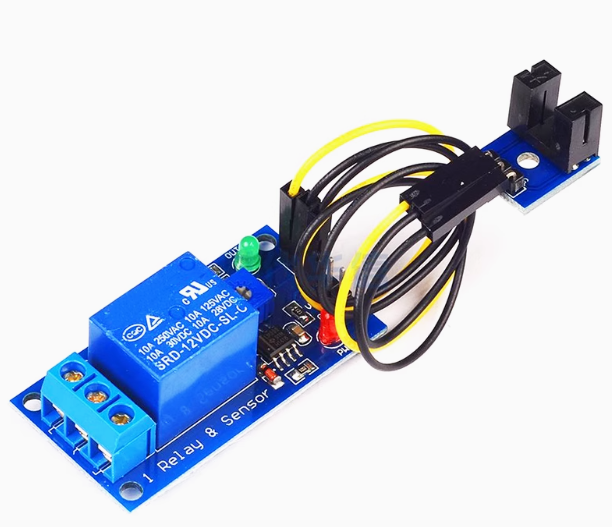
12v Speed measuring relay module

SKU: FA2086-11
Operating Voltage

12V DC (±10%) (10.8V – 13.2V)

Current Consumption

≤ 40 mA (relay idle) / ≤ 70 mA (relay active)

Input Signal Type

NPN open-collector, PNP (3-wire), magnetic pickup, Hall effect, TTL pulse (0–12V)

Frequency Measurement Range

0.5 Hz – 10,000 Hz (10 kHz)

Speed Monitoring Mode

Selectable: Overspeed / Underspeed

Relay Contact Rating

10A / 250V AC or 10A / 30V DC (resistive load)

Output Terminal Type

3-pin screw terminal (COM, NO, NC)

Start-Up Delay Time

0 – 99 seconds (adjustable)

Hysteresis (Switching Differential)

1% – 30% of setpoint (adjustable)

Operating Temperature

-20°C to +70°C

Description

The 12V Speed Measuring Relay Module is a professional-grade speed monitoring and control device designed for industrial and automotive environments. Operating on a stable 12V DC supply—common in automotive systems, PLC panels, battery-powered equipment, and industrial control cabinets—this module detects rotational speed or pulse frequency from sensors and triggers a built-in relay when user-defined speed thresholds are crossed.

The module accepts input signals from a variety of industrial sensors, including Hall effect sensors, NPN/PNP proximity switches, magnetic pickups, optical encoders, and tachogenerators. When the measured speed falls below or exceeds the preset value, the relay activates or deactivates connected equipment such as cooling fans, conveyor motors, alarms, warning lights, or solenoid valves.

Unlike basic 5V versions, the 12V module offers improved noise immunity, longer cable runs (up to 30 meters), and compatibility with industrial sensor standards. Features include an adjustable start-up delay to ignore false alarms during motor spin-up, configurable hysteresis to prevent relay chatter, and a bright digital display showing real-time frequency (Hz) or scaled RPM. Housed in a rugged, panel-mountable enclosure, this module is ideal for conveyor belt slip detection, pump dry-run protection, fan speed verification, generator overspeed shutdown, and rotating machinery monitoring—all without requiring a PLC.


Key Features

  • 12V DC Operation – Compatible with automotive, industrial PLC, battery, and solar power systems.

  • Overspeed & Underspeed Monitoring – Selectable mode to trigger relay when speed exceeds OR falls below setpoint.

  • Industrial Sensor Compatibility – Accepts NPN open-collector, PNP (high-side switching), magnetic pickups, Hall sensors, and TTL pulses (0–12V).

  • Long Sensor Cable Support – Reliable operation with sensor cables up to 30 meters (100 feet) due to higher drive voltage.

  • Built-in 12V Relay – Controls external devices up to 10A / 250V AC or 10A / 30V DC.

  • Adjustable Start-Up Delay – Programmable delay (0–99 seconds) ignores speed readings during motor start-up.

  • Adjustable Hysteresis – User-set switching differential (1%–30%) prevents rapid relay cycling near threshold.

  • Real-Time Speed Display – Digital screen shows current frequency (Hz) or scaled RPM.

  • Non-Volatile Memory – All settings are saved permanently, even after power loss.


Technical Parameters

Parameter Value
Operating Voltage 12V DC (±10%) (10.8V – 13.2V)
Current Consumption ≤ 40 mA (relay idle) / ≤ 70 mA (relay active)
Input Signal Type NPN open-collector, PNP (3-wire), magnetic pickup, Hall effect, TTL pulse (0–12V)
Frequency Measurement Range 0.5 Hz – 10,000 Hz (10 kHz)
Speed Monitoring Mode Selectable: Overspeed / Underspeed
Relay Contact Rating 10A / 250V AC or 10A / 30V DC (resistive load)
Output Terminal Type 3-pin screw terminal (COM, NO, NC)
Start-Up Delay Time 0 – 99 seconds (adjustable)
Hysteresis (Switching Differential) 1% – 30% of setpoint (adjustable)
Operating Temperature -20°C to +70°C

Usage Guide

Wiring Instructions

Step 1 – Power Connection

  • Connect a 12V DC power supply to the VCC (+) and GND (-) terminals. Suitable sources include a 12V battery, 12V industrial power supply, or vehicle electrical system.

Step 2 – Sensor Connection

Sensor Type Connection Method
NPN (open-collector) Sensor VCC → 12V, GND → GND, Signal → SIG
PNP (high-side) Sensor VCC → 12V, GND → GND, Signal → SIG (check module compatibility – some require a pull-down resistor)
Magnetic pickup (2-wire) Connect one wire to SIG, other wire to GND
Hall effect switch Standard 3-wire connection as NPN

Step 3 – Load (Device) Connection

  • COM (Common): Connect to your power source (AC or DC live/positive line).

  • NO (Normally Open): Relay closes when speed threshold is reached. Connect to device input.

  • NC (Normally Closed): Relay opens when speed threshold is reached. Use for fail-safe logic.

Step 4 – Sensor Placement

  • Mount the speed sensor near the rotating target. For magnetic sensors, maintain 1–5 mm gap to the magnet or gear tooth. For optical sensors, ensure unobstructed beam path.

Configuration Steps

Button Function
SET Enter settings / cycle through parameters
UP / DOWN Adjust values
Display Shows current frequency (Hz) or RPM

Programming Steps:

  1. Power on the module. Display shows real-time frequency (Hz) from the sensor.

  2. Press SET once – the trigger value blinks. Use UP/DOWN to set desired speed threshold.

  3. Press SET again – mode selection:

    • H (High / Overspeed) – Relay activates when speed exceeds setpoint.

    • L (Low / Underspeed) – Relay activates when speed falls below setpoint.

  4. Press SET again – start-up delay (dt). Set 0–99 seconds.

  5. Press SET again – hysteresis value. Set 1%–30%.

  6. Wait 5 seconds – display returns to normal; settings saved.

Example (Conveyor Belt Slip Protection):

  • Set trigger = 1200 Hz, mode = L (underspeed), start delay = 3 sec, hysteresis = 5%.
    → Relay activates if speed drops below 1200 Hz for more than 3 seconds; resets when speed exceeds 1260 Hz.

Q: Can I run this module on 24V DC?

No. The module is designed strictly for 12V DC (±10%) . Applying 24V will permanently damage the components. Use a 24V-to-12V DC-DC converter if your system is 24V.

Q: What is the difference between the 12V and 5V speed measuring relay modules?
Feature 12V Version 5V Version
Supply Voltage 12V DC 5V DC
Max Frequency 10 kHz 5 kHz
Sensor Cable Length Up to 30 meters Up to 5 meters
Industrial Noise Immunity High Moderate
Automotive Compatible Yes (12V vehicles) No
Q: What types of sensors work best with this module?
  • Hall effect sensors (NPN, 3-wire) – Best for general purpose.

  • Magnetic pickups (2-wire, variable reluctance) – Ideal for gear tooth detection.

  • Proximity switches (inductive NPN) – For metal target detection without contact.

  • Optical encoders – For high-precision speed measurement.

Q: Can I connect a PNP (sourcing) sensor directly?

Most 12V versions accept PNP sensors when configured properly. If the module does not detect PNP signals, add a 10kΩ pull-down resistor between SIG and GND. Check your specific module documentation.

Q: My relay clicks on and off rapidly. How to fix?

Increase the hysteresis value. For example, change from 5% to 15%. This creates a larger deadband between ON and OFF points.

Q: Why does my module trigger immediately at power-up?

Increase the start-up delay (dt) to 5–10 seconds. During this delay, the relay remains in its normal state regardless of speed reading.

Q: Can I use this module for both home and business applications?

Home users: DIY workshop dust collector monitoring, aquarium pump alarm, ceiling fan speed verification, small lathe spindle monitoring.

Business users: Conveyor belt slip detection, pump dry-run protection, generator overspeed shutdown, HVAC fan failure alarm, packaging line jam detection, elevator overspeed safety.

Q: How do I convert Hz to RPM?

RPM = (Frequency in Hz × 60) ÷ (Number of pulses per revolution). Example: 1 magnet per shaft revolution → 10 Hz = 600 RPM. 6 magnets → 10 Hz = 100 RPM.

Q: What is the maximum sensor cable length?
Q: Is the module reverse-polarity protected?

Most 12V industrial versions include reverse polarity protection. However, always double-check VCC (+) and GND (-) connections before applying power to be safe.