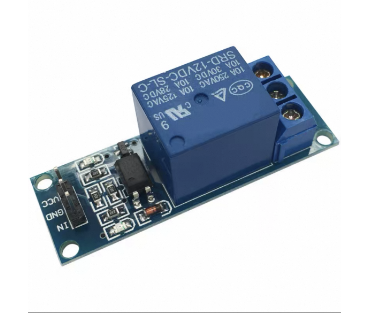
Product Overview
The 24V Single Channel Optocoupler Isolated Relay Module is a robust, industrial-grade control module designed for reliable switching of high-power AC or DC loads from a 24V control system. Whether you’re working with PLC automation equipment, industrial control panels, 24V battery-powered systems, or building automation projects, this module provides a safe and efficient interface between your 24V logic and the high-voltage load side .
At its core is a high-quality electromagnetic relay capable of switching loads up to 10A at 250V AC or 10A at 30V DC . The module features optocoupler isolation, which creates a complete electrical barrier between your control circuit and the potentially hazardous load side. This isolation protects your sensitive control electronics from dangerous voltage spikes, back-EMF from motors, and electrical noise common in industrial environments .
Designed with a low-level trigger, this module is activated when you apply a LOW signal (0V) to the input pin. This default behavior enhances safety—the relay remains off during power-up or if the control signal is lost, preventing accidental activation of connected devices . An onboard status LED provides clear visual confirmation of relay operation, and the module’s compact design allows for easy integration into control cabinets, DIN rails, or custom enclosures.
Key Features
-
Optocoupler Isolation: Provides complete electrical isolation between the control side (24V logic) and the load side (up to 250V AC), protecting your controller from voltage spikes and electrical noise .
-
High Load Capacity: SPDT relay contacts rated for 10A at 250V AC or 10A at 30V DC, suitable for controlling motors, solenoids, lighting, pumps, and industrial equipment .
-
Low Level Trigger: The relay activates when the IN pin is pulled LOW (0V). This “active LOW” design enhances safety—the relay remains off during power-up or if the control signal is lost .
-
24V DC Operation: Designed for 24V control systems, making it ideal for PLC automation, industrial controllers, and building automation applications .
-
SPDT Contact Configuration: Provides Common (COM), Normally Open (NO), and Normally Closed (NC) terminals for maximum wiring flexibility .
-
Clear Status Indicators: Onboard LEDs provide visual feedback: a power LED (green) lights when the module is powered, and a relay status LED (red) illuminates when the relay is activated .
-
Easy 3-Pin Control Interface: Standard terminal block with VCC (24V), GND, and IN (control signal) allows direct connection to PLCs, microcontrollers, or manual switches .
-
Industrial-Grade Construction: Meets international safety standards with isolation slot between control and load areas. PCB design with screw terminals for secure wiring .
Technical Specifications
Pinout & Interface Guide
Input Side (Control Interface)
Output Side (Load Terminals)
Status LEDs
Usage Guide
Wiring Instructions
IMPORTANT: Always disconnect mains power before wiring high-voltage loads.
Basic Connection (Control Side)
Load Connection (AC Example)
-
Connect the Live (L) wire from your AC source to the COM terminal
-
Connect the load (lamp, fan, motor) to the NO terminal
-
Connect the load’s Neutral (N) wire directly to the AC source neutral
Load Connection (DC Example)
-
Connect the positive (+) supply to the COM terminal
-
Connect the load’s positive wire to the NO terminal
-
Connect the load’s negative wire directly to the power supply ground
Control Logic
Since this module is low-level triggered, the relay behavior is as follows:
Example PLC Ladder Logic Concept
For PLC control, a normally open contact can be used to energize an output coil connected to the relay module’s IN terminal. When the contact closes, the output goes LOW (active), activating the relay.
Example Arduino Control (with External 24V Supply)
Note: Most Arduino boards operate at 5V. The relay module requires 24V for the coil, but the control signal can be 5V logic. Use an external 24V power supply for VCC, and connect the signal pin directly to the Arduino digital output. The 5V HIGH signal is sufficient to turn the relay off because the threshold for deactivation is typically 3V .
const int relayPin = 7;
void setup() {
pinMode(relayPin, OUTPUT);
digitalWrite(relayPin, HIGH);
}
void loop() {
digitalWrite(relayPin, LOW);
delay(5000);
digitalWrite(relayPin, HIGH);
delay(5000);
}
Example MicroPython Code (ESP32 / Raspberry Pi Pico with Level Shifter)
Since ESP32 operates at 3.3V logic, ensure the HIGH signal is sufficient to deactivate the relay (testing is recommended). An NPN transistor buffer can be used if needed.
from machine import Pin
import time
relay = Pin(7, Pin.OUT)
relay.value(1)
while True:
relay.value(0)
time.sleep(5)
relay.value(1)
time.sleep(5)
Important Considerations
-
Power Supply: The module requires a stable 24V DC supply capable of providing at least 100mA (the relay coil draws approximately 12-20mA when active) .
-
Control Signal: The module is designed for 24V logic, but it can also be controlled by 5V or 3.3V microcontrollers. The trigger threshold for deactivation is typically above 3V, so 5V signals work reliably. For 3.3V systems, testing is recommended .
-
Inductive Loads: For motors, pumps, or solenoids, add a flyback diode across the load to protect the relay contacts from voltage spikes .
-
Default State: The low-level trigger design means the relay stays OFF when the IN pin is HIGH or unconfigured, preventing unwanted activation during power-up .
-
Fault-Tolerant Design: Even if the control line is broken, the relay will not operate, ensuring fail-safe behavior .
Q: What is the difference between low-level trigger and high-level trigger?
Low-level trigger means the relay activates when the IN pin is pulled LOW (0V). High-level trigger means the relay activates when the IN pin is HIGH (positive voltage). This module is low-level trigger, which is safer because the relay remains off during power-up or if the control signal is lost
Q: What is the maximum load this relay can handle?
The contacts are rated for 10A at 250V AC or 10A at 30V DC . For inductive loads like motors, it is recommended to derate to 5A–7A to account for startup surges.
Q: Can I control this 24V relay module with a 5V Arduino or 3.3V ESP32?
Yes, with proper configuration. The module uses optocoupler isolation, so the control side can accept lower voltage logic . For 5V Arduino, the HIGH signal (5V) is sufficient to turn the relay off. For 3.3V ESP32, testing is recommended—if the 3.3V HIGH does not reliably deactivate the relay, use an NPN transistor buffer or level shifter.
Q: What is the purpose of the optocoupler?
The optocoupler provides electrical isolation between the control circuit and the high-voltage load. This protects your sensitive control electronics from voltage spikes, back-EMF, and electrical noise .
Q: What is the operating voltage range for this module?
The module is designed for 24V DC operation. Typical acceptable range is 22V–28V DC. Do not exceed 30V.
Q: What power supply do I need for this module?
The module requires a stable 24V DC power supply capable of providing at least 100mA. The relay coil draws approximately 12-20mA when active, plus a small quiescent current of about 5mA
Q: Why does the relay click but my load doesn't turn on?
This indicates the relay is activating but the load circuit is incomplete. Check:
-
The load is correctly wired between COM and NO (or COM and NC)
-
The load’s neutral/ground is connected correctly
-
The load itself is functional
-
The load’s current does not exceed the relay’s 10A rating
Q: What is the trigger voltage threshold for this module?
For low-level trigger mode:
Q: What is the expected lifespan of this relay?
The relay is rated for approximately 100,000 electrical operations at rated load . Actual lifespan depends on switching frequency and load type.
Q: Can I use this relay for 220V AC applications?
Yes. The contacts are rated for 250V AC, which is suitable for 220V/240V systems. Ensure proper insulation and clearance between the control and load sides for safety .
Q: The module's status LED lights up but the relay doesn't click. What's wrong?
The LED indicates the control signal is reaching the optocoupler. If the relay doesn’t click, check:
-
The VCC power supply is stable at 24V
-
The power supply can provide enough current (at least 100mA)
-
The relay itself may be faulty (though rare)
Q: The relay clicks when I power on my controller. Why?
During power-up, microcontroller pins may briefly float or be in an undefined state. With a low-level trigger module, this should not activate the relay because the pin needs to be pulled LOW. Adding a 10kΩ pull-up resistor on the IN pin to 24V can ensure the relay remains OFF during startup .
Q: Can I use multiple relay modules with a single controller?
Yes. Connect each module’s VCC and GND in parallel to the same 24V supply (ensure the supply can handle the total current), and connect each IN pin to a separate digital output pin on your controller.
Q: What can I build with this 24V relay module?
Popular applications include:
-
PLC automation: Output control for industrial equipment
-
Industrial control: Motor starters, conveyor systems, valve control
-
Building automation: HVAC control, lighting systems, access control
-
Home automation: Appliance switching, security systems
-
Solar power systems: Battery switching, panel control
Q: Can I use this relay with a 24V industrial PLC?
Yes. The 24V coil voltage is the standard for industrial control systems, making this relay perfect for PLC output modules. Connect the PLC output directly to the IN terminal .
Q: Is this module suitable for controlling a pump or motor?
Yes, with derating. For inductive loads like motors, it is recommended to operate at 50–70% of the rated contact current (5A–7A) to account for startup surges. Adding a flyback diode across the load is highly recommended to protect the relay contacts .
Q: Does this module have overcurrent protection?
The module does not have built-in overcurrent protection for the load side. It is recommended to use an external fuse or circuit breaker rated for your load current to protect the relay contacts from overload conditions.
Q: Can I use this module without a microcontroller?
Yes. You can trigger the relay by manually connecting the IN pin to GND (to activate) or leaving it disconnected (to deactivate). This can be done with a simple push button or toggle switch connected between IN and GND.