Description
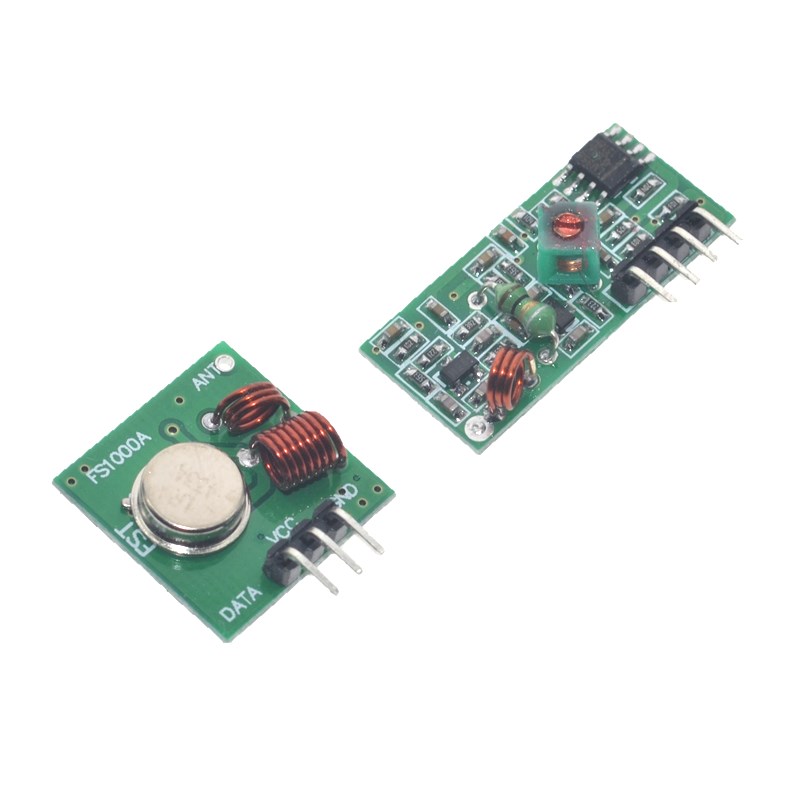
The 315MHz RF Wireless Transmitter & Receiver Module Kit is a cost-effective, easy-to-use wireless communication solution designed for microcontroller projects, remote control systems, and wireless data transmission applications. Operating in the 315MHz ISM (Industrial, Scientific, and Medical) band, this module pair enables reliable wireless communication between devices over distances of up to 100 meters or more in open areas, making it an ideal choice for projects where running wires is impractical or impossible.
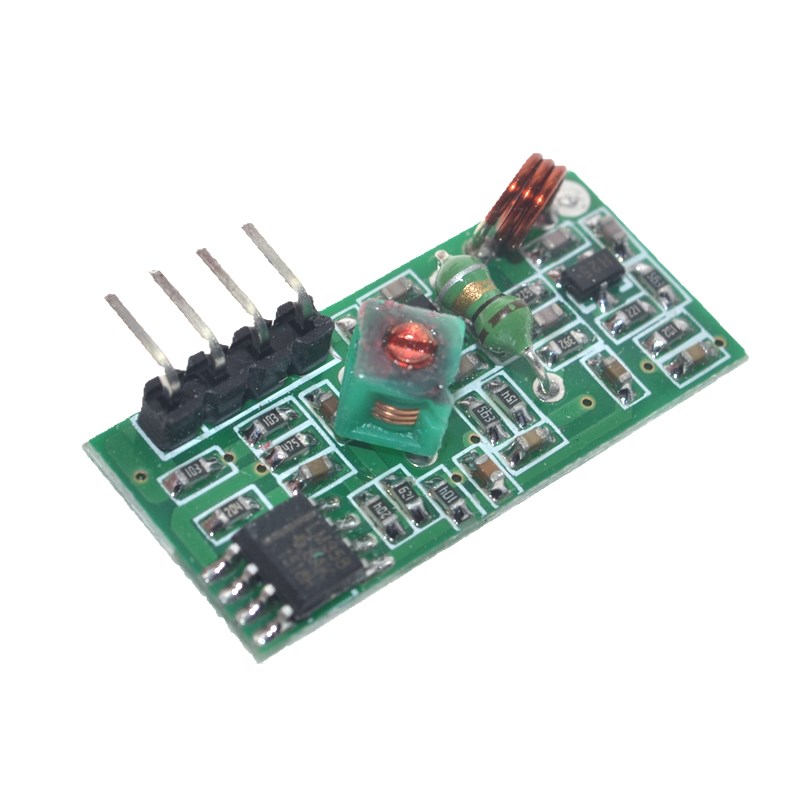
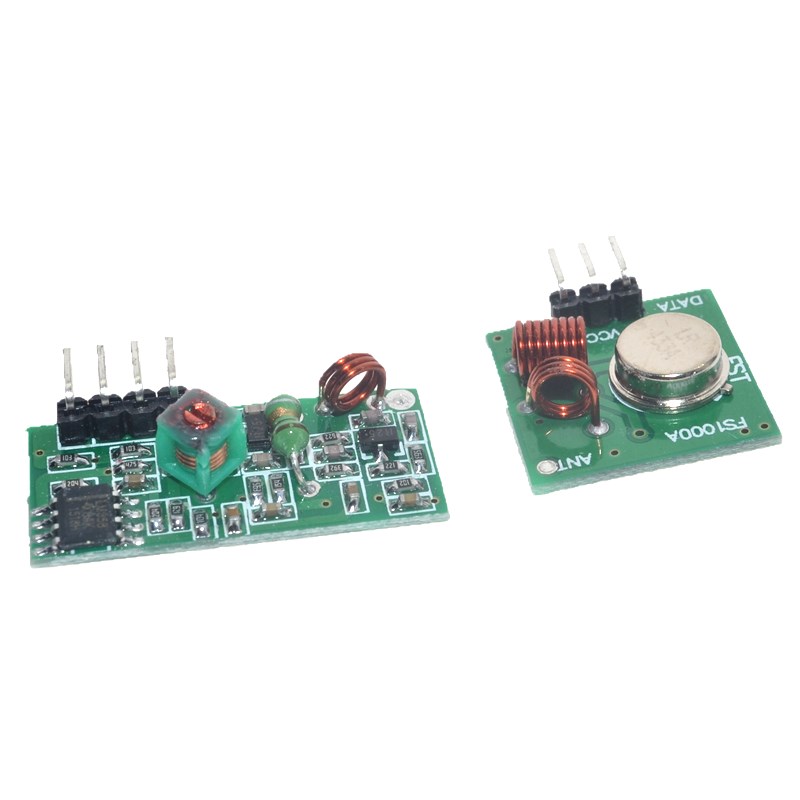
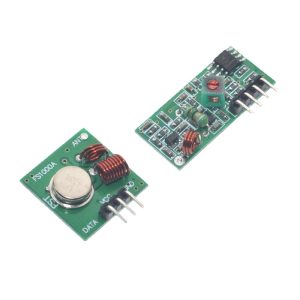
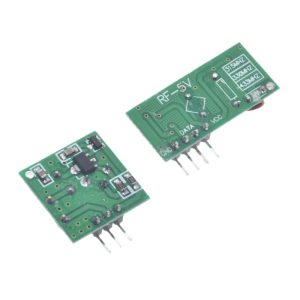
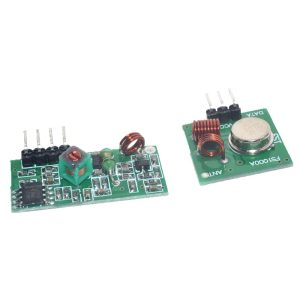
The kit includes two separate modules: a transmitter and a receiver. The transmitter accepts digital data signals from a microcontroller or switch and transmits them over the air via ASK (Amplitude Shift Keying) or OOK (On-Off Keying) modulation. The receiver captures these signals and outputs the corresponding digital data, allowing the receiving microcontroller or circuit to act upon the information. The modules are designed to work as a matched pair, pre-tuned to the same frequency for plug-and-play operation.
These modules are incredibly simple to use, requiring no complex configuration or frequency setup. They communicate via a straightforward logic-level serial data stream, making them compatible with virtually any microcontroller, including Arduino, ESP32, ESP8266, STM32, Raspberry Pi, PIC, and 8051 series devices. The transmitter accepts a wide input voltage range of 3V to 12V, with higher voltages providing greater transmission power and range.
Key advantages of 315MHz RF communication include:
-
Penetration through walls – RF signals can pass through common building materials like drywall, brick, and wood
-
Low power consumption – Suitable for battery-powered applications and portable devices
-
Simple encoding/decoding – Can be used with software libraries like VirtualWire or RadioHead
-
No line-of-sight required – Signals can travel around corners and through obstacles
-
Cost-effective – One of the most affordable wireless solutions available
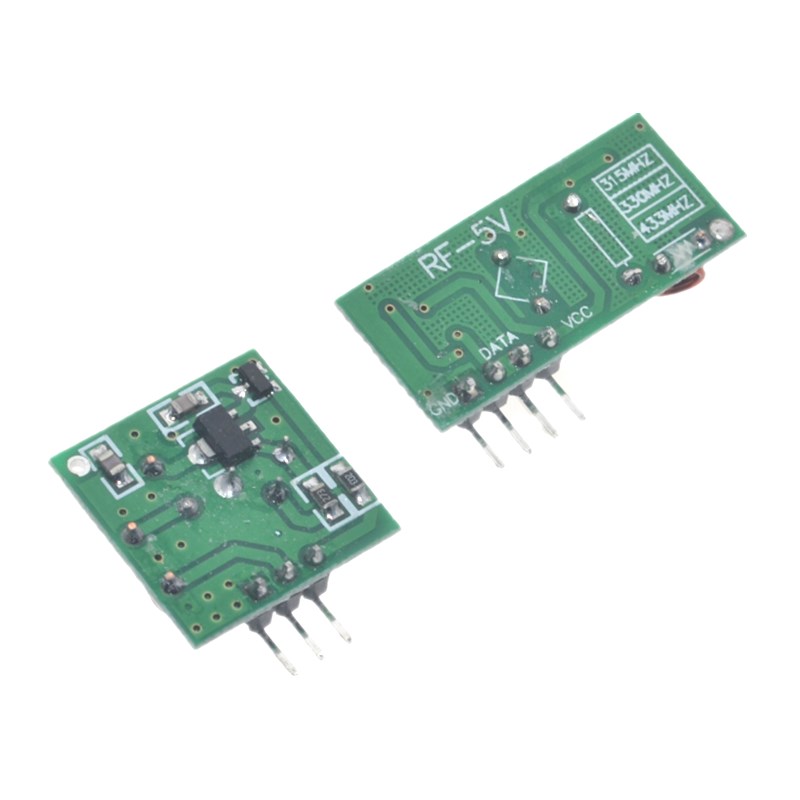
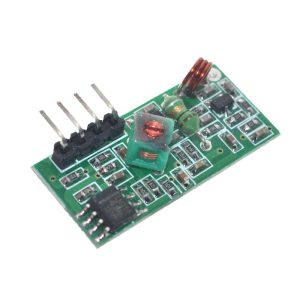
The transmitter and receiver modules come as bare boards with pin headers for easy breadboard or PCB integration. The modules feature an antenna pin for connecting a wire antenna (typically a 17-23cm straight wire for optimal performance at 315MHz).
Regulatory Note: 315MHz is a commonly used frequency in North America for low-power devices. If you are outside North America, please check your local regulations before use.
Whether you need to build a wireless remote control, a remote sensor monitoring system, a wireless doorbell, a garage door opener, a home automation controller, or a simple data link between two microcontrollers, this 315MHz RF Link Kit provides a simple, reliable, and affordable wireless solution.
Key Features
-
315MHz Operating Frequency – Operates in the ISM band commonly used in North America for remote control applications
-
ASK/OOK Modulation – Simple modulation scheme for easy integration with microcontrollers and logic circuits
-
Long Transmission Range – Up to 50-100 meters or more in open areas (depending on antenna and conditions)
-
Wide Transmitter Voltage Range – Transmitter operates from 3V to 12V DC (higher voltage = greater transmission power)
-
Low Receiver Current – Receiver typically draws only 6-7mA at 3V-5V operation
-
High Receiver Sensitivity – Typical sensitivity of -110dBm to -112dBm for reliable reception
-
Simple Digital Interface – Single data pin for serial communication with any microcontroller
-
Easy Antenna Connection – Onboard antenna pad for connecting a simple wire antenna (recommended length: 17-23cm)
-
Compact Form Factor – Small module size for easy integration into portable devices and enclosures
-
Compatible with Popular Libraries – Works with RadioHead, VirtualWire, and Manchester coding libraries
Technical Parameters
Usage Guide
How It Works
The 315MHz RF modules use ASK (Amplitude Shift Keying) modulation to transmit digital data. When the transmitter’s DATA pin is HIGH, the module transmits a carrier signal at 315MHz. When the DATA pin is LOW, the carrier is off. The receiver detects the presence or absence of this carrier signal and outputs a corresponding HIGH or LOW logic level. This simple on-off keying makes the modules easy to interface with microcontrollers.
Important Note: These modules do not encode or decode data. They simply transmit and receive raw logic levels. For reliable communication, you must implement some form of encoding in your software, such as Manchester coding, or use a library like RadioHead or VirtualWire.
Pinout Description
Transmitter (TX) Pinout:
Receiver (RX) Pinout:
Note: Pin arrangements may vary by manufacturer. Always check the silkscreen on your specific module before wiring.
Wiring Instructions
Step 1 – Basic Connection (Arduino Example)
Transmitter Side Wiring:
Receiver Side Wiring:
Step 2 – Install Required Libraries
For Arduino, install the RadioHead library for reliable operation:
-
Open Arduino IDE
-
Go to Sketch → Include Library → Manage Libraries
-
Search for “RadioHead”
-
Install the library by AirSpayce
Software Setup
Simple RadioHead ASK Example (Transmitter)
#include <RH_ASK.h>
#include <SPI.h>
RH_ASK rf_driver(2000, 12, 13);
void setup() {
Serial.begin(9600);
if (!rf_driver.init()) {
Serial.println("RF driver init failed");
}
}
void loop() {
const char *msg = "Hello World!";
rf_driver.send((uint8_t *)msg, strlen(msg));
rf_driver.waitPacketSent();
Serial.println("Message sent");
delay(1000);
}
Simple RadioHead ASK Example (Receiver)
#include <RH_ASK.h>
#include <SPI.h>
RH_ASK rf_driver(2000, 11, 12);
void setup() {
Serial.begin(9600);
if (!rf_driver.init()) {
Serial.println("RF driver init failed");
}
}
void loop() {
uint8_t buf[RH_ASK_MAX_MESSAGE_LEN];
uint8_t buflen = sizeof(buf);
if (rf_driver.recv(buf, &buflen)) {
Serial.print("Received: ");
Serial.println((char*)buf);
}
}
Antenna Installation
A proper antenna is critical for achieving maximum range:
-
Simple wire antenna: Cut a single-strand copper wire to 17-23cm (approximately 1/4 wavelength of 315MHz)
-
Antenna placement: Keep the antenna straight, away from metal surfaces, and vertically oriented
-
No antenna: The modules can work over very short distances (a few meters) without an antenna
Range Optimization Tips
-
Use a proper antenna – A 17-23cm straight wire is the minimum requirement for good range
-
Increase transmitter voltage – Higher voltage (up to 12V) provides greater transmission power
-
Elevate the modules – Higher mounting positions reduce ground reflection and interference
-
Avoid metal obstacles – Metal structures and reinforced concrete significantly reduce signal strength
-
Reduce data rate – Lower baud rates (e.g., 1200-2400 bps) provide better sensitivity and longer range
Typical Applications
Q: What is the difference between 315MHz and 433MHz modules?
The primary difference is the operating frequency:
Both frequencies are license-free ISM bands in their respective regions. Choose based on your geographic location and local regulations
Q: What is the maximum range of these modules?
The typical range is up to 50-100 meters in open areas with clear line-of-sight. Actual range depends on environmental factors such as walls, metal obstacles, electrical interference, antenna quality, and transmitter voltage. Using a higher transmitter voltage (up to 12V) and a proper antenna will maximize range
Q: Can I use this module with 3.3V microcontrollers like ESP32 or Raspberry Pi?
Yes. The receiver operates at 2.7V-5V, making it compatible with 3.3V logic. The transmitter can operate at 3.3V, but transmission power and range will be reduced compared to 5V or 12V operation. For best results with 3.3V systems, power the transmitter with 5-12V (from an external supply) and only connect the DATA pin to the 3.3V microcontroller output.
Q: What is the maximum data rate?
The modules typically support data rates up to 10 Kbps. For reliable communication, it is recommended to use lower data rates (e.g., 1200-2400 bps), especially when using simple encoding schemes without error correction.
Q: Why are my modules not communicating?
Most common issues and solutions:
-
Power supply: Check voltage levels and ensure stable power
-
Antenna: Ensure a proper antenna (17-23cm wire) is connected
-
Voltage mismatch: Transmitter needs 3-12V; receiver needs 2.7-5V
-
Modules too close: Move them at least 1 meter apart – direct proximity can overload the receiver
-
Data rate mismatch: Ensure transmitter and receiver are configured for the same baud rate
-
No encoding: Use a library like RadioHead to implement proper packet encoding
Q: Do I need an external antenna?
While the modules can work without an external antenna over very short distances (a few meters), an antenna is strongly recommended for reliable operation. A simple 17-23cm straight copper wire soldered to the ANT pad is sufficient for most applications.
Q: What is the receiver's output voltage levels?
The receiver’s DATA output typically provides:
This means the output may not reach full Vcc. For 5V operation, the HIGH output may be around 2.5V. Most microcontrollers will still recognize this as a logic HIGH, but you may need to adjust thresholds or use a comparator for critical applications.
Q: Can I use this module for both home and business applications?
Home users: Wireless remote controls, DIY home automation, garage door openers, wireless doorbells, remote garden watering systems, wireless temperature/humidity monitors, toy remote controls.
Business users: Remote industrial sensor monitoring, wireless status indicators, inventory tracking systems, access control systems, parking lot occupancy sensors, wireless alert systems, prototype development for commercial wireless products.
Q: What is the difference between ASK and FSK modulation?
This module uses ASK (Amplitude Shift Keying) – a simple modulation where the carrier is either ON (transmitting) or OFF (not transmitting). ASK is simple and low-cost but more susceptible to interference. FSK (Frequency Shift Keying) uses frequency changes to represent data and is more immune to noise but requires more complex hardware. For most hobbyist applications, ASK modules are perfectly adequate and significantly more affordable.
Q: What is included in the package?
-
1 x 315MHz RF Transmitter Module
-
1 x 315MHz RF Receiver Module
-
(Antenna wire may or may not be included depending on the specific kit)