Product Description
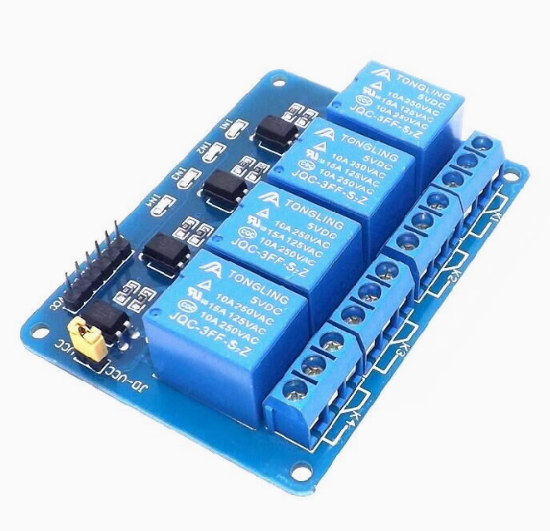
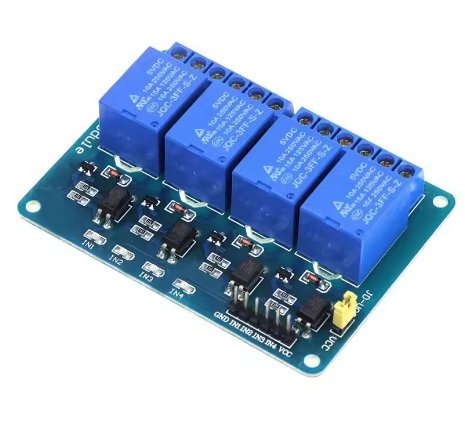
This 5V 4-Channel Non-Optocoupler Relay Module is a robust and high-performance control board designed for developers and engineers who require direct, high-current control without optical isolation. It is engineered specifically for industrial-grade applications where signal integrity and powerful switching capabilities are paramount.
Unlike standard opto-isolated relay modules, this board uses high-quality industrial relays connected directly to the control logic, which enables faster response times and the ability to handle larger inrush currents. Each channel is equipped with a protection diode to suppress back EMF from the relay coils, ensuring longevity and stable operation. It accepts a 5V logic level input (commonly from Arduino, Raspberry Pi, PLCs, or other microcontrollers) to switch loads of up to 10A, making it exceptionally versatile.
The module features screw terminals for secure AC/DC load connections, LED indicators for each relay’s status, and standard pin headers for easy integration into prototyping systems. Its design focuses on durability, making it suitable for continuous operation in industrial control panels, commercial automation systems, and demanding DIY projects.
Key Features
-
Direct Control, Non-Optocoupler Design: Faster switching response and robust performance for industrial applications, eliminating delays from optical isolation.
-
4 High-Current Channels: Control up to four independent high-power circuits with a single, compact module.
-
Industrial-Grade Relays: Utilizes durable, long-life mechanical relays rated for high inrush currents, ideal for motors and inductive loads.
-
High Load Capacity: Each relay supports up to 10A, allowing control of a wide range of appliances and equipment.
-
5V Logic Compatible: Directly interfaces with popular microcontrollers (Arduino, STM32) and development boards using a 5V signal.
-
Integrated Protection: Each channel includes a flyback diode across the relay coil to protect your control circuit from voltage spikes.
-
Clear Visual Status: Bright LEDs indicate the ON/OFF state of each relay channel for easy monitoring.
-
Secure Screw Terminals: Ensure reliable and vibration-resistant connections for both control and load wiring.
Main Parameters
-
Channels: 4
-
Control Signal Voltage: 5V DC (Logic Level)
-
Module Supply Voltage: 5V DC (for relay coils)
-
Relay Type: Mechanical, Non-Latching (Single Coil)
-
Contact Configuration: SPDT (Single Pole, Double Throw) – COM, NO, NC per channel
-
Maximum Load (per channel): 10A @ 250VAC or 10A @ 30VDC
-
Switching Time: <10ms (Response)
-
Dimensions: Approx. 120mm x 75mm x 18mm (L x W x H)
Typical Applications / Usage
-
Industrial Machine Control: Directly interface PLC outputs to control solenoids, contactors, or indicator lights on factory equipment.
-
Smart Home Hubs: Build custom automation controllers to switch high-power lighting circuits, fans, or pumps.
-
Agricultural & Aquaponic Systems: Automate water pumps, ventilation fans, and grow lights with precise timing control.
-
Prototyping & R&D: An essential tool for engineers developing and testing product prototypes requiring high-current switching.
-
Vending Machines & Kiosks: Control motors, actuators, and heating elements in commercial automated machines.
-
Automotive Testing Rigs: Simulate load conditions or control auxiliary devices in testing setups.
Wiring & Control Example:
-
Power & Control: Connect the module’s VCCand GNDto a stable 5V DC power source capable of supplying enough current for all four relay coils. Connect the signal pins (IN1to IN4) to the digital output pins of your microcontroller.
-
Load Connection: For each channel, connect your power source (AC or DC) to the Common (COM) terminal. Connect the device you want to control to either the Normally Open (NO) terminal (for device ON when relay activates) or the Normally Closed (NC) terminal (for device ON when relay is off). Always de-energize circuits before making connections.
Q: What does "Non-Optocoupler" mean, and what are its implications?
It means there is no optical isolator between your microcontroller and the relay coil. This allows for a faster, more direct signal path and often higher drive capability. The main implication is that your control circuit shares a common ground with the relay coil power, so proper power supply design is crucial to avoid ground loop noise.
Q: Is this module safe for my Arduino or Raspberry Pi?
Yes, when used correctly. The control signal pins are designed for 5V logic. However, because it lacks opto-isolation, it is critical to use a clean, shared 5V power supply for both the microcontroller and the relay module’s VCC. Using separate, ungrounded power supplies can cause damage. The integrated flyback diodes protect against most voltage spikes from the coils.
Q: Can I control both AC and DC loads with this module?
Yes, absolutely. The relay contacts are rated for both AC (250VAC/10A) and DC (30VDC/10A) loads. This makes it exceptionally versatile for controlling various types of devices.
Q: Why would I choose this over a cheaper opto-isolated relay module?
Choose this module if:
-
You need the fastest possible switching response from your control signal.
-
You are controlling heavy inductive loads (like motor starters) that benefit from the robust coil drive of a direct connection.
-
Your project is in a controlled environment (like an industrial cabinet) where ground loops are managed, and the primary need is durability and high-current capacity.
Q: The relays make a clicking sound. Is this normal?
Yes. This module uses electromechanical relays, which produce an audible click when they switch. This is normal operation. If silent switching is required, you would need a Solid State Relay (SSR).
Q: Can I use a 12V power supply with this 5V module?
No, you must not. The module’s control logic and relay coils are designed for a 5V supply. Applying 12V will permanently damage the module and may damage your connected microcontroller.
Q: How do I calculate the power supply requirements?
Each relay coil consumes approximately 70-80mA when active. Therefore, for all 4 relays energized simultaneously, you need a 5V power supply capable of delivering at least 4 x 80mA = 320mA, plus the current required by your microcontroller. A 5V/2A adapter is a common and safe choice.
Q: Is this product suitable for business or industrial procurement?
Yes, this module is built to industrial-grade specifications with high-current relays and a durable PCB. It is ideal for integration into commercial products, industrial control systems, and OEM applications. We offer volume discounts and customization options for business clients.