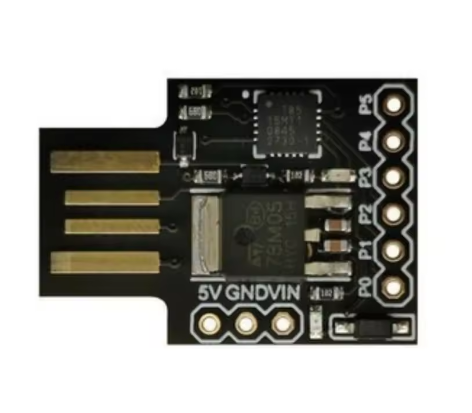
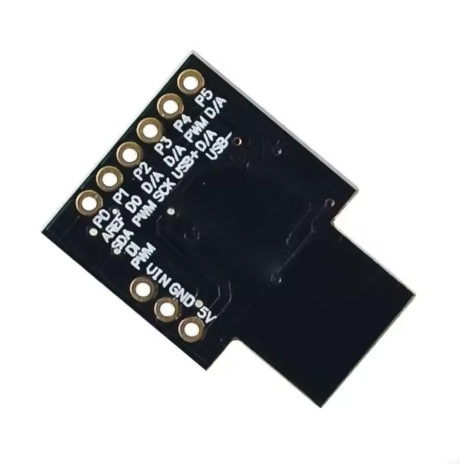
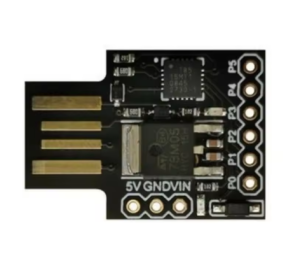
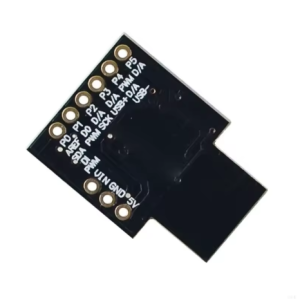
The ATTINY85 Digispark Pro Board is an advanced iteration of the popular ATtiny85 development platform, featuring an upgraded ATtiny167 microcontroller and a more versatile design. This compact QFN chip-based mini USB development tool offers enhanced capabilities, more memory, and improved connectivity options for both hobbyists and professional engineers developing sophisticated DIY electronics and prototypes.
Product Description
The ATTINY85 Digispark Pro Board elevates the capabilities of miniature microcontroller development. Moving beyond the original design, the “Pro” version often utilizes the more powerful ATtiny167 microcontroller, providing double the flash memory (16KB) and additional I/O pins within an incredibly small form factor, often integrating a convenient micro-USB connection instead of the direct plug-in style.
This board maintains the signature ease of use: it is fully programmable using the familiar Arduino IDE, leveraging a robust micronucleus bootloader that allows for simple drag-and-drop code uploads without requiring dedicated external hardware. Its primary appeal lies in its efficiency—offering powerful processing capabilities and ample memory for complex code while minimizing the board’s footprint. The onboard 5V boost regulator allows the board to be powered by a low 3.7V LiPo battery source, making it ideal for portable, wearable, and wireless applications where power management is crucial. With native USB communication capabilities, I2C, SPI, UART, and numerous general-purpose I/O pins, the Digispark Pro is a versatile tool for rapid prototyping of custom USB devices, smart sensors, and embedded systems.
Features
- Upgraded Microcontroller: Utilizes the ATtiny167 (or similar variant) for enhanced performance and memory compared to the standard ATtiny85.
- Arduino IDE Compatibility: Seamlessly integrates with the Arduino IDE (1.0+) for easy programming and driver installation.
- Micro-USB Connectivity: Features a micro-USB port for convenient programming and power supply using standard cables.
- Enhanced Memory: Offers 16KB of Flash Memory, 512 bytes of EEPROM, and 512 bytes of SRAM, providing more space for larger programs.
- Flexible Power Input: Supports a wide voltage range (Input voltage on VIN pin: 5-16V; Onboard 5V boost regulator allows input from 3.7V, e.g., LiPo batteries).
- Increased I/O: Provides 14 available I/O pins (some shared with USB and other functions), including analog inputs and PWM outputs.
- Multiple Communication Protocols: Supports Native USB, I2C, SPI, and UART interfaces for diverse project requirements.
- Compact QFN Form Factor: Ultra-small physical size suitable for highly integrated or space-constrained projects.