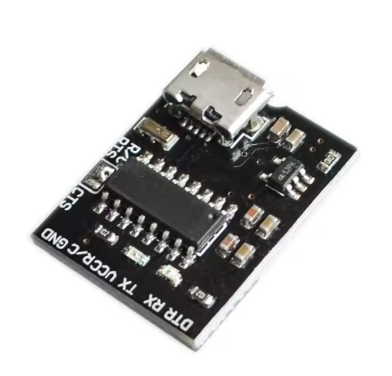
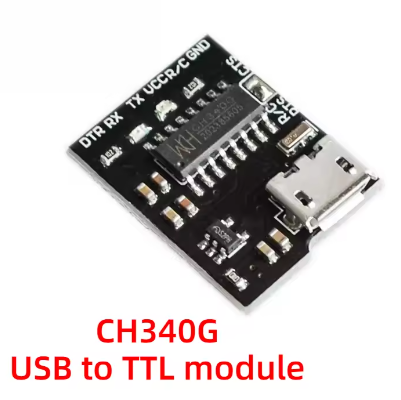
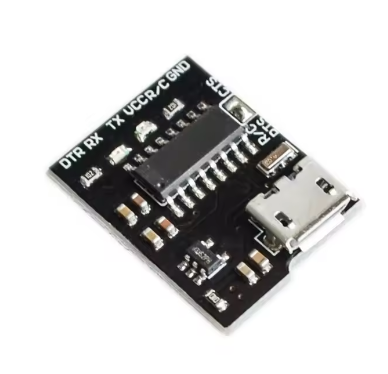
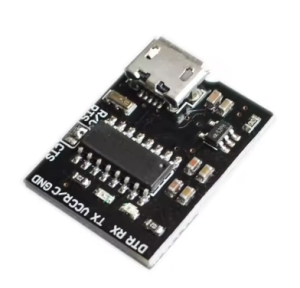
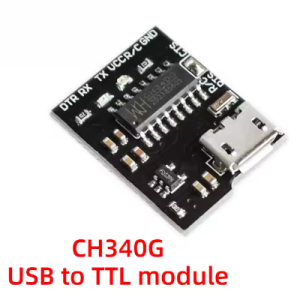
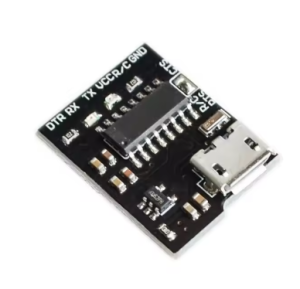
CH340G USB to TTL Serial Module Micro usb

SKU: FA2046-1-0
Main Chipset

CH340G (With External 12MHz Crystal)

USB Interface

Micro-USB (Type-B)

Output Logic

3.3V or 5V (Selectable via Jumper)

Baud Rate Range

50 bps to 2 Mbps

Current Output

5V (Up to 500mA) / 3.3V (Up to 100mA)

Driver Support

Windows 7/8/10/11, macOS, Linux, Android

Communication

Full-Duplex UART

PCB Dimensions

~26mm x 17mm

Product Description
The CH340G Micro-USB to TTL Serial Module is a robust and highly compatible solution for establishing a reliable serial communication link between your computer and microcontroller. Utilizing the industry-standard CH340G chipset with a dedicated external 12MHz crystal oscillator, this module offers superior timing accuracy and high-speed data stability compared to all-in-one chip alternatives.
Equipped with a standard Micro-USB port, it is compatible with the common cables already present in most labs and workshops. This module is an essential tool for developers, providing a bridge for uploading code, debugging terminal outputs, and flashing firmware on a variety of platforms. With an onboard jumper to switch between 3.3V and 5V logic, it is natively compatible with everything from 5V Arduino boards to modern 3.3V low-power ESP8266, ESP32, and STM32 systems.
Key Features
  • High-Stability CH340G Chipset: Features an external 12MHz crystal for precise baud rate timing and reduced data error rates during long-term serial logging.
  • Universal Micro-USB Interface: Connect easily using standard Micro-USB cables—ideal for modern development environments where USB-C or Micro-USB is the standard.
  • Dual-Voltage Flexibility: Integrated jumper allows for instant switching between 3.3V and 5V power and logic levels to suit different microcontroller requirements.
  • Full Signal Breakout: Provides all necessary pins for standard UART communication, including TXD, RXD, VCC, GND, and the DTR pin for “Auto-Reset” microcontroller programming.
  • Onboard Diagnostic LEDs: Features Power (PWR), Transmit (TX), and Receive (RX) indicators for immediate visual feedback on data activity.
  • USB Port Protection: Includes an onboard self-restoring fuse to protect your computer’s USB port from accidental short circuits or overcurrent.
Usage & Applications
  • Microcontroller Programming: The primary tool for uploading sketches to Arduino Pro Mini, ESP-01, and custom-designed AVR/ARM boards.
  • Firmware Upgrades: Flash or recover firmware on routers, 3D printer motherboards (Marlin/Klipper), and various smart home IoT devices.
  • Serial Terminal Debugging: Monitor real-time system logs and debug print statements from embedded software during the development phase.
  • Industrial Sensor Interfacing: Connect TTL-level industrial sensors (GPS, LiDAR, Weight Scales) directly to a PC for analysis.
  • Hardware Unbricking: Access the low-level serial console of networking equipment and hard drives for emergency repair.
Q: What is the benefit of the external crystal on the CH340G?

The external crystal provides much tighter timing tolerances than internal oscillators. This makes the CH340G more reliable for high-speed data transmission (above 115200 baud) and in environments with fluctuating temperatures

Q: Can I use this to program an Arduino Pro Mini?

Yes. This module breaks out the DTR pin. Simply connect the DTR pin of the module to the Reset pin of the Pro Mini to enable the “Auto-Reset” feature in the Arduino IDE.

Q: Is it safe for my 3.3V ESP32 or Raspberry Pi?

Yes, provided you move the onboard jumper to the 3.3V position. This ensures the TX and RX signals operate at 3.3V, preventing overvoltage damage to your low-power chips

Q: Where do I find the drivers for Windows 10/11?

Most modern versions of Windows and Linux will recognize the CH340G automatically. If not, the “CH341SER” driver is widely available and free to download

Q: Can I power my whole project from this module?

This module can provide up to 500mA on the 5V line, which is enough for a microcontroller and a few sensors. For high-current devices like motors or high-power LEDs, you must use an external power supply