Product Overview
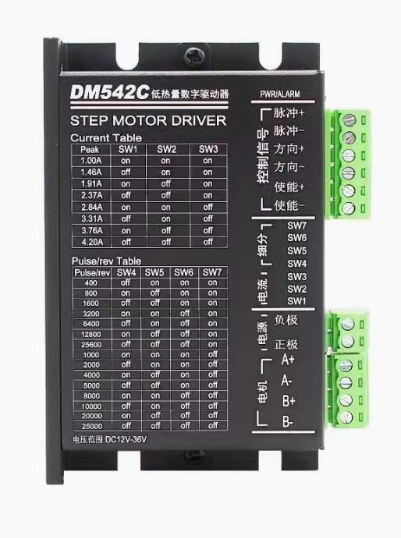
The DM542C DSP Stepper Driver is a professional-grade, high-performance digital stepper drive designed for demanding industrial applications. Built around a new generation 32-bit DSP (Digital Signal Processor) , this driver represents the pinnacle of digital motion control technology, delivering exceptional smoothness, ultra-low noise, and minimal motor heating compared to traditional analog drivers .
With an industry-leading input voltage range of 18V to 86V DC and output current adjustable up to 4.2A peak, the DM542C is specifically engineered to power medium to large stepper motors, including NEMA 23, 34, and even some 42mm frame motors requiring high torque . It is the ideal choice for high-performance CNC milling machines, large-format routers, heavy-duty automation equipment, and industrial machinery where precision and reliability are paramount.
The DM542C incorporates “servo-like” control algorithms that intelligently manage motor current in real-time. This advanced current control technology ensures the motor runs with remarkable stability even at low speeds and low microstep settings, virtually eliminating the mid-range resonance and vibration that plague conventional stepper drivers . The result is smoother operation, higher precision, and improved overall system performance.
All control signals feature high-speed optocoupler isolation, providing excellent noise immunity and protecting your CNC controller or PLC from electrical interference in harsh industrial environments . With 15 selectable microstep resolutions up to 25,600 steps per revolution, comprehensive protection features, and flexible configuration options, the DM542C is the professional’s choice for serious motion control applications.
Key Features
-
32-Bit DSP Technology: Utilizes a high-performance digital signal processor for precise current control, enabling advanced algorithms that optimize motor performance, smoothness, and efficiency in real-time .
-
Wide High-Voltage Input: Accepts motor supply voltage from 18V to 86V DC , allowing for exceptional high-speed torque performance. Higher voltage operation significantly improves motor performance at higher RPMs, making it ideal for milling machines and high-speed applications .
-
4.2A High Current Capacity: Delivers programmable output current from 1.0A to 4.2A peak (approximately 0.71A to 3.0A RMS), providing ample power for a wide range of stepper motors from NEMA 23 to NEMA 34 frame sizes .
-
“Servo-Like” Control Algorithm: Employs sophisticated software processing similar to servo drives, resulting in exceptionally smooth motor operation with minimal vibration and noise—even at low speeds and low microstep resolutions .
-
Automatic Motor Parameter Identification: Features a built-in motor parameter auto-detection function that automatically identifies the connected motor and optimizes control parameters to deliver the best possible performance .
-
15 Microstep Resolutions: Offers 15 selectable microstep resolutions via DIP switches, including standard and non-standard steps per revolution values:
-
Standard: 400, 800, 1600, 3200, 6400, 12800, 25600 steps/rev
-
Non-standard: 1000, 2000, 4000, 5000, 8000, 10000, 20000, 25000 steps/rev
-
Adjustable Idle Current Reduction: Features selectable idle current reduction (SW4). When set to OFF, the motor current automatically reduces to 50% after approximately 0.4 seconds of no pulses, significantly decreasing heat generation and power consumption while maintaining holding torque .
-
8-Level Current Control: Offers 8 selectable output current settings via DIP switches (SW1, SW2, SW3), enabling precise matching to your motor’s specifications .
-
Universal Signal Compatibility: Control signal inputs accept voltages from 5V to 24V, making the driver directly compatible with both 5V microcontrollers (Arduino, Mach3) and 24V industrial PLC systems without external level shifters or current-limiting resistors .
-
Opto-Isolated Inputs: All control signal inputs feature high-speed optocoupler isolation, providing excellent noise immunity and protecting your controller from electrical interference and ground loops .
-
High Pulse Frequency Support: Accepts step pulse frequencies up to 200 kHz , enabling high-speed operation and compatibility with fast motion controllers for applications requiring rapid positioning .
-
Flexible Control Modes: Supports both single-pulse (step/direction) and double-pulse (CW/CCW) control modes, configurable via onboard jumpers. Pulse active edge (rising or falling) is also selectable .
-
Comprehensive Protection Features:
-
Over-voltage protection (automatic shutdown)
-
Under-voltage protection
-
Over-current protection (phase-to-phase and phase-to-ground)
-
Motor phase open-circuit detection
-
Input reverse polarity protection
-
Diagnostic LED Indicators: Built-in status LEDs:
-
Green Power LED: Illuminates when power is applied
-
Red Alarm LED: Indicates fault condition (over-voltage, over-current, etc.)
-
Rugged Industrial Construction: Housed in a durable enclosure with natural cooling or forced-air convection, designed for reliable operation in demanding industrial environments .
Technical Specifications
Pinout & Interface Guide
Power Terminals
-
+V (VDC): Connect your DC power supply (18-86V) here. Observe correct polarity. Use a power supply with sufficient current capacity (typically 5-10A depending on motor load). Recommended voltage: 36V-48V DC for optimal performance .
-
GND: Power ground. Must be connected to power supply negative terminal.
Motor Output Terminals
-
A+, A-: Connect to Phase A of your two-phase stepper motor.
-
B+, B-: Connect to Phase B of your two-phase stepper motor.
Identifying Motor Wires: Use a multimeter in continuity mode. Wires from the same coil will be continuous (show low resistance). Connect one coil to A+/A- and the other to B+/B- . If the motor rotates in the wrong direction, swap the wires on either A+/A- or B+/B- (not both).
Control Signal Terminals
These optically isolated terminals accept signals from your motion controller. The DM542C supports multiple wiring configurations including common-anode and common-cathode .
-
PUL+ / PUL- (Pulse): Step pulse input. Each pulse (rising or falling edge, configurable) advances the motor by one microstep. Minimum pulse width: 2.5 µs. In double-pulse mode, PUL+ functions as CW+ .
-
DIR+ / DIR- (Direction): Direction control input. Logic level determines rotation direction. Direction signal must be established at least 5 µs before the pulse signal. In double-pulse mode, DIR+ functions as CCW+ .
-
ENA+ / ENA- (Enable): Enable input (optional). When this signal is active (internal optocoupler导通), the driver outputs are shut off and the motor enters a “free” state (no holding torque). When inactive (or disconnected), the driver is enabled and the motor holds position with the set current. Note: The enable input is active high on some models—test with your specific unit . If not using, leave disconnected .
Status Indicators
-
PWR (Green LED): Illuminates when power is applied, indicating normal operation .
-
ALM (Red LED): Fault indicator. Illuminates when a protection condition occurs (over-voltage, over-current, phase short circuit, or motor connection error) .
Control Signal Mode Jumpers (Internal)
The DM542C features onboard jumpers (typically J1, J2, J3) for advanced configuration :
DIP Switch Configuration (SW1 – SW8)
The DM542C features 8 DIP switches for configuring output current, idle current reduction, and microstep resolution. Configure switches with power OFF .
SW1, SW2, SW3: Output Current Setting
These three switches set the peak output current. Always set the current to match or be slightly less than your motor’s rated peak current to prevent overheating .
(Note: “ON” means the switch is in the ON position as indicated on the driver housing.)
SW4: Idle Current Reduction (Semi-Flow)
-
OFF (Recommended): Enable idle current reduction. Motor current automatically reduces to 50% of set value when no pulses are received for >0.4 seconds. This significantly reduces motor and driver heating while maintaining holding torque .
-
ON: Disable idle current reduction. Motor maintains 100% current even when idle (maintains maximum holding torque, but generates more heat).
SW5, SW6, SW7, SW8: Microstep Resolution Setting
These four switches set the number of microsteps per full step (for a standard 1.8° motor) .
(Note: Switch orientation (ON/OFF) may vary by manufacturer. Always verify with the label on your specific driver.)
Usage Guide
Important Safety Warnings
-
Never connect or disconnect motor wires while the driver is powered on. Doing so generates high-voltage spikes that will permanently damage the driver .
-
Ensure power supply voltage does not exceed the maximum rating of 86V DC. Over-voltage is a common cause of driver failure .
-
Use a power supply with sufficient current capacity. A rule of thumb: power supply current rating should be approximately 60-70% of the motor’s rated current for optimal performance.
-
Ensure proper grounding to minimize electrical noise interference. Use shielded cable for control signals in noisy environments .
-
Maintain adequate spacing: Allow at least 20mm of space around the driver for proper cooling. Do not place near other heat sources .
Wiring Guide (Common Anode Connection with 5V Controller)
This is the most common wiring method for connecting the DM542C to a 5V microcontroller like an Arduino or parallel port BOB .
Note on Enable Pin: The enable pin is optional. If you do not need to use the enable function, leave the ENA+ and ENA- terminals disconnected. The motor will be enabled by default .
Wiring for 24V PLC Systems
For 24V industrial PLC systems, use the same common anode wiring but connect PUL+, DIR+, and ENA+ to the controller’s +24V supply. No external resistors are needed as the DM542C accepts 5-24V directly .
Control Signal Timing Requirements
For reliable operation, observe these timing requirements :
-
t1 (ENA to DIR): Enable signal must be established at least 5 µs before direction signal (if using enable).
-
t2 (DIR to PUL): Direction signal must be established at least 5 µs before the first pulse.
-
t3 (PUL Width): Pulse width (high level) must be at least 2.5 µs.
-
t4 (PUL Low): Pulse low level width must be at least 2.5 µs.
Basic Arduino Example Code
This code will make the motor rotate forward and reverse continuously.
int PUL = 7;
int DIR = 6;
int ENA = 5;
void setup() {
pinMode(PUL, OUTPUT);
pinMode(DIR, OUTPUT);
pinMode(ENA, OUTPUT);
digitalWrite(ENA, LOW);
}
void loop() {
digitalWrite(DIR, HIGH);
for(int i = 0; i < 3200; i++) {
digitalWrite(PUL, HIGH);
delayMicroseconds(100);
digitalWrite(PUL, LOW);
delayMicroseconds(100);
}
delay(1000);
digitalWrite(DIR, LOW);
for(int i = 0; i < 3200; i++) {
digitalWrite(PUL, HIGH);
delayMicroseconds(100);
digitalWrite(PUL, LOW);
delayMicroseconds(100);
}
delay(1000);
}
First-Time Setup Procedure
-
Configure DIP switches for your motor’s rated current and desired microstep resolution with power OFF .
-
Connect motor to A+/A- and B+/B- terminals.
-
Connect power supply (18-86V DC) to +V and GND.
-
Set control signal mode via internal jumpers if needed (default single-pulse mode is typical).
-
Connect control signals (PUL and DIR, and ENA if desired) using appropriate wiring method.
-
Apply power – the green PWR LED should illuminate .
-
Test operation with simple step/direction signals at a low speed.
-
Check motor temperature after a few minutes of operation. If the motor is excessively hot, reduce the current setting or enable idle current reduction (SW4 OFF)
Q: What is the difference between the DM542C and older analog drivers like the TB6600?
The DM542C uses 32-bit DSP digital technology with advanced control algorithms, while the TB6600 uses older analog technology. Key advantages include:
-
Smoother operation: “Servo-like” control eliminates low-speed vibration and resonance
-
Lower motor heating: More efficient current control and automatic idle current reduction
-
Auto motor matching: Automatically optimizes parameters for your specific motor
-
Higher microstep resolution: Up to 25,600 steps/rev with multiple non-standard options
-
Higher voltage capability: Up to 86V for superior high-speed performance
Q: What types of motors can I use with the DM542C?
The DM542C is designed for two-phase hybrid stepper motors with frame sizes from NEMA 23 to NEMA 34 . It can drive motors with rated currents between 1.0A and 4.2A peak (approximately 0.71A to 3.0A RMS)
Q: What is the maximum voltage I can use?
The DM542C accepts input voltages from 18V to 86V DC . The recommended operating voltage for optimal performance is 36V to 48V DC . Exceeding 86V will permanently damage the driver
Q: Can I use this with a 3.3V controller like an ESP32 or Raspberry Pi?
Yes. The DM542C’s logic inputs accept voltages from 5V to 24V. While 3.3V is slightly below the minimum specification, many users successfully drive it with 3.3V logic. For guaranteed reliability, we recommend using a small level shifter or configuring the driver for common anode wiring with a 5V pull-up
Q: What is the maximum pulse frequency?
The DM542C accepts step pulse frequencies up to 200 kHz , which is suitable for high-speed applications and fast motion controllers
Q: What do the non-standard microstep resolutions (1000, 2000, etc.) do?
These non-standard resolutions are designed for specific applications where standard binary steps/rev don’t match the mechanical requirements. For example, 1000 steps/rev can simplify calculations for certain lead screw pitches or belt drive systems
Q: How do I set the output current correctly?
Use DIP switches SW1, SW2, and SW3 to select a peak current value equal to or less than your motor’s rated peak current . If unsure, consult your motor datasheet. The motor’s rated current is typically specified as either peak or RMS—ensure you’re comparing correctly:
Start with a lower setting and gradually increase while monitoring motor temperature during operation. The motor should not exceed 80°C
Q: What microstep setting should I choose?
The optimal setting depends on your application:
-
General CNC milling/routing: 1600-3200 steps/rev (8-16 microsteps) balances smoothness and speed
-
High precision machining: 6400-25600 steps/rev (32-128 microsteps) for maximum resolution
-
High speed applications: Lower settings (400-800 steps/rev) for maximum RPM
-
Ball screw drives: Consider mechanical resolution to select appropriate microstepping
-
Non-standard leadscrews: Use 1000, 2000, etc. to get integer steps per mm/inch
Q: What does SW4 (idle current reduction) do?
SW4 controls the automatic current reduction function:
-
OFF (Recommended): Current reduces to 50% when motor is idle (>0.4 seconds no pulses). This significantly reduces motor heating and power consumption while maintaining adequate holding torque .
-
ON: Motor maintains 100% current even when idle. Use only when maximum holding torque is absolutely required during idle periods.
Q: How do I wire the control signals for my system?
The DM542C supports both common anode and common cathode wiring. For 5V systems like Arduino, common anode is typical: connect PUL+, DIR+, and ENA+ together to +5V, and connect PUL-, DIR-, and ENA- to your controller output pins . For 24V PLC systems, use the same method with +24V.
Q: Do I need external resistors for 24V signals?
No. The DM542C accepts 5-24V signals directly without external current-limiting resistors. The internal optocoupler circuits are designed for this voltage range
Q: My motor runs weakly or loses steps. What's wrong?
Common causes and solutions:
-
Insufficient voltage: Use a higher voltage supply (36-48V recommended) for better high-speed torque
-
Current too low: Verify DIP switches are set to correct current for your motor
-
Acceleration too high: Use acceleration ramps in your software—motors cannot instantly start at high speeds
-
Power supply inadequate: Ensure supply can deliver required current without voltage sag (minimum 5A recommended)
-
Mechanical binding: Check for mechanical issues in your system
-
Microstep setting too high: Very high microstepping reduces maximum speed—try a lower setting
Q: The motor gets very hot. Is this normal?
Some warmth is normal, but excessive heat indicates:
-
Current set too high: Reduce the current setting to match your motor’s rating
-
Idle current reduction disabled: Enable SW4 (OFF position) to reduce current when idle
-
Inadequate cooling: Ensure proper ventilation around the driver and motor
-
Motor undersized: Motor may be too small for the application load
Q: The driver's red alarm LED is on. What does it mean?
The red ALM LED indicates a fault condition . Common causes:
Troubleshooting steps:
-
Turn off power immediately
-
Check power supply voltage
-
Verify motor connections for shorts or open circuits
-
Allow driver to cool if overheated
-
Restart after resolving the issue
Q: The motor runs in the wrong direction.
This is easily fixed by either:
-
Swapping the two wires connected to either A+/A- or B+/B- (not both)
-
Changing the DIR signal polarity in your controller software
-
Changing the J2 jumper setting (if accessible)
Q: The motor doesn't move at all. What should I check?
Follow this systematic checklist:
-
Power OK? Green PWR LED should be on. If not, check power supply connections and voltage .
-
Enable signal? If using ENA, ensure it’s set to enable the driver (active high on some models, test with your unit). If not using ENA, leave it disconnected .
-
Motor connected? Verify motor wires are securely connected to A+/A- and B+/B- .
-
Pulse signal? Check with an oscilloscope or LED that pulses are reaching PUL input.
-
Current setting? Verify DIP switches are set correctly for your motor .
-
Motor locked but no rotation? Pulse signal may be too weak—check signal voltage and wiring.
Q: The motor vibrates but doesn't rotate.
This typically indicates a wiring issue:
-
One motor phase may be connected incorrectly
-
Check that A+/A- are connected to one coil and B+/B- to the other coil
-
Use a multimeter to verify coil continuity and identify proper wire pairs
Q: The driver works initially but stops after a few minutes.
This is classic thermal shutdown behavior:
Q: Can I damage the driver by connecting/disconnecting wires while powered?
Yes, absolutely. Connecting or disconnecting motor wires while the driver is powered on generates high-voltage spikes that will instantly destroy the driver. Always power off completely before making or changing connections
Q: The green power LED is off. What's wrong?
This indicates no power or internal power supply damage:
-
Check power supply connections and voltage
-
Verify power supply is turned on
-
Check for input fuse (if present)
-
If connections are correct but LED remains off, the driver may require factory service
Q: What is the enable pin for and do I need to use it?
The enable (ENA) input allows you to electronically “disconnect” the motor, putting it in a free state with no holding torque. This is useful for:
-
Manual positioning during setup
-
Emergency stop situations
-
Power saving when motor not needed
If you don’t need this function, simply leave ENA+ and ENA- disconnected—the driver will remain enabled by default