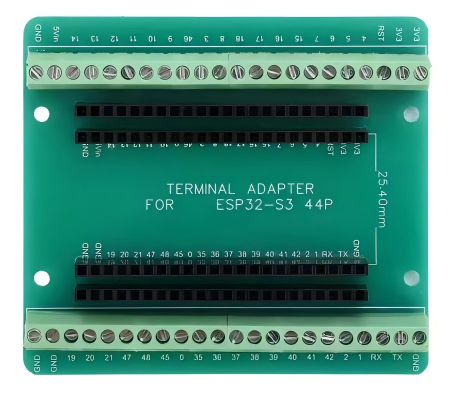
This 44-Pin ESP32-S3 Expansion Board is a professional-grade power management and signal breakout solution specifically engineered for high-performance ESP32-S3 development modules. In 2025, as AIoT projects demand more memory and peripherals, this board serves as the essential foundation for stabilizing and scaling applications using N8R2 and N16R8 configurations.
Product Description
The ESP32-S3 44P Expansion Board is designed to unlock the full hardware potential of the S3 chip. While standard 38-pin expansion boards often leave critical pins inaccessible, this 44-pin variant breaks out every available GPIO, including specialized pins for JTAG debugging, OPI PSRAM, and high-speed LCD/Camera interfaces.
Engineered for industrial reliability, the board features an advanced power delivery system. It converts high-voltage DC input into rock-solid 3.3V and 5V rails, providing the high current (up to 2A) required by 8MB Octal PSRAM and peripherals like 5MP cameras or TFT touchscreens. Whether you are a business developing a smart retail kiosk or a single user building a complex Home Assistant hub, this board ensures your hardware remains stable and your wiring remains organized.
Key Features
- Complete 44-Pin Breakout: Specifically mapped for the ESP32-S3 footprint, ensuring no “hidden” GPIOs.
- Industrial-Grade Power: Supports wide-range DC input via Type-C (5V) or DC Barrel Jack (6.5V – 24V).
- GVS Prototyping System: Every GPIO is grouped with dedicated Ground (G) and Voltage (V) pins, allowing for direct “plug-and-play” with standard 3-pin sensors.
- Dual-Row Header Design: Each signal is mirrored across two rows of pins, making it easy to connect a peripheral and a logic analyzer/oscilloscope simultaneously.
- Integrated Protection: Features onboard capacitors and regulators to prevent “brown-out” resets during Wi-Fi/Bluetooth bursts or high AI processing loads.
- Enclosure Ready: Includes four M3 mounting holes for secure installation in industrial control panels or custom project boxes.