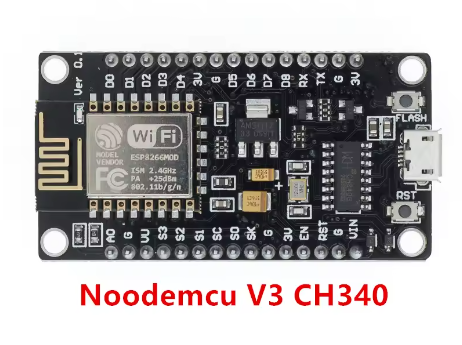
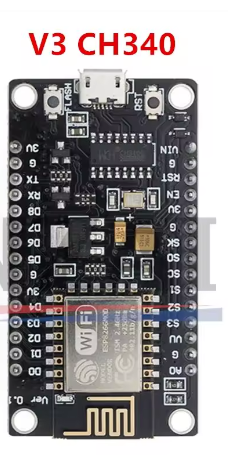
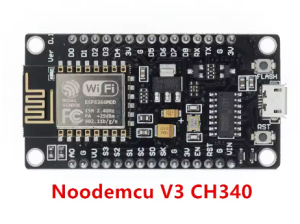
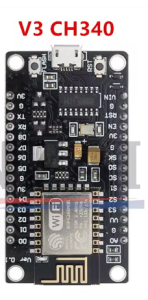
ESP8266 serial wifi module NodeMcu Lua wifi V3 CH340 1M (External antenna)

SKU: FA2062
Microcontroller

ESP8266 (ESP-07 or equivalent)

USB Interface

CH340 (Industrial Grade)

Antenna Type

IPEX (U.FL) Connector for External Antenna

Operating Voltage

3.3V (Onboard Regulator)

Input Voltage

5V (via Micro-USB) or 4V-9V (via Vin Pin)

Flash Memory

1 MB (8 Mbits)

Clock Speed

80MHz / 160MHz

Network Support

2.4GHz Wi-Fi (WPA/WPA2 Security)

I/O Logic Level

3.3V (Not 5V Tolerant)

Dimensions

~58mm x 31mm (V3 Lolin Size)

Product Description
The NodeMCU V3 (External Antenna Edition) is a high-performance IoT development platform designed for applications requiring extended wireless range and superior signal penetration. While standard NodeMCU boards rely on a small integrated PCB antenna, this specialized version features an onboard IPEX (U.FL) connector, allowing you to attach high-gain external antennas.
Built on the powerful ESP8266 SoC, this “V3” (Lolin-style) board utilizes the reliable CH340 USB-to-Serial bridge for seamless programming and debugging. The external antenna capability makes it the definitive choice for industrial IoT gateways, outdoor sensor nodes, and smart-home devices located inside metal enclosures or at the edge of Wi-Fi coverage. With 1MB of Flash memory and a full suite of I/O pins, it provides a “plug-and-play” experience for modern wireless networking.
Key Features
  • Enhanced Wireless Range: Features an onboard IPEX (U.FL) connector for attaching external high-gain antennas, significantly boosting signal stability and distance.
  • High-Stability CH340 Chipset: Provides reliable USB-to-Serial conversion with wide driver support across Windows, macOS, and Linux.
  • Versatile Network Support: Fully supports 802.11 b/g/n protocols with a complete TCP/IP stack for Station, SoftAP, or mixed-mode operation.
  • Robust I/O Interface: Offers 10 GPIOs, PWM, I2C, SPI, and a 10-bit Analog-to-Digital Converter (ADC) for extensive sensor integration.
  • Multi-Platform Programming: Supports Lua scripting natively, but is most commonly used with the Arduino IDE, MicroPython, and ESP-IDF.
  • Cost-Effective Scalability: A high-performance, low-cost solution ideal for large-scale business deployments and DIY prototypes alike.
Usage & Applications
  • Outdoor IoT Gateways: Deploying Wi-Fi nodes in agricultural or environmental monitoring where long-range connectivity is required.
  • Industrial Enclosures: Perfect for smart controllers mounted inside metal cabinets where an external antenna must be routed outside the box.
  • Smart Home Expansion: Improving connectivity for devices located in garages, basements, or at the far edges of a property.
  • Wireless Data Relays: Creating Wi-Fi repeaters or signal bridges in complex architectural environments.
  • STEM Education: Teaching the principles of RF engineering, antenna gain, and wireless communication protocols.
Q: Do I need to buy an antenna separately?

Yes. This board is designed for use with an external antenna. For the best performance, we recommend a 2.4GHz high-gain antenna with an IPEX/U.FL connector or a pigtail adapter.

Q: Why choose the 1MB Flash version over the 4MB version?

The 1MB version is highly cost-effective and perfectly sufficient for the vast majority of IoT sensor applications and communication protocols. It is favored by businesses looking to minimize per-unit costs in large fleets

Q: Can I use this board with the Arduino IDE?

Absolutely. You simply need to install the ESP8266 board package in the Arduino IDE and select “Generic ESP8266 Module” or “NodeMCU 0.9” to begin programming.

Q: Is it safe to use 5V sensors with this board?

You can power the board with 5V, but the GPIO pins operate at 3.3V. If your sensor outputs a 5V signal, you must use a logic-level shifter or a voltage divider to avoid damaging the microcontroller

Q: Does the CH340 driver work with Windows 11?

Yes. The CH340 is a globally recognized chipset, and drivers are widely available and fully compatible with Windows 10/11, macOS, and Linux.