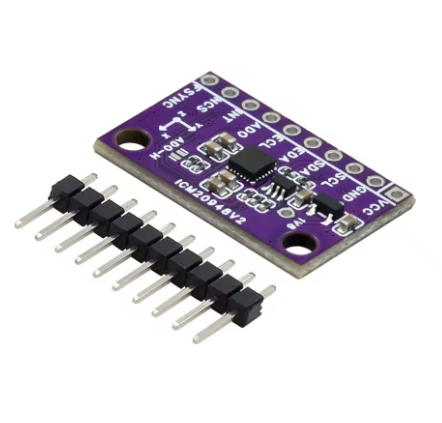
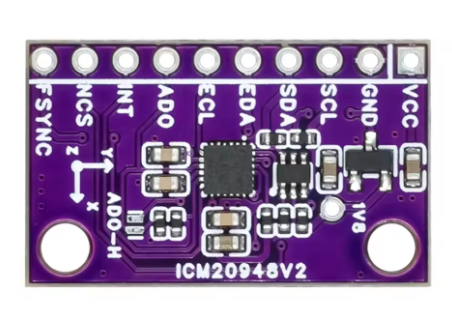
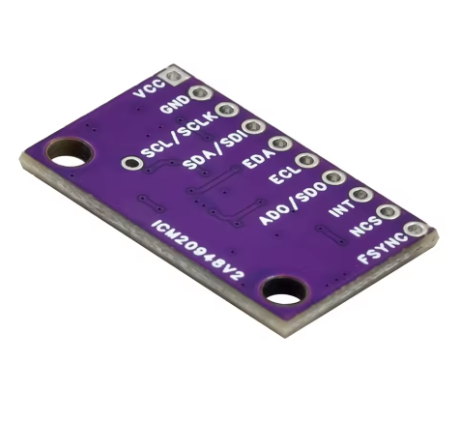
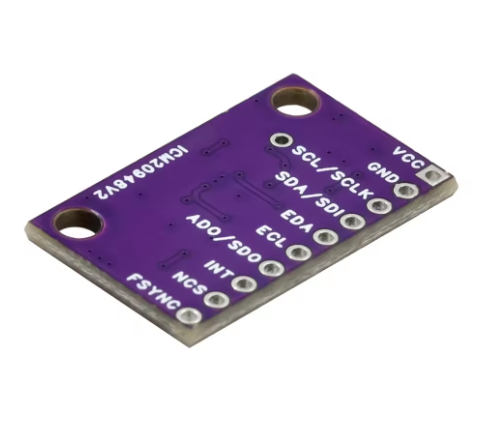
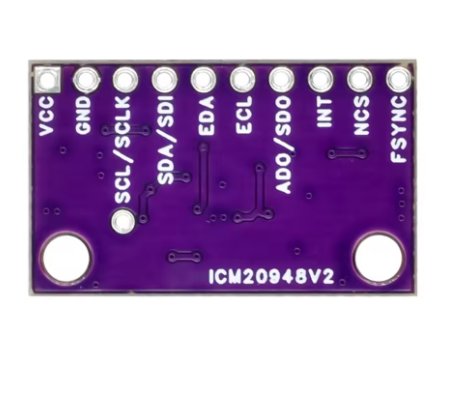
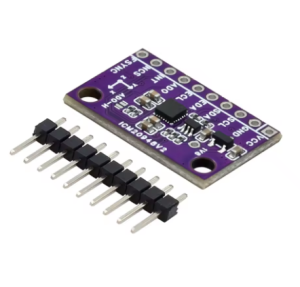
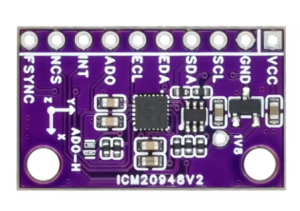
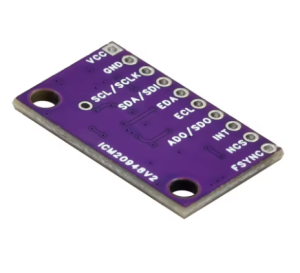
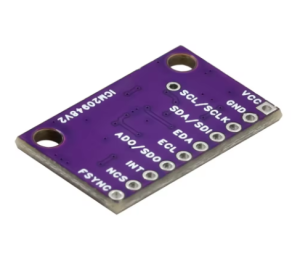
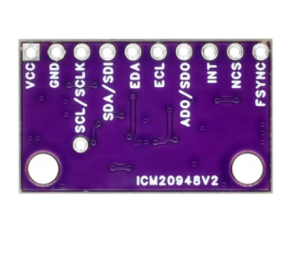
The GY-ICM20948V2 9-Axis IMU Sensor Module is a high-performance, ultra-low-power Inertial Measurement Unit designed as a superior replacement for legacy MPU-9250 and MPU-9150 modules. It integrates a 3-axis accelerometer, a 3-axis gyroscope, and a 3-axis magnetometer into a single package, providing complete 9-Degrees of Freedom (9-DOF) sensing capability for professional and DIY applications.
Product Description
The GY-ICM20948V2 Module is built around the authentic InvenSense (TDK) ICM-20948 chip, which is one of the most advanced, compact, and energy-efficient 9-axis motion tracking devices available. This module solves complex orientation tracking needs by offering precise data for linear acceleration, angular velocity (rotation), and absolute heading (magnetic North) with an integrated electronic compass.
A key differentiator is its inclusion of a Digital Motion Processor (DMP) and an auxiliary I2C interface that enables “sensor fusion” entirely onboard, offloading computationally intensive tasks from the host microcontroller (MCU). The ICM-20948 also features a dedicated data synchronization pin (Sync pin) for applications requiring precise timing across multiple sensors. The module supports both I2C and high-speed SPI communication interfaces and includes an onboard voltage regulator compatible with standard 3.3V and 5V systems. Its robust design and high stability make it ideal for demanding applications in VR/AR, robotics, and industrial automation.
Key Features
- Superior 9-Axis Sensing: A high-performance, low-power replacement for MPU-9250/MPU-9150 modules.
- Triple Integration: Combines 3-axis accelerometer, 3-axis gyroscope, and 3-axis magnetometer.
- Dual Communication Interfaces: Supports both I2C (up to 400 kHz) and SPI (up to 7 MHz) for flexible integration.
- Digital Motion Processor (DMP): Integrated engine reduces host MCU workload for sensor fusion algorithms.
- Ultra-Low Power: Optimized for battery-operated and wearable applications.
- Wide Voltage Compatibility: Onboard regulator allows operation from 3V to 5V DC power supplies.
- High Resolution: 16-bit Analog-to-Digital Converters (ADCs) for all 9 channels.