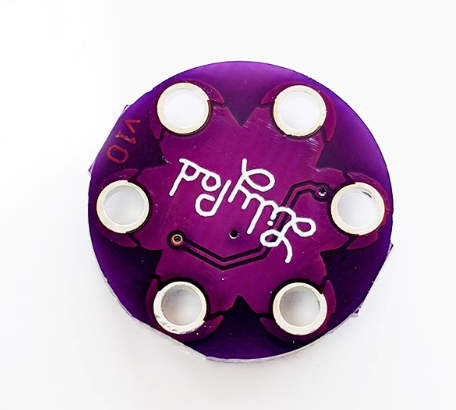
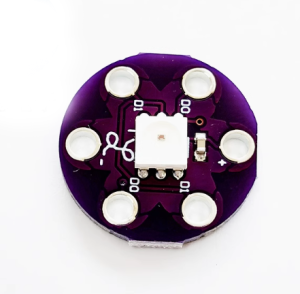
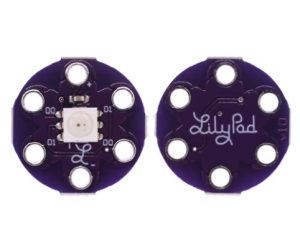
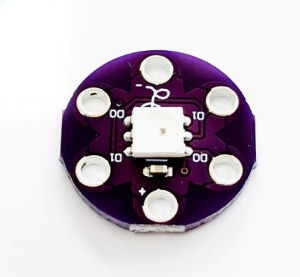
LilyPad Pixel Board WS2812 LED: Addressable RGB for E-Textiles
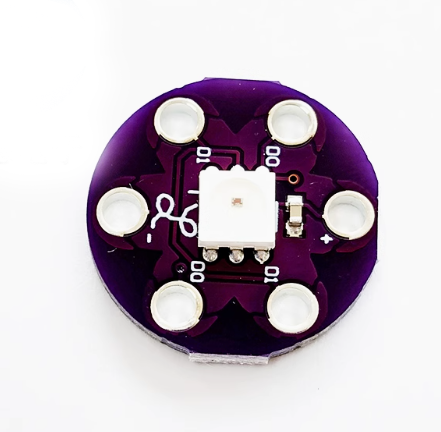
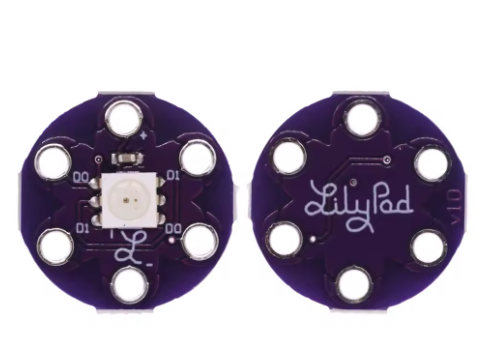
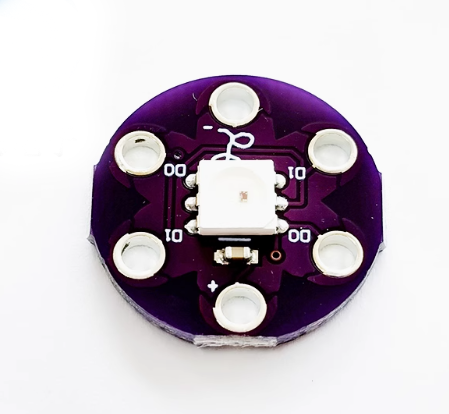
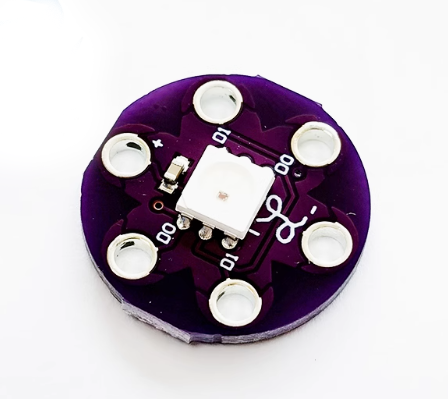
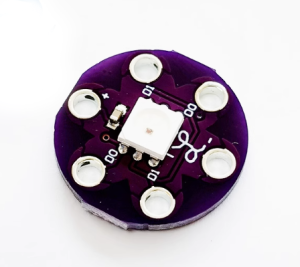
The LilyPad Pixel Board WS2812 brings full-color, individually addressable lighting control to your wearable electronics and e-textile projects. Unlike traditional single-color or static RGB LEDs, each Pixel Board contains an integrated driver chip (WS2812/WS2812B) within the LED package itself, allowing you to control the color and brightness of every single LED using just one data signal line from your microcontroller.
This makes it possible to create complex, dynamic lighting displays, custom animations, and vibrant visual effects within fabric, clothing, or costumes with minimal wiring complexity. The circular board design and large, sewable pads are hallmarks of the LilyPad ecosystem, ensuring seamless integration using conductive thread.
Key Features
- Individually Addressable: Each LED can display any of 16.7 million colors (24-bit color depth) independently of others in a chain.
- Single-Wire Control: Requires only three connections: Power (+), Ground (-), and a single Data Input (DI) line, drastically simplifying wiring.
- Chainable Design: Multiple Pixel Boards can be linked together in series (connecting Data Out (DO) of one to Data In (DI) of the next) to create larger displays or addressable strings.
- E-Textile Ready: Features large, rounded sew-tabs for secure attachment and electrical connection using conductive thread.
- Low Profile & Washable: Compact design ensures minimal bulk in garments and the entire project is washable (when proper care is taken and the power source is removed).
- Wide Compatibility: Works seamlessly with the Adafruit NeoPixel and FastLED Arduino libraries, making programming accessible for beginners and advanced users alike.
Technical Parameters (Specifications)
| Parameter |
Value |
| LED Chip |
WS2812B (5050 SMD RGB LED with integrated driver) |
| Input Voltage |
DC 3.5V to 5.3V (Ideal 5V operation) |
| Current Consumption |
~60mA at full brightness (20mA R, 20mA G, 20mA B) per LED |
| Color Depth |
24-bit color (8 bits per R/G/B channel) |
| Interface |
Single-wire digital serial communication protocol |
| Data Speed |
800 Kbps (Kilobits per second) |
| PCB Dimensions |
Approx. 20mm outer diameter |
| Connection Method |
Sewable pads (+, -, DI, DO) |
Usage Instructions
The LilyPad Pixel Board requires a compatible microcontroller (like a LilyPad Arduino or ESP32 board) to send the necessary data signals.
Wiring Diagram:
- Power Connection: Connect the + (Power) pad to your 5V power source (or the 5V pin on your Arduino) and the – (Ground) pad to the common ground.
- Data Input: Connect a digital I/O pin on your microcontroller (e.g., Arduino Pin 6) to the DI (Data In) pad of the first Pixel Board in the chain.
- Chaining Multiple Boards (Optional): To add more pixels, connect the DO (Data Out) pad of the first board to the DI pad of the second board. Continue this pattern for all subsequent LEDs.
- Programming: Use the Adafruit NeoPixel or FastLED libraries in the Arduino IDE to control the color and behavior of each individual LED.
- Pro Tip for Large Projects: If using many LEDs, you will need an external 5V power supply, as the Arduino board cannot supply enough current for more than a few pixels.
Q: Do I need a special controller to use these LEDs?
Yes, you need a programmable microcontroller (like an Arduino board) that can manage the specific timing required by the WS2812 single-wire protocol.
Q: How many Pixel Boards can I chain together?
The limit depends on your microcontroller’s available memory (RAM) and power supply capacity. Standard ATmega328P-based Arduinos can typically handle 300-400 LEDs. Ensure your power supply can handle the current draw (up to 60mA per LED at full brightness).
Q: Are the finished projects truly washable?
Yes, with care. You must always remove the battery pack before washing. We recommend hand-washing the garment gently and allowing it to air dry completely before re-inserting power.
Q: The color seems off, or the lights flicker. What's wrong?
This is usually a power issue or a data timing issue. Ensure you have a stable 5V power supply, consider adding a large capacitor (1000µF) across the power lines, and add a small resistor (300-500 Ohm) to your data line near the microcontroller to reduce signal noise.
Q: Can I connect these to a 3V coin cell battery?
A single 3V coin cell (like a CR2032) is generally insufficient as the LEDs require at least 3.5V to operate reliably and draw too much current for these small batteries. Use a 3.7V LiPo battery or 5V source for best results.