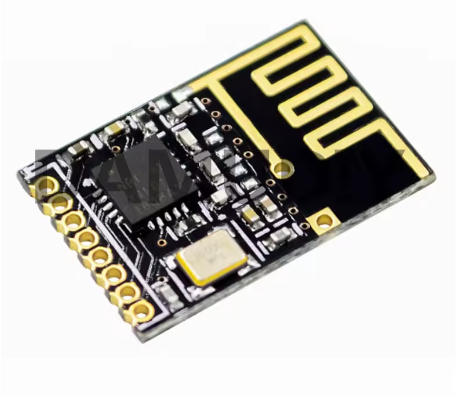
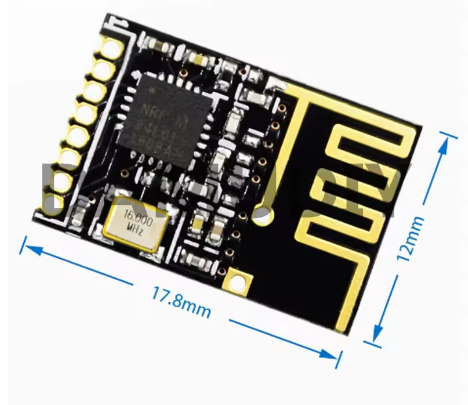
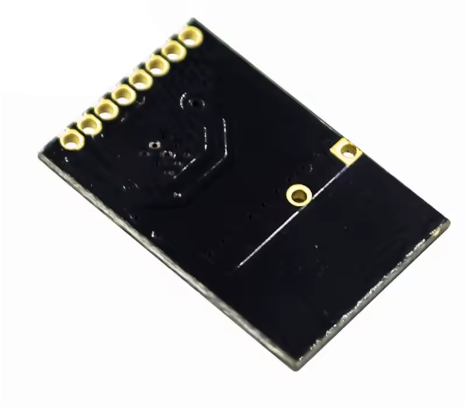
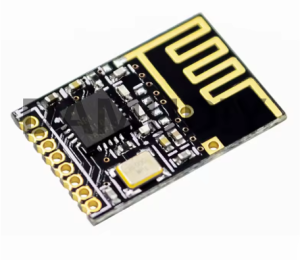
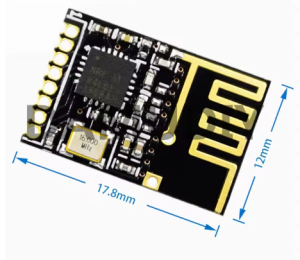
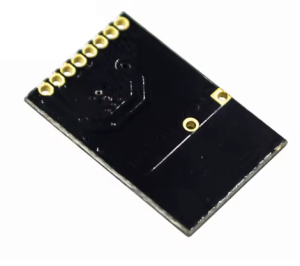
- Ultra-Compact Form Factor: Specifically designed for “Mini” applications where PCB real estate is at a premium.
- Low Power Consumption: Features built-in Power Down and Standby modes, making it ideal for battery-operated devices.
- Enhanced ShockBurst™: Automatically handles packet assembly, timing, and retransmissions, reducing the processing load on the host MCU.
- Multi-Point Communication: Supports up to 6 data pipes (1-to-6 star networks), allowing a single receiver to communicate with multiple transmitters.
- High-Speed Transfer: Capable of data rates up to 2Mbps, suitable for fast data logging and real-time control.
- Integrated Antenna: Features a high-efficiency trace antenna etched directly onto the PCB for consistent performance without external hardware.
Mini NRF24L01+ 2.4GHz Wireless Transceiver Module – Low Power, Long Range
| Frequency Band | 2.4GHz ISM Band (2400MHz – 2525MHz) |
|---|---|
| Operating Voltage | 1.9V to 3.6V DC (Note: 3.3V is recommended) |
| Logic Level | 5V Tolerant (Inputs can handle 5V signals, but VCC must remain below 3.6V) |
| Data Rate | 250kbps, 1Mbps, or 2Mbps |
| Max Output Power | +0dBm |
| Receiver Sensitivity | ≤ -94dBm at 250kbps |
| Peak Current | Approx. 13mA (at 2Mbps), 11mA (at 0dBm output) |
| Interface | 8-Pin SPI (Serial Peripheral Interface) |
| Dimensions | Approx. 12mm x 18mm (Mini version) |


- Power Supply: Connect the VCC pin to a 3.3V source. Connecting to 5V will permanently damage the module. For best results, use a 10µF–100µF capacitor across the VCC and GND pins to smooth out power spikes.
- SPI Interface: Connect the MISO, MOSI, SCK, CSN, and CE pins to your microcontroller’s SPI bus.
- Software Setup: Use established libraries (such as RF24 for Arduino) to initialize the radio, set the channel, and define the data rate.
- Network Setup: Ensure both the transmitter and receiver are on the same frequency channel and share the same address (ID) for successful communication.
In an open outdoor area at a 250kbps data rate, the range is typically between 50 to 100 meters. Indoors, this will vary depending on walls and interference from Wi-Fi signals.
Yes. The “Mini” version uses the same silicon and protocol as the standard-sized modules. They can communicate with each other seamlessly as long as the software settings match.
Yes. These modules are widely used in industrial automation for wireless sensor nodes (temperature, humidity, vibration) and inventory tracking due to their low unit cost and high reliability in star-network configurations.
Each module can “listen” to 6 different addresses simultaneously using data pipes. For larger networks, you can implement a mesh or time-slotted protocol to manage hundreds of nodes.
Since it operates in the 2.4GHz band, there is potential for overlap. However, the nRF24L01+ allows you to choose from 125 different channels. Moving your project to a channel above 2.4835GHz (Channel 84+) typically avoids Wi-Fi interference.
Most issues are power-related. The module requires a very stable voltage. We highly recommend using an 8-pin Socket Adapter with an onboard regulator to ensure consistent 3.3V power.