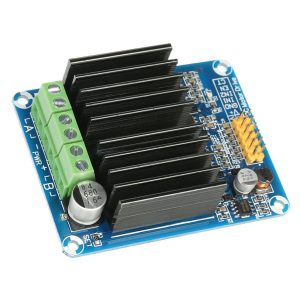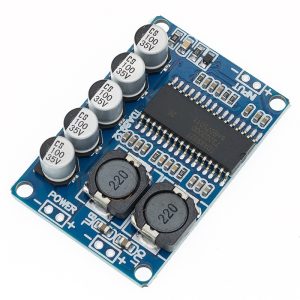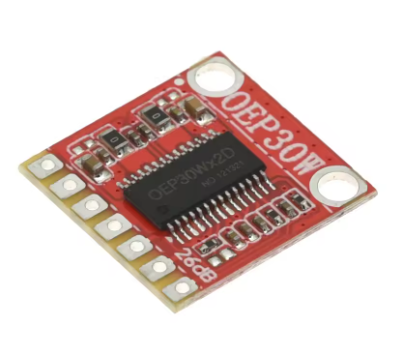
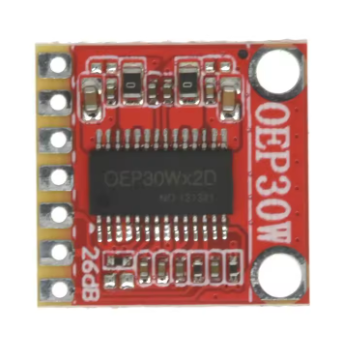
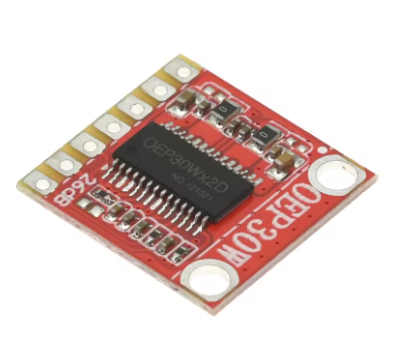
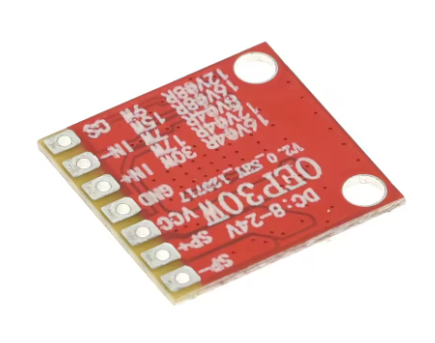
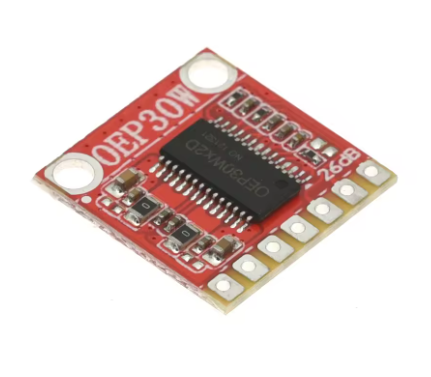
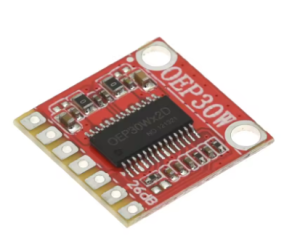
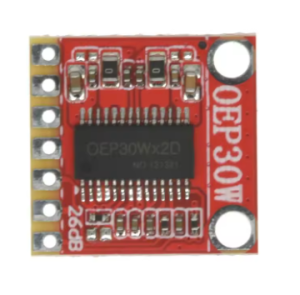
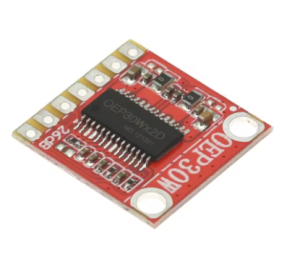
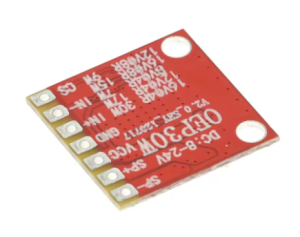
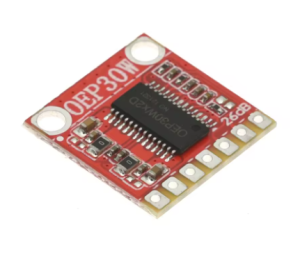
The OEP30W Mono Class D Digital Amplifier Board is a highly efficient single-channel audio power module capable of delivering up to 30 watts of power. Based on the robust TDA8932 chip (or a similar high-performance equivalent), this board is designed for high-power mono applications and features differential inputs for superior noise rejection, making it ideal for professional and DIY audio systems.
Description
The OEP30W Mono Class D Digital Amplifier Board provides a powerful, compact, and energy-efficient solution for various mono audio amplification needs, such as subwoofers, public address (PA) systems, or single-speaker installations. Utilizing Class D technology, this module achieves efficiencies often exceeding 90%, which significantly reduces power consumption and heat generation compared to traditional linear amplifiers.
The board operates within a flexible DC input voltage range, typically 10V to 30V (12V recommended for 20W output, higher voltage for max 30W output). Its maximum power output is dependent on the input voltage and speaker impedance, capable of producing 10W, 15W, 20W, or up to 30W under optimal conditions (e.g., 25V supply into a 4Ω speaker).
A key feature of the OEP30W is its differential input capability. This design allows the board to effectively reject common-mode noise and interference, resulting in a cleaner audio signal, particularly over long cable runs or in electrically noisy environments like industrial settings or car audio systems. The board also incorporates protection features such as over-voltage protection, under-voltage protection, and short-circuit protection for reliable operation. The compact size and high power density make it an excellent choice for both hobbyist projects and commercial product integration.
Features
- High-Efficiency Class D Technology: Ensures over 90% power efficiency, reducing heat output and power consumption.
- Mono Channel Output: Dedicated single channel design for focused high-power applications (e.g., subwoofers, PA systems).
- Variable Power Output: Delivers 10W/15W/20W/30W depending on input voltage and load impedance.
- Wide Voltage Operation: Operates reliably from DC 10V to 30V (12V recommended for general use).
- Differential Audio Input: Features differential inputs for excellent noise rejection and a clean audio signal.
- Protection Features: Built-in protections including over-voltage, under-voltage, and output short-circuit protection.
- Compact Design: Small form factor facilitates integration into tight enclosures and various projects.