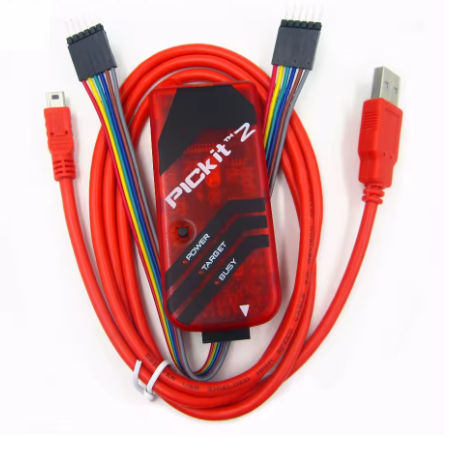
PIC KIT2 Offline Programmer & Debugger Offline/Programming/Emulator

SKU: FA1058
Interface

USB 2.0 Full Speed

Target Voltage (Vdd)

2.5 V to 5.0 V (Adjustable)

Programming Voltage (Vpp)

Up to 13 V (Internal Boost)

Connectivity

6-pin ICSP Header

Memory Capacity

Integrated EEPROM for Offline HEX storage

Compatibility

Windows 7, 10, 11 (32/64-bit)

Supported Software

MPLAB IDE, MPLAB IPE, PICkit 2 Programmer Software

Product Description
The PIC KIT2 Offline Programmer & Debugger is a versatile and cost-effective development tool designed for Microchip’s PIC10, PIC12, PIC16, PIC18, PIC24, dsPIC30, dsPIC33, and PIC32 families. This specific edition is enhanced with “Programmer-To-Go” technology, allowing for offline programming—a critical feature for field technicians and factory production lines where a PC connection is not always feasible.
By integrating the functions of an in-circuit debugger (ICD) and a standalone programmer, the PIC KIT2 provides a stable bridge between your firmware and the silicon. Its robust architecture ensures reliable code execution, real-time debugging, and rapid data transmission, making it an essential tool for embedded engineers working on the Microchip ecosystem.

Key Features
    • Offline “Programmer-To-Go” Mode: Store your HEX file directly on the internal memory of the PIC KIT2 and program target boards with a single button press—no PC required.
    • Broad Device Support: Extensive compatibility with most 8-bit, 16-bit, and 32-bit PIC microcontrollers and dsPIC Digital Signal Controllers.
    • USB Powered & Plug-and-Play: Connects via USB 2.0; no external power supply is needed for the programmer itself.
    • UART Tool & Logic Analyzer: Includes built-in features for basic UART serial communication and a 3-channel logic analyzer for signal troubleshooting.
    • Integrated Voltage Control: Software-adjustable target voltage (Vdd) from 2.5V to 5.0V, ensuring compatibility with low-power chips.
    • ICSP Interface: Uses the standard 6-pin In-Circuit Serial Programming (ICSP) header for easy connection to target boards.
Usage Instructions
  1. Driver Installation: Install MPLAB X IDE or the standalone PICkit 2 Programmer software.
  2. Online Mode: Connect the PIC KIT2 to your PC via USB. Link the ICSP pins to your target board. Use your IDE to “Write” or “Debug” your code.
  3. Offline Programming (Programmer-To-Go):
    • Connect to PC and open the PICkit 2 software.
    • Select your device and load the HEX file.
    • Select “Download to Programmer-To-Go.”
    • Disconnect from PC, connect the PIC KIT2 to the powered target board, and press the “Push Button” on the programmer to flash the chip.
  4. Status Monitoring: Watch the onboard LEDs (Power, Target, Busy) to confirm successful programming.
Q: Does this unit support the latest PIC32 or newer AVR chips?

While the PIC KIT2 supports most classic PIC10/12/16/18/24 and PIC32 series, for the very latest 2026 releases or AVR integration, the PICkit 4 or MPLAB ICE 4 is recommended. However, for 90% of standard PIC projects, the PIC KIT2 remains the most stable and cost-effective choice.

Q: Can the PIC KIT2 power my target board?

Yes. The software allows you to toggle “Target Power” on/off. It can provide up to 100mA of current at the selected voltage (2.5V–5V), which is sufficient for many small-scale prototype boards.

Q: Is this suitable for business production environments?

Absolutely. Business customers value the Offline Programming feature for assembly lines. It allows operators to program chips without exposing source code on a PC, protecting company intellectual property while increasing efficiency.

Q: What do I do if my device is not listed in the software?

You can often update the PK2DeviceFile.dat file manually to include newer chip definitions. We provide instructions and updated files for our business partners upon request.

Q: Is it compatible with macOS or Linux?

Official support is primarily for Windows. However, open-source tools like pk2cmd allow for basic programming functions on Linux and macOS environments.