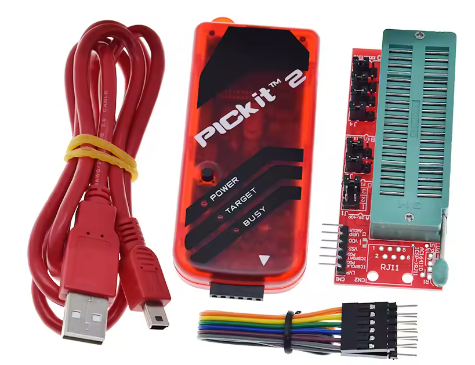
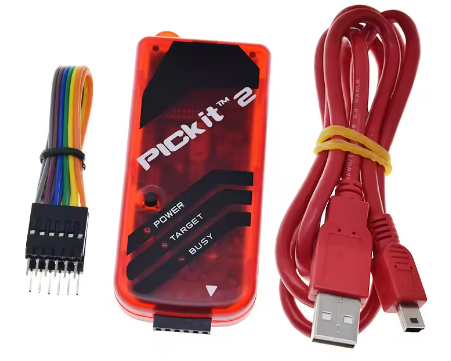
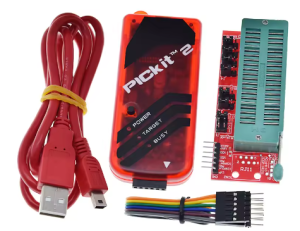
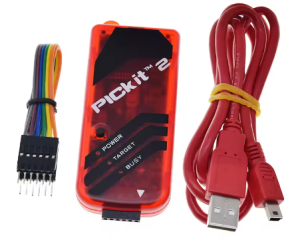
PIC KIT2 Offline Programmer & Debugger Offline/Programming/Emulator with ICD2

SKU: FA1058-1
PC Interface

USB 2.0 Full Speed

Connection Port

6-Pin ICSP (In-Circuit Serial Programming)

Target Voltage (Vdd)

2.5 V – 5.0 V (Adjustable via Software)

Programming Voltage (Vpp)

1.8 V – 13.5 V (Internal DC-DC Boost)

Debug Support

Breakpoints, Single-stepping, Variable Watch

Offline Memory

Onboard EEPROM for 1x HEX file storage

Operating System

Windows 7, 10, 11 (Supports 32/64-bit)

Product Description
The PIC KIT2 Enhanced Edition is a high-performance, cost-effective development tool that combines the reliable programming capabilities of the PICkit series with the advanced In-Circuit Debugger (ICD2) logic. It is designed specifically for Microchip’s PIC10, PIC12, PIC16, PIC18, PIC24, dsPIC, and PIC32 families.
This 2026 edition features a reinforced Offline “Programmer-To-Go” mode, allowing for secure, PC-independent firmware deployment—perfect for field service or high-volume factory floors. By bridging the gap between an entry-level programmer and an industrial emulator, this tool allows for real-time code stepping, hardware breakpoints, and comprehensive memory inspection at a fraction of the cost of professional enterprise tools.

Key Features
  • Offline “Programmer-To-Go”: Download HEX files once and program target MCUs anywhere with a single button press. No computer required for onsite updates.
  • ICD2 Simulation Logic: Enhanced hardware stability allows for reliable emulation and debugging in the MPLAB environment, similar to the legacy ICD2 units but with USB 2.0 speed.
  • Broad Device Support: Comprehensive support for most 8-bit, 16-bit, and 32-bit PIC microcontrollers.
  • Three-in-One Utility: Works as a Programmer, a Debugger, and a UART Serial Tool (for basic console communication/terminal testing).
  • Adjustable VDD Power: Software-controlled voltage output (2.5V to 5.0V) allows you to power your target board directly from the USB port (up to 100mA).
  • Safety Protection: Integrated over-voltage and short-circuit protection to safeguard both your PC and the target application.
Usage Instructions
  1. Software Prep: Install the latest MPLAB X IDE or the standalone PICkit 2 Programmer v2.61.
  2. Hardware Hookup: Connect the PIC KIT2 to your PC. Connect the ICSP header to your target board (ensure Pin 1/MCLR alignment).
  3. Online Debugging: Open your project in MPLAB, select PICkit 2 as the debugger, and use the “Debug” icon to begin real-time code analysis.
  4. Offline Programming (Programmer-To-Go):
    • Open the PICkit 2 standalone software.
    • Load your project HEX file.
    • Go to Programmer > Download To Programmer-To-Go.
    • Once loaded, the unit can be disconnected. Press the physical “Push” button on the unit while connected to a powered target board to flash it.
  5. LED Indicators:
    • Power (Green): System Ready.
    • Target (Yellow): Target board detected/powered.
    • Busy (Red): Data transmission or programming in progress.
Q: How does this differ from a standard ICD2?

While it uses ICD2-compatible logic for debugging stability, it is much smaller, USB-powered, and faster. Unlike the bulky original ICD2, this unit does not require an external power brick for standard operation.

Q: Is it compatible with the latest 2026 MPLAB X software?

Yes. While Microchip has moved to PICkit 4/5, the PIC KIT2 remains fully supported in MPLAB X via the “PICkit 2” hardware selection for most legacy and mid-range devices.

Q: Can this program the newer AVR or SAM chips?

No. This tool is dedicated specifically to the Microchip PIC and dsPIC families. For AVR/SAM support, we recommend our PICkit 4 listings.

Q: Is it suitable for business/industrial procurement?

Yes. Business customers prefer this model for its Offline Mode, which prevents sensitive source code from being exposed on assembly line PCs. Operators only need to press a button to program, minimizing human error.

Q: Does it work with 3.3V low-power devices?

Absolutely. The software allows you to cap the voltage at 3.3V (or as low as 2.5V) to prevent damaging sensitive low-voltage microcontrollers.