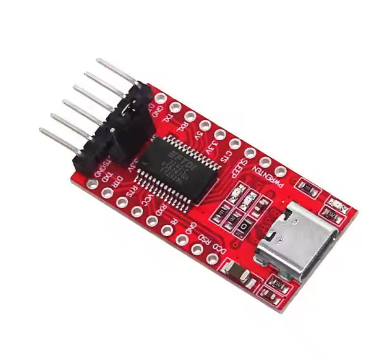
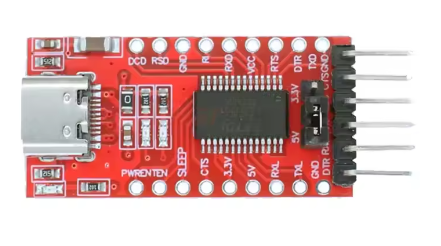
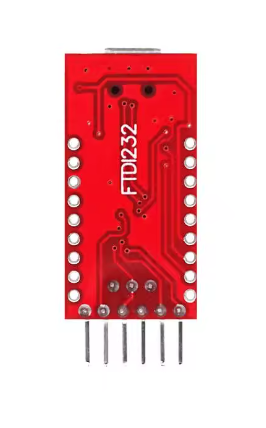
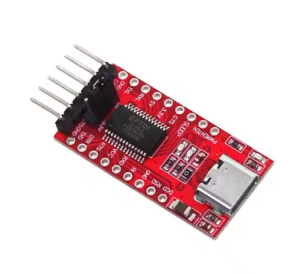
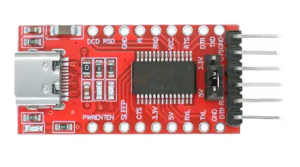
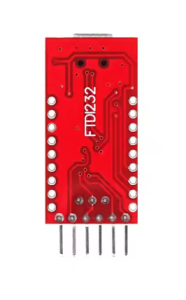
Type-C to TTL Download Cable to Serial for FT232RL module

SKU: FA2048-0
Main Chipset

FTDI FT232RL (High-Stability Core)

USB Interface

USB Type-C (Reversible)

Logic Levels

3.3V or 5V (Selectable via Jumper)

Baud Rate Range

300 bps to 3 Mbps

Output Power

5V (up to 500mA) / 3.3V (up to 50mA)

Supported OS

Windows 11/10/8/7, macOS, Linux, Android

Communication

Full-Duplex UART

Dimensions

~36mm x 18mm

Product Description
The FT232RL USB Type-C to TTL Serial Module brings the industry-standard reliability of FTDI technology into the modern era. By combining the world-renowned FT232RL chipset with a high-durability USB Type-C port, this module provides a rock-solid serial bridge that eliminates the need for legacy cables and specialized adapters.
Engineered for professional developers and industrial maintenance, the FTDI core ensures maximum driver stability across Windows, macOS, and Linux—making it the “gold standard” for bit-perfect data transmission. With an integrated jumper to switch between 3.3V and 5V logic, it is natively compatible with everything from legacy 5V Arduino boards to modern, sensitive 3.3V microcontrollers like the ESP32, STM32, and Raspberry Pi. Its compact design and integrated status LEDs make it an indispensable tool for firmware flashing, hardware debugging, and high-speed serial data logging.
Key Features
  • Original FTDI FT232RL Chip: Industry-leading stability with official driver support natively integrated into most modern operating systems.
  • Modern USB Type-C Interface: Reversible connector for convenience and compatibility with modern laptops, tablets, and mobile devices.
  • Selectable Dual-Voltage Logic: Onboard jumper allows instant toggling between 3.3V and 5V TTL levels to protect sensitive components.
  • Real-Time Status LEDs: Features high-visibility LEDs for Power (PWR), Transmit (TXD), and Receive (RXD) for immediate diagnostic feedback.
  • USB Port Protection: Includes an onboard self-restoring 500mA fuse to protect your computer from accidental short circuits or overcurrent.
  • Full 6-Pin Breakout: Standard header layout (DTR, RXD, TXD, VCC, CTS, GND) ensures 100% compatibility with Arduino Pro Mini and similar programming interfaces.
Usage & Applications
  • Microcontroller Programming: The primary tool for uploading code to Arduino Pro Mini, ESP8266, and custom-designed AVR/ARM boards.
  • Hardware “Unbricking”: Access the serial console of routers, switches, and hard drives for low-level system recovery and firmware flashing.
  • Industrial Sensor Interfacing: Connect high-precision TTL-level sensors (GPS, LiDAR, Weight Scales) directly to a modern PC for analysis.
  • IoT & Wearable Development: A compact bridge for configuring 3.3V low-power modules during the prototyping phase.
  • Lab Diagnostics: Monitor real-time serial logs from embedded software to identify and fix bugs in complex code
Q: Why choose the FT232RL over cheaper CH340 or CP2102 modules?

The FTDI FT232RL is widely considered the most reliable serial chip in the industry. It offers the best driver stability and handles high-speed, continuous data streams with significantly fewer errors and lower latency than budget alternatives.

Q: Is this module safe for my 3.3V ESP32 or Raspberry Pi?

Yes, provided you move the onboard jumper to the 3.3V position. This ensures the TX and RX signals operate at 3.3V, preventing overvoltage damage to your sensitive low-power chips

Q: Can I use this for "Auto-Reset" in the Arduino IDE?

Absolutely. This module breaks out the DTR pin. Simply connect the DTR pin of the module to the Reset pin of your microcontroller to enable automatic code uploads without manual button pressing.

Q: Where can I find the drivers for Windows 10/11?

Most modern versions of Windows and Linux will recognize the FTDI chip automatically. If not, the latest official “VCP” (Virtual COM Port) drivers are always free to download from the FTDI Chip website

Q: Can I power a high-power device (like a cellular modem) from this module?

This module can provide up to 500mA on the 5V rail. While sufficient for most microcontrollers, high-current devices like motors or modems will require a separate external power source.