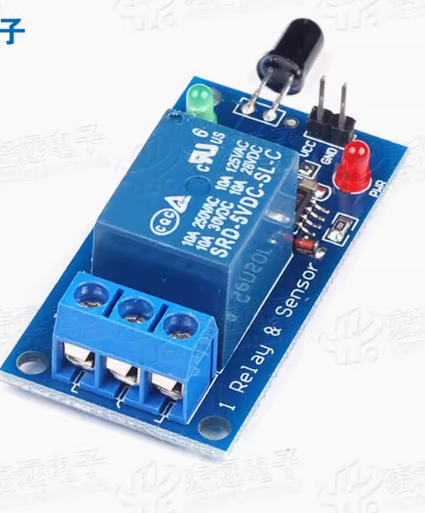
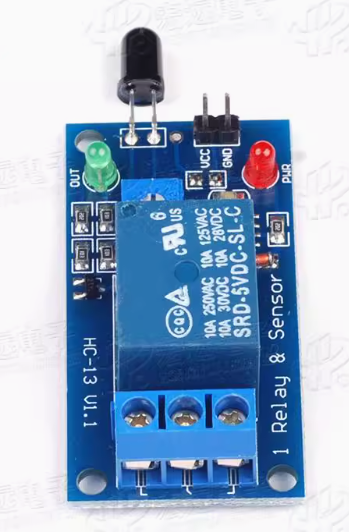
Description
The 5V Flame Detection & Relay Control Module is an all-in-one fire detection and response solution that combines an infrared flame sensor with a powerful relay output on a single compact board. Unlike separate sensor and relay modules that require additional wiring and programming, this integrated module provides a complete “detect and act” system — when a flame is detected, the relay automatically activates, allowing you to directly control alarms, water sprinklers, exhaust fans, or any other high-power AC or DC equipment.
The module uses an infrared-sensitive phototransistor that detects flames and light sources within the 760nm to 1100nm wavelength range — the typical spectral signature of open flames from hydrocarbon fuels such as gas, oil, candles, and lighters. It can reliably detect a lighter flame from up to 80cm (31 inches) away, with larger flames detectable at even greater distances. The detection angle is approximately 60 degrees, providing a useful field of view for monitoring an area.
Key features include an onboard LM393 comparator with a blue potentiometer for adjustable sensitivity, allowing you to set the exact flame intensity threshold that triggers the relay. The relay provides SPDT (Single Pole Double Throw) contacts rated for 10A at 250V AC or 30V DC, making it capable of switching most common loads directly without external contactors.
This module is ideal for fire alarm systems, kitchen fire suppression, industrial safety monitoring, educational robotics, and any application where automatic response to flame presence is required. It operates directly from a 5V power supply (USB, Arduino, or dedicated adapter) and requires no microcontroller for basic operation — though it can easily be interfaced with one if more complex logic is needed.
Features
-
Integrated flame sensor and relay on a single PCB
-
Detects flame wavelengths: 760nm – 1100nm (infrared range)
-
Detection distance: up to 80cm for lighter flame (larger flames detectable further)
-
Detection angle: approximately 60 degrees
-
Adjustable sensitivity via onboard blue potentiometer
-
Onboard LM393 comparator for reliable threshold detection
-
Relay directly triggered by comparator output (no MCU required)
-
SPDT relay contacts: NO (Normally Open), NC (Normally Closed), COM (Common)
-
LED indicator shows relay activation status
-
Compact size with mounting holes for easy installation
-
Screw terminal blocks for convenient wiring
Technical Parameters
Usage Guide
1. Module Overview
The board has two main sections:
-
Flame Sensor Section: Contains the IR phototransistor (looks like an LED, often clear or black), LM393 comparator, and blue potentiometer for sensitivity adjustment.
-
Relay Section: Contains the 5V relay, indicator LED, and three screw terminals (COM, NO, NC).
2. Wiring Instructions
For basic fire alarm operation (load ON when flame detected):
For normally-on operation (load OFF when flame detected):
3. Sensitivity Adjustment
The blue potentiometer on the board adjusts the flame intensity threshold:
Tip: Test with a lighter (keep at least 30cm distance for safety). Adjust until the relay activates reliably at your desired flame distance. Do not hold the lighter too close to the sensor — high heat can damage it.
4. Using Without a Microcontroller (Standalone Mode)
The module works entirely on its own with just a 5V power supply:
-
Connect 5V and GND to a USB charger, battery pack, or 5V adapter
-
Connect your alarm or load to the relay terminals (COM and NO)
-
Adjust sensitivity with the potentiometer
-
When a flame is detected, the relay clicks ON and the LED lights
No programming required!
5. Using With a Microcontroller (Arduino, ESP32, etc.)
The module also provides a digital output (often labeled DO or OUT) that goes LOW when a flame is detected. This can be connected to any digital input pin on your microcontroller for custom logic.
Arduino Connection:
Sample Arduino Code:
int flamePin = 7;
int buzzerPin = 9;
void setup() {
pinMode(flamePin, INPUT);
pinMode(buzzerPin, OUTPUT);
Serial.begin(9600);
Serial.println("Flame Detection System Ready");
}
void loop() {
int flameDetected = digitalRead(flamePin);
if (flameDetected == LOW) {
Serial.println("!!! FLAME DETECTED !!!");
digitalWrite(buzzerPin, HIGH);
delay(200);
digitalWrite(buzzerPin, LOW);
delay(200);
} else {
digitalWrite(buzzerPin, LOW);
}
delay(100);
}
Note: Output logic polarity may vary by manufacturer — test to confirm if flame detection gives HIGH or LOW signal.
6. Important Notes
-
Keep the sensor at a safe distance from the flame — high temperatures can permanently damage the IR phototransistor. The recommended minimum distance for testing with a lighter is 30-40cm.
-
The sensor also responds to sunlight and other infrared sources (heaters, incandescent bulbs). For indoor fire detection, position the sensor away from windows or direct sunlight.
-
The detection range depends on flame size — a candle flame may be detected at ~50cm, while a larger fire can be detected from several meters away.
-
For critical fire safety applications, use multiple modules for redundancy and combine with other detection methods (smoke, heat, gas).
Q: What types of flames can this module detect?
The module detects flames from hydrocarbon-based fuels — including natural gas, propane, butane (lighters), gasoline, oil, candles, wood fires, and alcohol flames. It detects the infrared radiation (760nm–1100nm wavelength) emitted by these flames.
Q: How far can it detect a flame?
-
Lighter flame: Approximately 80cm (31 inches)
-
Candle flame: Approximately 50-70cm (20-28 inches)
-
Larger fire: Several meters — the larger the flame, the farther the detection distance
The exact distance depends on flame intensity, ambient light conditions, and sensitivity setting.
Q: Does it detect sunlight or artificial light?
Yes, the sensor will respond to strong infrared sources including:
-
Direct sunlight (especially midday sun)
-
Incandescent light bulbs (halogen, standard bulbs)
-
Heat lamps and infrared heaters
For this reason, the module is best suited for enclosed or indoor installations away from direct sunlight. In outdoor applications, consider shielding the sensor or using it only at night.
Q: Can I adjust the sensitivity? How?
Yes. The onboard blue potentiometer adjusts the detection threshold:
Adjust while testing with a flame (at a safe distance) until the relay activates reliably at your desired distance.
Q: Does this module need a microcontroller to work?
The module works in standalone mode with just a 5V power supply. When a flame is detected, the relay automatically activates — you can directly connect an alarm, siren, or other load to the relay terminals. This makes it perfect for simple fire alarm systems without programming.
Q: What loads can I control with the relay?
The relay is rated for 10A at 250V AC or 10A at 30V DC — sufficient for most common loads:
For inductive loads (motors, pumps, solenoids), we recommend derating to ≤5A or adding external snubber protection.
Q: Why is my module triggering randomly or too easily?
Possible causes:
-
Sunlight or IR sources in the detection area — reposition the sensor or shield it
-
Sensitivity too high — turn the potentiometer clockwise to reduce sensitivity
-
Reflective surfaces — flames reflecting off walls can cause false triggers
-
Electrical noise — ensure stable 5V power (use a regulated supply)
Q: Why isn't my module detecting flames at all?
Troubleshooting steps:
-
Check power — ensure 5V is present (measure with multimeter)
-
Check sensitivity — turn potentiometer counter-clockwise for higher sensitivity
-
Check flame distance — move flame closer (but keep safe distance of ~30cm)
-
Check ambient light — bright sunlight can saturate the sensor; test in darker conditions
-
Check relay indicator LED — if LED lights but load doesn’t work, check load wiring
Q: Can I use this module with a 3.3V microcontroller (ESP32, Raspberry Pi Pico)?
The module’s power (VCC) must be 5V. However, the digital output (DO) level is typically 5V as well. For direct connection to a 3.3V microcontroller:
-
Option 1: Use a voltage divider (two resistors) to drop 5V to 3.3V
-
Option 2: Use a level shifter module
-
Option 3: Use the relay output instead (isolated, no voltage issue)
Do NOT connect the 5V DO pin directly to a 3.3V input pin — this may damage the microcontroller.
Q: Can I use multiple flame detection modules together?
Yes. You can:
-
Connect multiple modules to a single microcontroller (each to a different digital input pin) for multi-point detection
-
Wire the relay outputs of multiple modules in parallel (with proper diode isolation) to trigger a single alarm from any module
-
Place modules in different locations (e.g., kitchen, garage, workshop) for whole-area coverage
Q: Is this module suitable for professional/commercial fire alarm systems?
This module is suitable for non-critical fire detection applications such as:
-
Workshop fire alerts
-
Kitchen fire suppression triggers (with proper testing)
-
Educational demonstrations
-
Laboratory safety monitoring
-
DIY home automation fire response
For life safety or certified commercial fire alarm systems, you must use professional UL/EN listed fire detection equipment. This module does not carry such certifications.
Q: Can I connect this directly to a water sprinkler system?
WARNING: While the relay can switch the solenoid valve of a water sprinkler system, we strongly recommend:
-
Using a secondary safety interlock (manual shut-off, pressure switch)
-
Installing a separate fire-rated controller for life safety applications
-
Consulting local fire safety codes before installation
This module is best suited for alarm and notification applications rather than direct fire suppression control.
Q: What happens if power is lost?
The module requires 5V power to operate. If power is lost, the flame detection and relay control will not function. For critical applications, we recommend:
-
Using a UPS (Uninterruptible Power Supply) or battery backup
-
Using a fail-safe configuration (e.g., NC relay connection that opens on power loss — but note this won’t detect flames without power)
Q: How do I mount the module?
The PCB has two mounting holes (approximately 3mm diameter) for screw mounting. We recommend mounting on a non-conductive surface with:
-
M3 nylon screws and standoffs (to prevent short circuits)
-
A protective enclosure if used in dusty or humid environments
-
The flame sensor pointed toward the area to be monitored
Q: What is the response time when a flame is detected?
The response time is typically under 1 second — fast enough for most fire alert applications. The exact response time depends on sensitivity setting and flame intensity.
Q: Can this module detect fire through smoke or glass?
-
Through smoke: Partial — smoke can attenuate the infrared signal, reducing detection distance. For smoky fires, we recommend combining with a smoke detector.
-
Through glass: Very poor — standard glass blocks most infrared radiation. Do not mount behind glass windows or enclosures.
Q: What is the lifespan of the relay?
The relay is rated for approximately 100,000 switching cycles at rated load. In a typical fire alarm application where the relay activates only during actual fire events (rarely), the lifespan is essentially the lifetime of the module. For testing, keep test cycles to a minimum.
Q: Is this module RoHS compliant?
This varies by manufacturer. Please check the product packaging or contact us for specific compliance documentation for your batch.