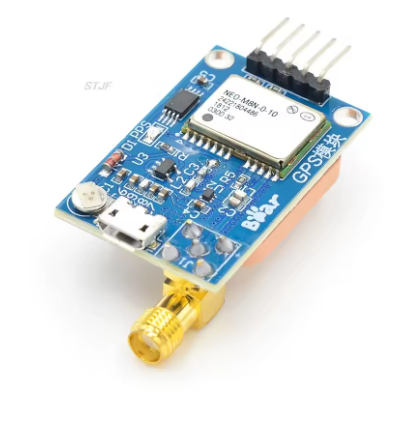
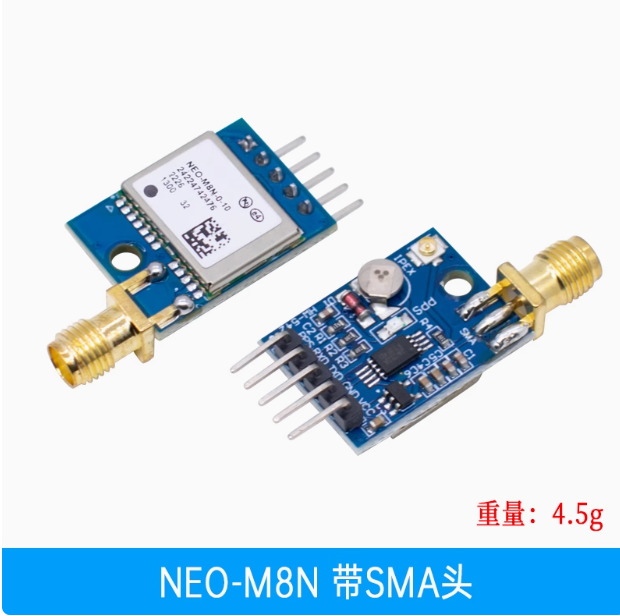
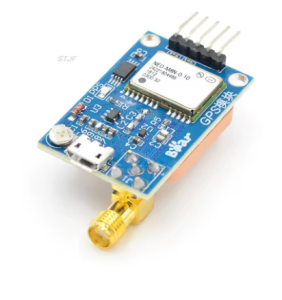
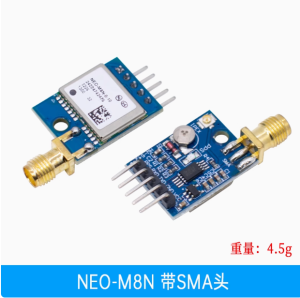
GY-NEO-8M V2 Flight Controller GPS Module with EEPROM – Compatible with MWC & APM2.5 – Onboard Ceramic Antenna

SKU: FA2172-2
GPS Chipset

u-blox NEO-8M / NEO-M8N (72-channel)

Supported GNSS

GPS L1C/A, GLONASS L1OF, BeiDou B1, Galileo E1B/C, QZSS L1C/A, SBAS

Operating Voltage

3V – 5V DC

Default Baud Rate

9600 bps (configurable: 4800 – 115200 bps)

Communication Interface

UART TTL (TX/RX)

Tracking Sensitivity

-167 dBm

Position Accuracy

2.0m – 2.5m CEP

Update Rate

Up to 5Hz – 10Hz (configurable)

Cold Start Time

<27 seconds (typical)

Warm Start Time

<28 seconds (typical)

Hot Start Time

<1 second (typical)

Antenna Type

25mm × 25mm active ceramic patch + SMA external antenna connector

Module Dimensions

25mm × 35mm (approx.)

Mounting Holes

3mm diameter

Operating Temperature

-40°C to +85°C

Description

The GY-NEO-8M V2 represents the latest generation of high-performance GNSS (Global Navigation Satellite System) modules, built around the advanced u-blox NEO-8M / NEO-M8N chipset. As the successor to the NEO-6M and NEO-7M series, this module delivers superior positioning accuracy, faster satellite acquisition, and support for multiple global navigation constellations simultaneously .

The heart of this module is the 72-channel u-blox M8 engine capable of concurrently tracking GPS, GLONASS, BeiDou, Galileo, QZSS, and SBAS (WAAS/EGNOS/MSAS) satellite systems . This multi-GNSS capability provides a significantly larger pool of visible satellites compared to GPS-only modules, resulting in faster time-to-first-fix, improved positional accuracy, and more reliable performance in challenging environments such as urban canyons, dense tree cover, or deep valleys.

The module features a high-gain 25mm × 25mm active ceramic patch antenna that provides excellent signal reception with tracking sensitivity down to -167 dBm, ensuring reliable lock even in weak signal conditions . For users requiring even greater signal quality or remote antenna placement, an SMA connector is provided for connecting an external active antenna.

Key onboard features include EEPROM memory for permanent storage of all configuration parameters (baud rate, update rate, NMEA message settings) — your custom settings are retained even after power loss. A rechargeable backup battery maintains the real-time clock and ephemeris data, enabling hot starts with a time-to-first-fix as low as 1 second .

Operating from a wide 3V to 5V DC input with onboard voltage regulation, the GY-NEO-8M V2 is compatible with both 3.3V and 5V logic systems. It provides UART TTL serial communication at a configurable baud rate (default 9600bps), making it plug-and-play compatible with Arduino, ESP32, STM32, Raspberry Pi, and popular flight controllers including MWC (MultiWii) and APM 2.5/2.6 .

The bright LED signal indicator provides immediate visual feedback of GNSS fix status — regular blinking confirms a successful 3D satellite lock. For advanced users, the module can be configured using u-blox u-center software via a USB-to-TTL adapter, allowing detailed performance monitoring and parameter customization.

Whether you are building a drone with position-hold and return-to-home, a fleet tracking system, an autonomous robot, or an IoT location-aware device, the GY-NEO-8M V2 offers the multi-GNSS performance, configuration persistence, and integration ease required for both hobbyist and professional applications .

Key Features

  • Multi-GNSS Support – 72-channel u-blox M8 engine concurrently tracks GPS, GLONASS, BeiDou, Galileo, QZSS, and SBAS for superior accuracy and reliability 

  • Upgraded Chipset – Next-generation NEO-8M/M8N design with backward compatibility to NEO-7 and NEO-6 families for easy migration 

  • High Sensitivity – -167 dBm navigation sensitivity for reliable operation in weak signal environments 

  • Onboard Ceramic Antenna – 25mm × 25mm active patch antenna provides excellent signal reception

  • SMA Antenna Connector – Allows connection of an external active antenna for extended signal range

  • EEPROM Configuration Memory – Permanently saves all user settings (baud rate, update rate, message configuration) even after power loss 

  • Rechargeable Backup Battery – Maintains RTC and ephemeris data for hot starts (<1s TTFF) 

  • Wide Voltage Compatibility – Operates from 3V to 5V DC with onboard regulation; compatible with 3.3V and 5V logic systems

  • Configurable Update Rate – Supports up to 5Hz to 10Hz position update rate for real-time tracking applications 

  • LED Signal Indicator – Provides real-time visual confirmation of satellite fix status

  • Internal Flash Memory – Supports firmware updates for future GNSS system upgrades (on M8N variants) 

  • Compact Form Factor – 25mm × 35mm module with 3mm mounting holes for easy integration 

Technical Specifications 

Specification Value
GPS Chipset u-blox NEO-8M / NEO-M8N (72-channel)
Supported GNSS GPS L1C/A, GLONASS L1OF, BeiDou B1, Galileo E1B/C, QZSS L1C/A, SBAS 
Operating Voltage 3V – 5V DC 
Default Baud Rate 9600 bps (configurable: 4800 – 115200 bps) 
Communication Interface UART TTL (TX/RX)
Tracking Sensitivity -167 dBm 
Position Accuracy 2.0m – 2.5m CEP 
Update Rate Up to 5Hz – 10Hz (configurable) 
Cold Start Time <27 seconds (typical) 
Warm Start Time <28 seconds (typical)
Hot Start Time <1 second (typical) 
Antenna Type 25mm × 25mm active ceramic patch + SMA external antenna connector 
Module Dimensions 25mm × 35mm (approx.) 
Mounting Holes 3mm diameter 
Operating Temperature -40°C to +85°C

Pinout Description

Pin Function
VCC Power input (3V – 5V DC)
GND Ground connection
TX Serial data output (connect to RX of microcontroller)
RX Serial data input (connect to TX of microcontroller)
PPS Pulse-per-second timing output (optional)

Typical Usage

  • Drone & UAV Navigation – Provides position data for GPS hold, waypoint navigation, return-to-home, and autonomous flight modes

  • Flight Controller Integration – Directly compatible with MWC (MultiWii), APM 2.5/2.6, Pixhawk, and ArduPilot systems 

  • Vehicle Tracking Systems – Real-time GPS/GLONASS tracking for fleet management, asset tracking, and stolen vehicle recovery 

  • Autonomous Robots & Rovers – Enable outdoor navigation, path planning, and geofencing for agricultural and industrial robots 

  • Precision Agriculture – Field mapping, autonomous tractor guidance, and crop monitoring applications 

  • IoT Location-Aware Devices – Add multi-GNSS positioning to weather stations, environmental monitors, and remote sensors

  • Marine & Hiking Navigation – Handheld GPS devices for boating, hiking, and geographic surveys

  • School Bus & Fleet Safety Systems – Real-time location tracking with notification systems for student safety 

  • Data Logging – Record position, speed, altitude, and satellite data for post-mission analysis

  • Timing & Synchronization – Precision timing applications using PPS output

Basic Wiring Example (Arduino)

GY-NEO-8M V2 Pin Arduino Connection
VCC 5V
GND GND
TX Digital Pin 4 (RX)
RX Digital Pin 3 (TX)

Note: The module requires a clear view of the sky for initial satellite acquisition. For ESP32 users, using hardware serial (UART1/UART2) rather than SoftwareSerial is recommended for reliable data reception at higher baud rates .

Q: What is the difference between GY-NEO-8M V2 and GY-NEO-6M/7M V2?

The GY-NEO-8M V2 features the advanced u-blox M8 chipset (72-channel) with support for four GNSS constellations (GPS + GLONASS + BeiDou + Galileo + QZSS), whereas NEO-6M supports GPS only and NEO-7M supports GPS + GLONASS. The 8M also offers higher sensitivity (-167 dBm), faster update rates (up to 10Hz), and BeiDou compatibility — making it significantly more accurate and reliable in challenging environments .

Q: Does this module support BeiDou (Chinese GPS)?

Yes. The 72-channel u-blox M8 engine supports BeiDou B1 navigation system concurrently with GPS, GLONASS, and Galileo . This is a key upgrade from the NEO-7M series and provides superior satellite availability in Asia and other regions.

Q: What is the difference between NEO-8M and NEO-M8N?

The NEO-8M series includes multiple variants. The NEO-M8N includes internal Flash memory that allows firmware updates for future GNSS system upgrades and supports higher update rates. The NEO-M8M is optimized for cost-sensitive applications. The GY-NEO-8M V2 typically ships with the NEO-M8N or M8M variant .

Q: Can I use this module with ESP32?

Yes. The module operates on 3V to 5V, so you can power it directly from the ESP32’s 3.3V or 5V pin. For best performance, use the ESP32’s hardware serial ports (UART1 or UART2) rather than SoftwareSerial to avoid data loss, especially when using higher baud rates (e.g., 38400bps) .

Q: Why does the LED on my module keep blinking without stopping?

The LED indicator blinks when the module has acquired a GNSS fix (satellite lock). A steady or non-blinking LED indicates no fix. Once you have a fix, the LED will blink at regular intervals. If you cannot get a fix, ensure the module has a clear view of the sky (ceramic antenna facing upward) and allow 5-15 minutes for initial acquisition .

Q: What is the EEPROM used for?

The built-in EEPROM stores your configuration settings (such as baud rate, update rate, and NMEA message configuration). These settings are retained even after power loss, so you don’t need to reconfigure the module every time you power it on. Some vendors may pre-configure modules (e.g., for 38400 baud for APM compatibility) .

Q: How long does the backup battery last?

The rechargeable backup battery maintains the RTC and ephemeris data for several days to a few weeks when the module is powered off, depending on the specific battery and storage conditions. The battery recharges automatically when the module is powered on. This enables hot starts (<1 second) when power is restored .

Q: What is the maximum baud rate I can use?

The module can be configured for baud rates from 4800 bps to 115200 bps. The default setting is 9600 bps. For higher update rates (e.g., 5Hz or 10Hz), you should increase the baud rate to at least 38400 bps to handle the increased data throughput .

Q: Is an external antenna required or optional?

No external antenna is required for normal operation. The GY-NEO-8M V2 includes a built-in 25mm × 25mm ceramic patch antenna that provides excellent signal reception for most applications. However, if you need to mount the module inside an enclosure or in a location with poor sky visibility, you can connect an external active antenna to the SMA connector for improved signal quality .

Q: Can this module be used for automotive or industrial applications?

Yes. The NEO-M8N is qualified according to AEC-Q100 and manufactured in ISO/TS 16949 certified sites, making it suitable for automotive applications . The operating temperature range of -40°C to +85°C ensures reliable performance in vehicle and industrial environments. Typical applications include fleet management, stolen vehicle recovery, autonomous vehicles, and precision timing systems .