Product Overview
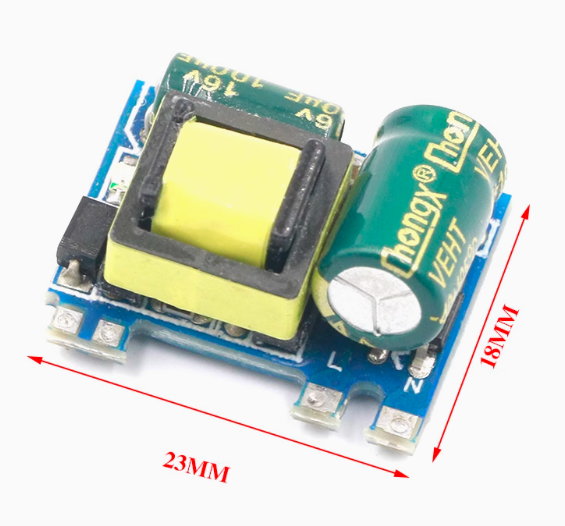
The 12V 300mA 3.5W Switching Power Supply Module is a compact, high-efficiency AC-DC converter designed to power your microcontroller projects, embedded systems, and industrial devices directly from a wall outlet. Rated at 3.5 Watts (12V @ 300mA), this tiny module eliminates the need for bulky power bricks by converting hazardous AC mains voltage (85V–265V) into a stable, regulated 12V DC output .
This module is a perfect solution for powering relays, solenoid valves, LED strips, wireless modules, Arduino, ESP32, STM32, and various sensors . Unlike traditional linear transformers that are heavy and inefficient, this switching mode power supply (SMPS) achieves up to 80% efficiency while staying cool, thanks to its modern flyback topology .
Because the module uses a high-frequency transformer and complies with international isolation standards, it provides complete electrical isolation between the dangerous high-voltage AC input and the low-voltage DC output . This ensures the safety of both your sensitive electronics and the person handling the equipment. Its encapsulated design protects against dust and moisture, making it ideal for integration into home appliances, automation panels, and commercial electronic products .
Key Features
-
High Efficiency: Converts AC power with approximately 80% efficiency (up to 85% in some variants), minimizing energy waste and heat generation .
-
Wide Universal Input Voltage: Accepts AC 50V ~ 277V (or 85–265V) or DC 70V ~ 390V, making it compatible with global mains standards (110V, 220V, 240V) without any jumper settings .
-
Compact Isolated Design: Features a built-in high-frequency transformer that provides 1500V to 2500V galvanic isolation between the hazardous AC input and the low-voltage DC output, ensuring user safety .
-
Full Protection Suite: Built-in overvoltage, overcurrent, overtemperature, overload, and short-circuit (SCP) protection prevent damage to the power supply and your devices during fault conditions .
-
Low Ripple and Noise: With a 50% load ripple of just 100mV, it provides clean, stable DC power suitable for sensitive analog circuits and microcontrollers .
-
Sufficient 300mA Capacity: Provides a steady 12V output with 300mA continuous current (Max 3.5W). This is enough to power low-power industrial controllers, relays, LED indicators, and most non-motorized IoT devices .
-
Low Power Consumption: Features a minimal no-load power consumption of < 0.05W, making it highly efficient even when idle .
-
PCB Mount Design: Features standard through-hole pins (2.54mm pitch) for easy soldering directly onto a printed circuit board (PCB), making it ideal for high-volume production and permanent installations .
-
Excellent Durability: Utilizes high-quality capacitors rated for 105°C operation with a 10,000-hour lifespan, ensuring a long service life (rated 5+ years at 70°C) .
-
Parallel Operation Support: Multiple modules can be used in parallel to satisfy higher current requirements in tight spaces .
Technical Specifications
Pinout & Connection Guide
The module uses a standard pin arrangement for easy breadboard or PCB wiring. Always verify the specific labeling on your module before connecting power.
AC Input Side (Primary / High Voltage)
DC Output Side (Secondary / Low Voltage)
-
+ (Vout / +12V): Connect to the positive power rail of your load (e.g., relay module, LED strip).
-
– (GND / COM): Connect to the ground (GND) of your microcontroller and the return path of your load .
Wiring Warning: Ensure the AC wiring is properly insulated and kept physically separated from the DC output side to maintain isolation and prevent short circuits. It is highly recommended to add a fuse (e.g., 1A slow-blow) and a physical on/off switch in line with the L wire for safety during permanent installations .
Usage Guide
1. Safety First (Critical)
⚠️ This module deals with potentially lethal high voltage. Always ensure the device is UNPLUGGED during wiring. Do not touch any part of the AC side or the underside pins while the device is powered.
2. Mounting
-
For Prototyping: Solder female pin headers to the 4 main pins. You can then plug it into a breadboard or connect jumper wires.
-
For Permanent Installation: Solder the module directly to your custom PCB using the through-hole pins. The four corner mounting holes help prevent vibration damage .
3. Connect AC Input
4. Connect DC Load
5. Test the Output
-
Before connecting expensive components, plug the module into a standard AC outlet (110V or 220V).
-
Use a multimeter to verify the output voltage is within 12V (±0.5V) .
Application Note: Adding Extra Filtering
Because this module operates at a high switching frequency, it may introduce high-frequency noise (ripple) into the DC output. For powering sensitive analog circuits (like audio preamps or high-resolution ADCs), consider adding a low-ESR filter capacitor (e.g., 100µF electrolytic in parallel with a 0.1µF ceramic) across the output terminals to reduce ripple further.
Q: Can I use this module to power a 12V Relay or Solenoid directly?
Yes, absolutely. This module is an excellent choice for powering industrial relays, small solenoid valves, and other 12V actuators. Just ensure the load does not exceed the 300mA continuous current rating .
Q: How many devices can I power with 300mA?
300mA is sufficient for a single 12V relay coil (approx. 20-80mA), a small 5W LED strip segment, or a low-power sensor network. It is generally sufficient for non-motorized, low-power projects .
Q: Is this module truly isolated? Is it safe to touch the output wires?
Yes and Yes. This module uses a high-frequency transformer to provide galvanic isolation between the input AC mains and the output DC voltage. Because they are separated, touching the 12V output wires is safe (although you should never touch the AC input side) .
Q: The specification says 300mA, but it is labeled 3.5W. Does that match?
Yes, perfectly. Power (Watts) = Volts (12V) × Current (Amps). 12V × 0.3A = 3.6 Watts. The 0.1W difference accounts for a tiny safety margin and the module’s conversion efficiency .
Q: Can I use this module to charge a 12V Lead-Acid or Lithium battery?
No, not directly. This is a Constant Voltage (CV) power supply. A 12V battery requires a precise Constant Current/Constant Voltage (CC/CV) charging profile. Using this directly could over-current and damage the battery. You must use a dedicated battery charger module between this power supply and your battery.
Q: The module gets warm. Is this normal?
Yes. At near-maximum load (300mA), the module will generate some heat due to the 20% inefficiency (resulting in about 0.7W of heat). This is normal. However, if it is too hot to touch, ensure there is adequate airflow and that you are not exceeding the 300mA limit .
Q: Can I use a 12V DC input to power this "AC-DC" module?
No, not at all. This module is designed specifically for AC Mains voltage. The internal high-frequency transformer expects a rectified high voltage (approx. 120V-350V DC). Applying 12V DC will not be enough to start the control IC, and the module will not function.
Q: Does this module require external components to work?
It is a standalone power supply. It does not require any external capacitors or resistors to provide a stable 12V output. You simply connect the AC input and DC output, and it works. Adding a fuse and switch on the AC line is recommended for safety, but not required for basic operation .
Q: Why is my multimeter reading slightly less than 12.00V?
The specification allows a tolerance of ±0.2V to ±0.5V (11.5V – 12.5V) . This slight variation is standard for simple switch-mode supplies and is well within the operating limits of all 12V electronics.
Q: Can I use multiple modules in parallel for more current?
Yes. These modules are specifically designed to be used in parallel to increase the total available current. You can wire multiple modules’ inputs together and their outputs together to achieve higher power (e.g., 2 modules in parallel give 12V 600mA) .