Description
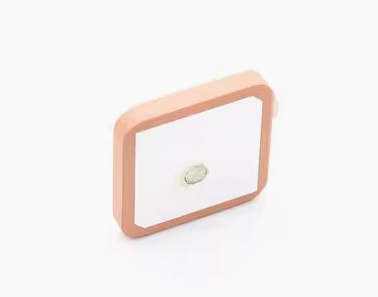
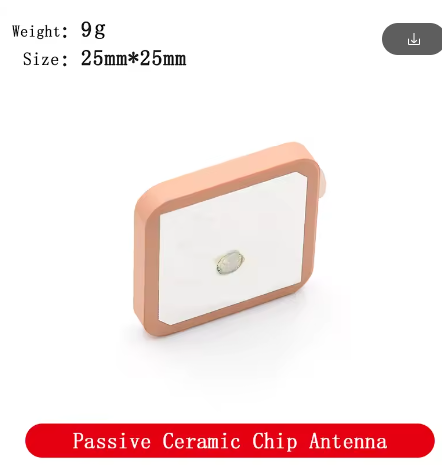
The 25×25mm Square GPS BeiDou Passive Antenna is a high-performance ceramic patch antenna designed for GNSS (Global Navigation Satellite System) applications requiring GPS and BeiDou compatibility. With its compact 25×25mm footprint and 4mm thickness, this passive antenna is ideal for integration into GPS modules, flight controllers, navigation devices, and other embedded systems where an external active antenna is not feasible or desired.
Unlike active antennas that include a built-in Low Noise Amplifier (LNA), this is a passive antenna — meaning it contains no amplifier and does not require external power. The antenna consists solely of a high-quality ceramic patch element precision-tuned to receive signals in the GPS L1 (1575.42 MHz) and BeiDou B1 (1561 MHz) frequency bands. This dual-band capability makes it suitable for multi-GNSS applications that utilize both the American GPS and Chinese BeiDou satellite constellations.
The antenna features Right-Hand Circular Polarization (RHCP) , which matches the signal polarization used by GNSS satellites, ensuring maximum energy transfer and optimal signal reception. With a compact 4mm thickness, this antenna is significantly thinner than many competing patch antennas, allowing for low-profile installations in space-constrained devices.
This passive antenna is commonly used as a direct replacement or upgrade for the ceramic patch antennas found on many GPS modules, including GY-NEO series modules with built-in antennas. It can also be used as an external passive antenna when mounted close to the receiver (within 30cm) due to the lack of an onboard amplifier.
Housed in a durable ceramic substrate with a protective coating, this antenna is suitable for indoor and protected outdoor applications. Whether you are repairing a damaged GPS module, building a custom GNSS receiver, or upgrading the antenna on a flight controller, this 25×25mm passive ceramic patch antenna delivers reliable, multi-constellation signal reception in a compact, low-profile package.
Key Features
-
Dual GNSS Band Support – Tuned for both GPS L1 (1575.42 MHz) and BeiDou B1 (1561 MHz) for multi-constellation compatibility
-
Passive Design – No amplifier, no power required; simple, reliable, and low-cost solution for close-coupled installations
-
Compact Square Form Factor – Standard 25×25mm footprint, compatible with most GPS module antenna mounting pads
-
Ultra-Thin Profile – Only 4mm thick, ideal for low-profile and space-constrained designs
-
High-Quality Ceramic Material – Precision-engineered ceramic patch for stable frequency response and high dielectric constant
-
Right-Hand Circular Polarization (RHCP) – Matches GNSS satellite signal polarization for maximum signal transfer
-
Low VSWR (≤1.5) – Excellent impedance matching to 50Ω, ensuring minimal signal reflection (≤4% power loss)
-
Wide Operating Temperature – -40°C to +85°C, suitable for automotive and outdoor applications
-
Lead-Free Tin Plating – Environmentally friendly, RoHS-compliant construction
-
Versatile Mounting – Can be soldered directly to PCB or mounted via adhesive and pin header connection
Technical Specifications
Q: What is the difference between a passive antenna and an active antenna?
A passive antenna (like this product) consists only of the radiating element (ceramic patch) with no amplifier. It requires no power and is suitable only when the antenna is placed very close to the GPS receiver (typically within 30cm). An active antenna includes a built-in Low Noise Amplifier (LNA), requires power (3V–5V), and can be placed meters away from the receiver. This product is a passive antenna.
Q: Will this antenna work with my GY-NEO-6M/7M/8M GPS module?
Yes, but with important caveats. This is a passive antenna, while the GY-NEO modules are typically designed for active antennas (they provide power for an external LNA). If you replace the onboard ceramic antenna on a GY-NEO module with this passive antenna, it will work because the module’s internal LNA will still amplify the signal. However, if you try to use this as an external antenna connected by a long cable, performance will be poor because there is no LNA to overcome cable losses. For external use with long cables, you need an active antenna.
Q: Can I use this antenna for GLONASS or Galileo?
This antenna is optimized for GPS L1 (1575.42 MHz) and BeiDou B1 (1561 MHz). GLONASS L1 (1602 MHz) is outside the specified frequency range, and performance will be reduced. For full multi-GNSS support including GLONASS and Galileo, we recommend a wideband antenna covering 1559–1610 MHz.
Q: Does this antenna require an external power supply?
No. This is a passive antenna with no amplifier, so it requires no power supply. This makes it ideal for applications where power is unavailable or where you want to minimize current consumption. However, the GPS receiver itself must still have its own LNA to amplify the weak signal from this antenna.
Q: How far can I place this antenna from my GPS receiver?
Because this is a passive antenna (no amplifier), it should be placed as close as possible to the GPS receiver — ideally directly on the same PCB or connected by a very short cable (under 30cm). For longer distances (over 30cm), cable losses will significantly degrade signal quality. For installations requiring longer cables (1–10 meters), you must use an active antenna with a built-in LNA.
Q: What is the advantage of the 4mm thickness compared to thicker antennas?
A 4mm thick ceramic patch is thinner than standard 6mm or 8mm patches, making it suitable for low-profile installations where vertical space is limited. However, thicker patches generally offer slightly better gain and bandwidth. The 4mm version offers a good balance between performance and profile height for most consumer applications.
Q: Can I solder this antenna directly to my PCB?
Yes. The antenna features lead-free tin-plated contacts that are suitable for soldering. Typical mounting involves soldering the antenna’s feed pin (center) and ground pins to corresponding pads on your PCB. Follow standard reflow or hand-soldering procedures for ceramic components (avoid excessive thermal shock). Consult the antenna’s datasheet for recommended land pattern dimensions.
Q: What is the difference between this antenna and the ceramic antenna already on my GY-NEO module?
The ceramic antenna on most GY-NEO modules is very similar — typically a 25×25mm square patch of similar or slightly thicker (6mm–8mm) construction. This antenna can be used as a direct replacement if the original antenna is damaged. The 4mm thickness may be slightly thinner than some original antennas, which could affect performance minimally, but it will generally work as a suitable replacement.
Q: Why is my GPS module not receiving any satellites with this antenna?
Check the following: (1) Ensure the antenna is properly soldered or connected — the feed pin and ground must be correctly attached. (2) The antenna must have a clear view of the sky — no metal objects above it. (3) Your GPS receiver must have its own Low Noise Amplifier (LNA) — a passive antenna cannot work with a receiver that lacks an internal LNA. (4) If using a cable longer than 30cm, the signal loss may be too high — use a shorter cable or switch to an active antenna.
Q: What is VSWR ≤ 1.5 and why does it matter?
VSWR (Voltage Standing Wave Ratio) measures how well the antenna’s impedance matches the receiver’s 50Ω standard. A VSWR of 1.5 means approximately 96% of the received signal power is transferred to the receiver, with only 4% reflected back as loss. Lower VSWR is better. A VSWR of 1.5 or less is considered excellent for GNSS patch antennas and indicates good design and manufacturing quality.