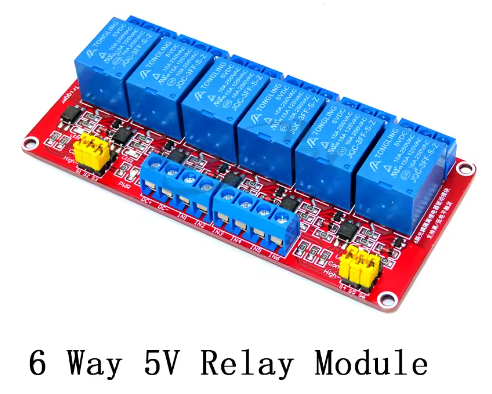
Dual-Trigger 6CH 5V Relay Shield with Optical Isolation (High/Low Level)

SKU: FA2085-0-1
Board Format

Arduino Shield (Uno/Mega compatible)

Number of Channels

6

Control Voltage

5V DC (from Arduino 5V pin)

Trigger Logic

High or Low Level (individually selectable per channel)

Isolation

Optical Isolation (2500Vrms)

Relay Contact Rating

10A @ 250VAC / 10A @ 30VDC

Contact Type

SPDT (COM, NO, NC)

Dimensions

Standard Arduino Shield size (~69mm x 54mm)
Product Description

The Dual-Trigger 6CH 5V Relay Shield is a professional-grade, Arduino-compatible expansion board engineered for maximum flexibility and robust control in demanding electronic projects. Unlike standard relay modules, this shield integrates directly onto the pin headers of popular Arduino boards (Uno, Mega, Leonardo), creating a compact, stackable, and highly integrated control unit. Its defining feature is the dual-trigger capability with optical isolation, allowing each of its six channels to be independently configured for either high-level or low-level activation via simple solder jumpers. This provides unparalleled compatibility with any control logic, from simple microcontroller outputs to industrial PLC signals.
Each channel is protected by advanced optocoupler isolation, which creates a complete electrical barrier between your sensitive Arduino and the high-power load circuits. This prevents damaging voltage spikes, ground loops, and electrical noise from interfering with the microcontroller’s operation. The shield combines the convenience of a plug-and-play form factor with industrial-grade features, making it the ideal choice for developing reliable prototypes, educational kits, and final products in home automation, industrial control, and IoT applications where signal integrity and flexible control logic are paramount.

Key Features

  • Arduino Shield Form Factor:​ Directly plugs onto standard Arduino boards (Uno, Mega), saving space and eliminating messy wiring for control signals and power.
  • Dual-Trigger Logic per Channel:​ Each of the six relays can be independently configured for High-Level (active-HIGH) or Low-Level (active-LOW) trigger via onboard solder jumpers.
  • Full Optical Isolation:​ Integrated optocouplers on all channels provide 2500Vrms isolation, protecting your Arduino from high-voltage transients and electrical noise on the load side.
  • Six High-Current Relays:​ Features six industrial-quality electromagnetic relays with SPDT contacts, capable of switching both AC and DC loads.
  • Stackable Design:​ Includes pass-through female headers, allowing you to stack other shields (e.g., Ethernet, display) on top for more complex projects.
  • Wide Load Compatibility:​ Relay outputs are rated for high-current AC and DC loads, with screw terminals for secure and safe load connections.
  • Visual Status Indicators:​ Bright LEDs for both relay coil status and optocoupler activation provide clear feedback for each channel.
  • Integrated Protection:​ Includes flyback diodes across each relay coil to suppress voltage spikes and protect the driving circuitry.

Main Parameters

  • Board Format:​ Arduino Shield (Uno/Mega compatible)
  • Number of Channels:​ 6
  • Control Voltage:​ 5V DC (from Arduino 5V pin)
  • Trigger Logic:​ High or Low Level (individually selectable per channel)
  • Isolation:​ Optical Isolation (2500Vrms)
  • Relay Contact Rating:​ 10A @ 250VAC / 10A @ 30VDC
  • Contact Type:​ SPDT (COM, NO, NC)
  • Dimensions:​ Standard Arduino Shield size (~69mm x 54mm)

Typical Applications / Usage

  1. Advanced Arduino Prototyping:​ The ultimate tool for engineering students and professionals developing sophisticated Arduino-based controllers for automation, robotics, or IoT.
  2. All-in-One Automation Hub:​ Create a central, compact control unit for smart homes by stacking a Wi-Fi shield on top, allowing remote control of up to six appliances.
  3. Educational Training Kits:​ Perfect for teaching industrial control concepts, logic types, and electrical isolation in university labs or technical workshops.
  4. Industrial Controller Interface:​ Use the Arduino+Shield as a programmable logic controller (PLC) substitute to interface with sensors and control motors, solenoids, or lights in machinery.
  5. Exhibition & Interactive Displays:​ Build reliable, integrated controllers for museum exhibits, trade show booths, or art installations requiring robust multi-channel control.
  6. Custom Test Equipment:​ Develop bespoke test rigs or environmental chambers where an Arduino handles logic and data logging, and the shield controls the devices under test.
Implementation Guide:
  1. Configuration:​ Use a soldering iron to bridge the solder jumper pads for each channel to select either HIGH​ (bridge the two pads marked “H”) or LOW​ (bridge the pads marked “L”) trigger mode.
  2. Mounting:​ Simply plug the shield directly onto the headers of your Arduino Uno, Mega, or compatible board. Ensure proper alignment.
  3. Power:​ The shield draws power for the relay coils and optocouplers directly from the Arduino’s 5V and GND pins. Ensure your Arduino’s power supply (USB or barrel jack) can provide enough current (approx. 500mA for all relays on).
  4. Load Wiring:​ Connect your high-power load (AC or DC) to the screw terminals for the desired channel: power source to COM, and the device to NO​ (Normally Open) or NC​ (Normally Closed).
  5. Programming:​ In your Arduino sketch, set the corresponding digital pin (pins 2-7 are typical) to HIGH​ or LOW​ based on your chosen trigger mode to control the relay.
Q: What is the advantage of the "Dual-Trigger" feature?

It provides maximum flexibility. You can mix and match trigger types in a single project. For example, you can have three relays activated by a HIGH signal (for sensors that output 5V) and three activated by a LOW signal (for modules that sink to ground), all on the same board, without needing external circuitry.

Q: Do I need an external power supply for the relays, or does the Arduino power them?

The shield is designed to be powered by the Arduino’s 5V pin. However, activating all six relay coils simultaneously can draw close to 500mA, which may exceed the capacity of a standard USB port (500mA) or a weak power supply. For reliable operation with all relays active, power your Arduino via the barrel jack with a 7-12V, 1A+ adapter.

Q: How is this shield different from a regular 6-channel relay module?

The key differences are the direct plug-in form factor, individual optical isolation per channel, and per-channel trigger selection. A regular module requires separate wiring for all control pins and power, and typically has a fixed trigger logic for all channels.

Q: My project uses 3.3V logic boards (like ESP32 or Raspberry Pi Pico). Is this shield compatible?

The shield is designed for 5V logic. A 3.3V HIGH signal may not be sufficient to reliably trigger the optocouplers. For 3.3V boards, it is recommended to use a logic level converter between the GPIO pins and the shield’s signal inputs, or seek a shield specifically designed for 3.3V logic.

Q: What are the solder jumpers for, and do I have to solder them?

The solder jumpers are how you configure the trigger logic for each relay channel. You must solder-bridge the pair of pads for the mode (H or L) you want for each channel. This is a one-time configuration that makes the setting permanent and reliable.

Q: Can I still use the digital pins (like D0, D1, A4, A5) that are under the shield?

Yes, via the pass-through headers.​ The shield includes female headers that pass all the Arduino pins through, allowing you to access them from the top of the shield. You can use jumper wires to connect to them or stack another compatible shield.

Q: The relay contacts are rated for 10A. Can I control a 2000W heater?

No, not directly.​ At 240VAC, 10A is 2400W, but it’s at the absolute maximum limit. For safety, reliability, and to avoid overheating the relay contacts, it is strongly advised​ to use this shield to control the coil of a higher-rated contactor​ for any continuous high-power load like a heater.

Q: Is this shield suitable for final product integration or just prototyping?

While excellent for prototyping, its industrial features (optical isolation, screw terminals, robust relays) also make it suitable for integration into low-to-medium volume commercial products, educational kits, or specialized equipment. For high-volume OEM, please contact us to discuss custom PCB solutions.