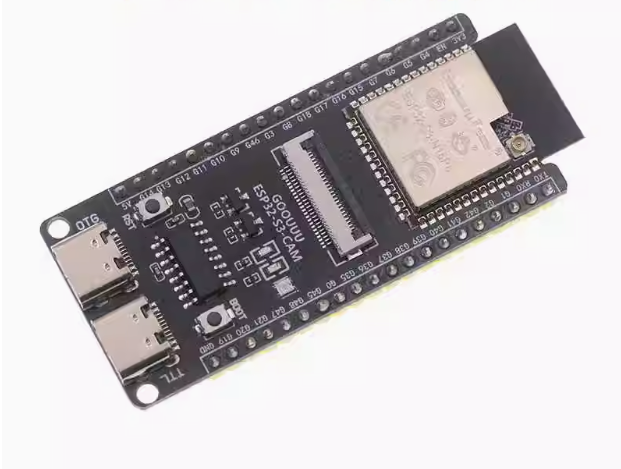
This high-performance Goouuu ESP32-S3-CAM is a professional-grade AI vision development platform. In 2025, this specific 42-pin variant is highly sought after by engineers for its expanded I/O and the high-speed N16R8 memory configuration. Featuring dual Type-C interfaces, it provides a seamless workflow for both programming and native USB device emulation.
Product Description
The Goouuu ESP32-S3-CAM N16R8 is an advanced evolution of the ESP32 camera series, built on the powerful Xtensa® LX7 dual-core processor. It is specifically optimized for Edge AI and high-resolution imaging. With 16MB of Flash and 8MB of Octal PSRAM, it can handle memory-intensive tasks like real-time facial recognition, voice processing, and high-definition video streaming without the “out-of-memory” errors common in standard boards.
The board features a unique 42-pin layout, breaking out more GPIOs than standard DevKit models, making it ideal for projects that require a camera plus multiple sensors or displays. The dual Type-C interfaces serve two distinct purposes: one for stable UART debugging and the other for native USB OTG functionality (allowing the board to act as a USB webcam or HID device).
Key Features
- AI-Optimized Performance: The S3 core features specialized vector instructions designed to accelerate neural network inference and signal processing.
- Maximized Memory (N16R8): 16MB Flash and 8MB Octal PSRAM allow for high-speed buffering of 5MP images and large-scale AI models.
- Dual Type-C Design:
- UART Port: For rock-solid programming and serial data monitoring.
- Native Port: Direct S3 connection for USB OTG, UVC camera, or HID emulation.
- Expanded 42-Pin Header: Provides additional access to GPIOs, I2C, SPI, and PWM pins, ensuring you never run out of connections.
- Universal Camera Support: Includes a standard FPC camera header compatible with OV2640 (2MP) and OV5640 (5MP) modules.
- Integrated SD Card Slot: Most Goouuu models include an onboard MicroSD slot for local high-speed data and image logging.