HM-10 Bluetooth 4.0 BLE Module V3 – HC-06 Pinout Compatible, 6-Pin UART Wireless Transceiver for Arduino/Raspberry Pi

SKU: FA2043
Bluetooth Version

Bluetooth V4.0 BLE (Low Energy)

Working Frequency

2.4GHz ISM Band

Input Voltage (VCC)

3.6V to 6.0V DC

Logic Level (I/O)

3.3V / 5V TTL Compatible

Default Baud Rate

9600 bps

Modulation Method

GFSK (Gaussian Frequency Shift Keying)

Power Consumption

400µA~1.5mA (Sleep); 8.5mA (Active)

Transmission Range

Up to 60 meters (Open space/theoretical)

Dimensions

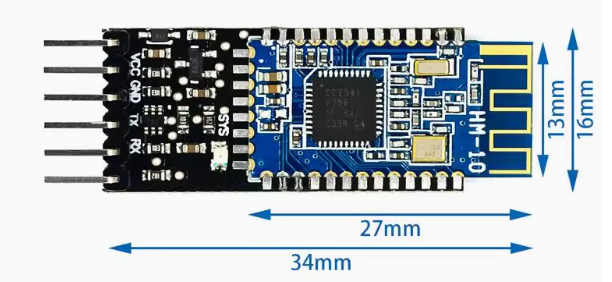
43mm x 16mm x 7mm (Standard 6-pin version)

Product Description
The HM-10 Bluetooth 4.0 BLE Module V3 is a high-performance, low-energy wireless transceiver designed for seamless data communication between microcontrollers and mobile devices. This “V3” iteration is specifically engineered with HC-06 pinout compatibility, making it an effortless “drop-in” upgrade for legacy projects that require a transition from Bluetooth Classic to modern Bluetooth Low Energy (BLE).
Built on the stable CC2541 chipset architecture, the HM-10 V3 offers superior power efficiency compared to older Bluetooth versions, significantly extending the battery life of portable electronics. Its transparent serial bridge functionality ensures that data sent via UART is instantly available on any connected iOS or Android device. With integrated level-shifting and a 6-pin baseboard, it provides a robust, “plug-and-play” solution for developers, educators, and industrial engineers alike.
Key Features
  • Legacy Compatibility: Features an HC-06 style pinout for easy hardware migration from Bluetooth 2.0 to 4.0 BLE.
  • Universal Mobile Support: Fully compatible with iOS (iPhone/iPad) and Android, enabling driverless app-to-hardware connectivity.
  • High Efficiency (BLE 4.0): Optimized for ultra-low power consumption, ideal for “always-on” sensor nodes and wearable technology.
  • Dual-Voltage Logic: Onboard level-shifting circuitry allows direct connection to both 3.3V and 5V microcontrollers (Arduino, Raspberry Pi, STM32).
  • Full AT Command Set: Easily configure device name, baud rate, and pairing passwords through standard serial commands while in an unpaired state.
  • Integrated Status LED: Provides real-time visual feedback on pairing status and system power.
Usage & Applications
  • Project Upgrades: Replace aging HC-06 modules with modern BLE technology without redesigning your PCB or wiring.
  • Industrial Data Acquisition: Wireless monitoring of sensors, meters, and diagnostic tools via tablets or smartphones.
  • Smart Home Automation: Implementation of Bluetooth-controlled lighting, smart locks, and environmental controllers.
  • Education & Prototyping: A reliable tool for students and hobbyists building Bluetooth-controlled robots and IoT devices
Q: Can I replace my HC-06 module directly with this HM-10 V3?

Yes. This version is designed with an HC-06 compatible pinout (VCC, GND, TXD, RXD, etc.), allowing you to swap the hardware. However, please note that BLE requires a BLE-compatible app on your smartphone, as it behaves differently than Bluetooth Classic

Q: Is it compatible with the latest iPhone/iOS versions?

Absolutely. The HM-10 V3 uses the Bluetooth 4.0 BLE protocol, which is the standard for iOS serial communication. Use a BLE Terminal app or your custom application to discover and connect to the module.

Q: Does it require a password to pair?

By default, many BLE applications connect without a pop-up PIN request. If a password is required by your specific software, the default is typically 000000 or 123456. This can be changed using AT commands

Q: Why can't I see the module in my phone's Bluetooth settings?

This is a feature of BLE 4.0. To save power and increase security, BLE devices are designed to be connected through specific apps (like “BLE Scanner” or custom control apps) rather than the phone’s general Bluetooth menu

Q: What is the "BRK" or "STATE" pin used for?

The STATE pin outputs the connection status (High when connected, Low when disconnected). The BRK (Break/Key) pin can be used to manually interrupt a connection or reset the module depending on your firmware configuration