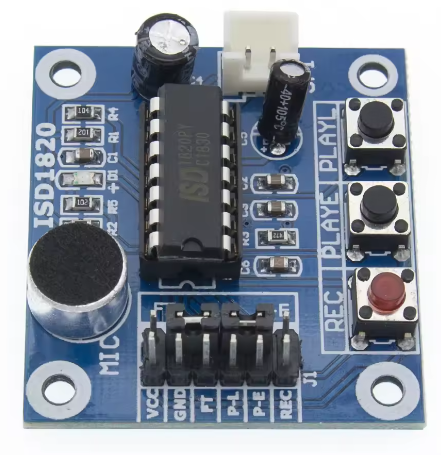
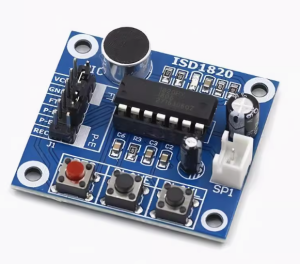
Industrial-Grade ISD1820 Audio Recording Board with Microphone

SKU: FA2044-0-0
Operating Voltage

3.0V – 5.0V DC

Recording Duration

10 Seconds (Standard); Adjustable up to 20 Seconds

Sampling Frequency

6.4KHz (at 10s recording)

Storage Technology

DAST (Direct Analog Storage Technology)

Control Logic

High-Level Trigger (3.3V – 5V)

Message Cycles

100,000 Record Cycles (Typical)

PCB Dimensions

38mm x 42.5mm

Included Accessories

High-Sensitivity Mic (Mounted), 0.5W 8Ω Speaker

Product Description
The Industrial-Grade ISD1820 Audio Board is a robust, high-fidelity voice recording solution designed for mission-critical applications where reliable audible feedback is essential. Engineered for longevity and ease of integration, this module allows for the high-quality capture and playback of short vocal messages, alerts, or instructions.
At the heart of the board is the ISD1820 CMOS device, which utilizes patented Direct Analog Storage Technology (DAST). This allows for natural-sounding voice reproduction without the complex compression algorithms that often degrade audio quality. Designed to withstand the rigors of industrial environments, the board features reinforced solder points and high-tolerance components. Whether it is providing voice-guided prompts for a kiosk or emergency alerts in a factory setting, the ISD1820 ensures your audio is stored safely in non-volatile memory—meaning the message is never lost, even during a total power failure.
Key Features
  • High-Fidelity Recording: Integrated high-sensitivity electret microphone with automatic gain control for clear, intelligible voice capture.
  • Non-Volatile Flash Storage: Messages are stored in solid-state memory with a retention period of up to 100 years without power.
  • Three-Way Playback Control: Support for Edge-triggered (one-touch), Level-triggered (hold-to-play), and continuous loop playback.
  • Direct MCU Integration: Fully compatible with 3.3V and 5V logic, allowing for automated control via Arduino, Raspberry Pi, or PLC industrial controllers.
  • Industrial Temperature Stability: Component selection allows for stable operation in varying environment temperatures.
  • Onboard Power Amplifier: Capable of driving an 8Ω 0.5W speaker directly without the need for an external amp module.
Usage & Applications
  • Factory Safety Systems: Program the module to play safety warnings (“High Voltage,” “Wear Protection”) when a sensor is triggered.
  • Automated Kiosks: Provide audible “Welcome” or “Thank You” messages to enhance customer interaction at point-of-sale terminals.
  • Medical Equipment: Add clear voice instructions to portable diagnostic tools or emergency medical kits.
  • Transit & Logistics: Use as a voice-notification system for small-scale elevators, conveyors, or sorting machines
Q: Can this module be used in noisy industrial environments?

Yes. While the onboard 0.5W speaker is sufficient for close-proximity use, the module’s audio output can be fed into an industrial power amplifier if high-volume broadcasting across a factory floor is required

Q: How do I automate the playback using a PLC or Arduino?

You can bypass the manual buttons and send a HIGH pulse (3.3V or 5V) to the PLAYE (Edge) or PLAYL (Level) pins. This allows your controller to trigger specific audio prompts based on sensor input.

Q: What is the benefit of "Non-Volatile" storage for my business?

It ensures that once a message (such as an emergency instruction) is recorded, it remains on the device regardless of power outages. This eliminates the need for technicians to re-record messages after maintenance or battery changes.

Q: Can I record a new message remotely?

Recording requires a HIGH signal to the REC pin while audio is being fed into the microphone. While this can be triggered by a microcontroller, the audio source must be physically present at the microphone

Q: Can I chain multiple modules together for longer messages?

Yes. Advanced users can use a microcontroller to trigger multiple ISD1820 boards in sequence to create longer, seamless instructional narratives