Description
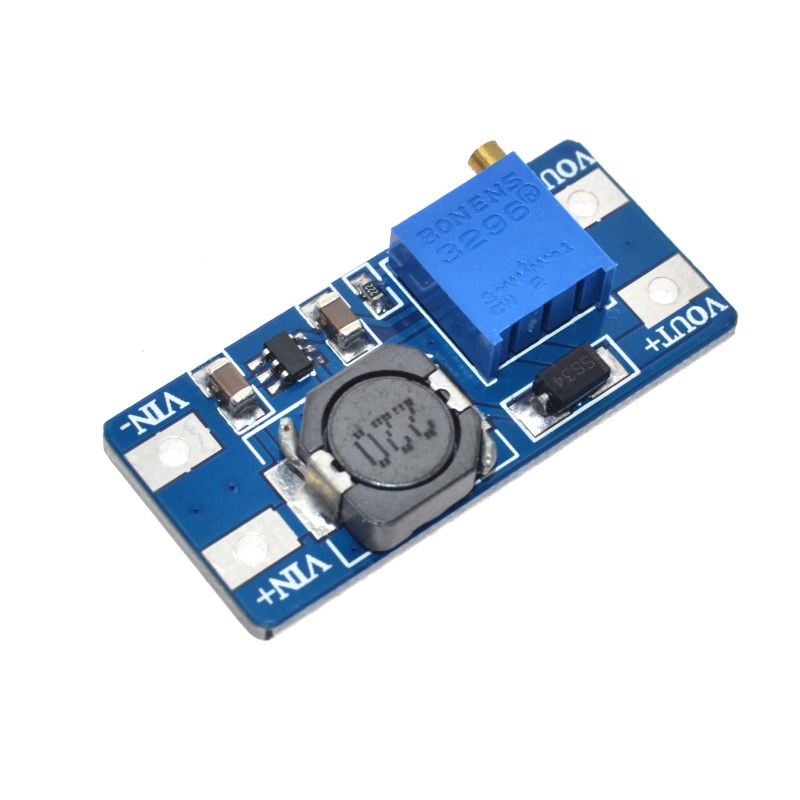
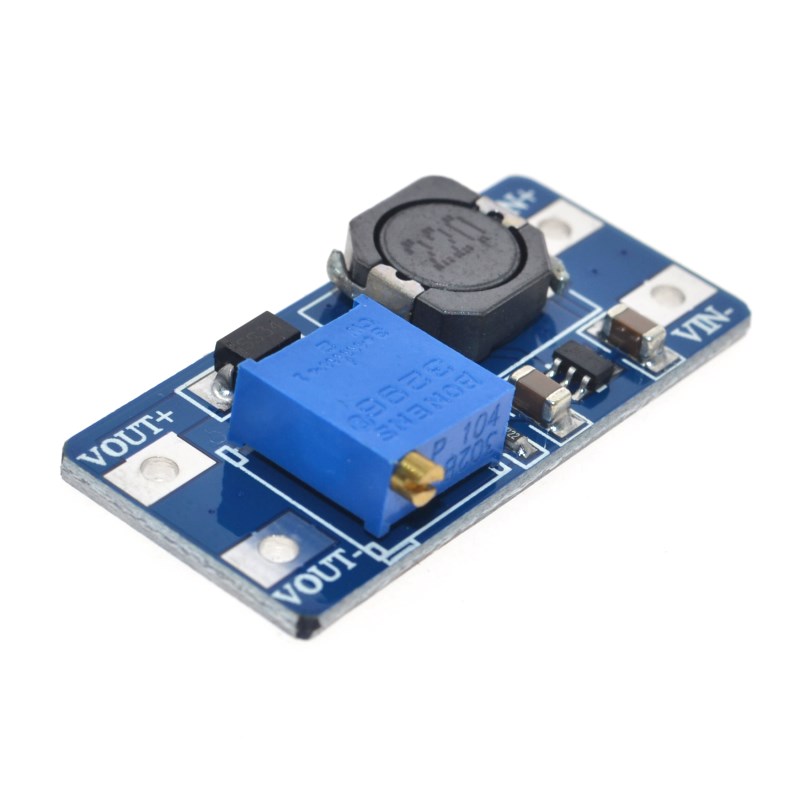
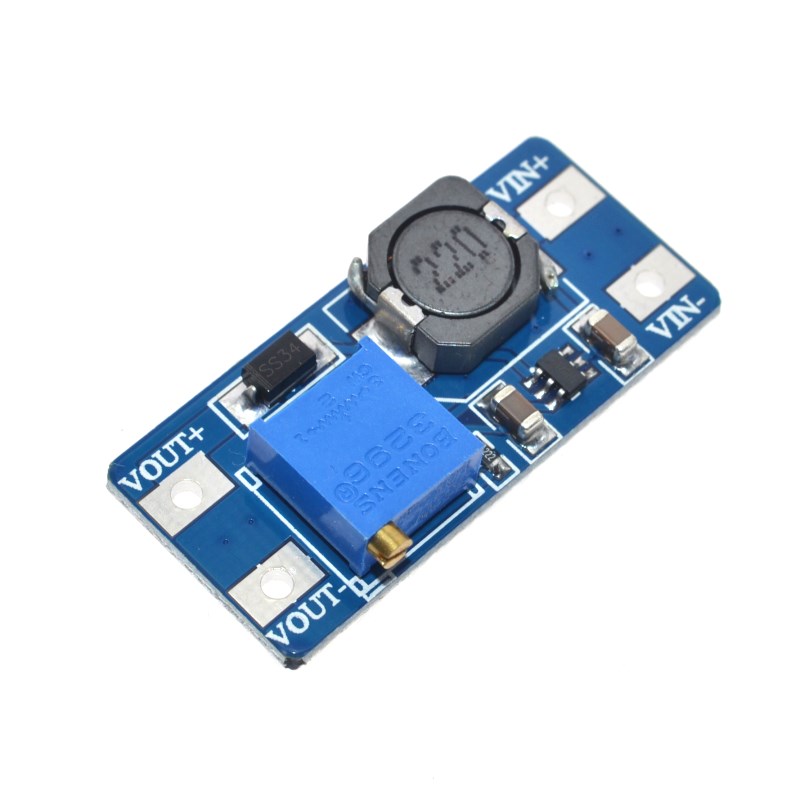
The MT3608 2A DC-DC Step-Up Boost Converter Module is a compact and highly efficient power solution designed to elevate lower DC voltages to higher, usable levels. Whether you need to power a 12V LED strip from a 5V USB port, run an Arduino project from a single 3.7V lithium battery, or create a custom power bank, this tiny module is an essential tool for any electronics workbench.
At the heart of this module is the MT3608 chip, a constant frequency, current mode step-up converter that operates at a high 1.2MHz switching frequency . This high frequency allows the module to use small, low-profile inductors and ceramic capacitors, resulting in a compact form factor without sacrificing performance .
How It Works:
As a dedicated “Boost” converter, the MT3608 module only steps voltage up. It takes an input voltage (from 2V to 24V) and efficiently increases it to a higher, adjustable output voltage (up to 28V) . It works by rapidly switching the current through an inductor to build a magnetic field, then releasing that stored energy at a higher voltage.
High Efficiency & Power:
With an efficiency rating of up to 93-97% , the module wastes very little energy as heat, making it ideal for battery-powered applications. It features an internal 4A switch current limit and an 80mΩ power MOSFET, allowing it to handle peak output currents of up to 2A .
Adjustability & Protection:
Adjusting the voltage is simple using the onboard multi-turn potentiometer, allowing you to fine-tune your exact voltage output (e.g., 5V, 9V, 12V, or 24V). The MT3608 chip also includes built-in safety features such as over-current limiting and thermal shutdown to protect your circuit from accidental shorts or excessive loads .
Note: Because the output voltage must always be higher than the input, this module is not suitable for “stepping down” voltage (e.g., converting 12V to 5V).
Whether you are a hobbyist powering a portable speaker, an IoT developer needing a 5V rail from a battery, or a professional creating a custom power supply, the MT3608 provides a simple, reliable, and low-cost solution for all your voltage boosting needs.
Key Features
-
Wide Input Voltage Range – Accepts DC 2V to 24V input, compatible with single-cell Li-Ion (3.7V), USB (5V), and various battery packs .
-
Adjustable Output Voltage – Output can be set from 5V up to 28V DC via onboard potentiometer .
-
High Output Current – Delivers up to 2A peak current (1A recommended for continuous use without heatsink) .
-
High Conversion Efficiency – Up to 93-97% efficiency, minimizing power loss and heat generation .
-
1.2MHz Switching Frequency – Allows use of small, low-cost external components and reduces output ripple .
-
Integrated Protection – Features over-current limiting and thermal shutdown for safe operation .
-
Integrated 80mΩ MOSFET – Built-in power switch handles high currents efficiently .
-
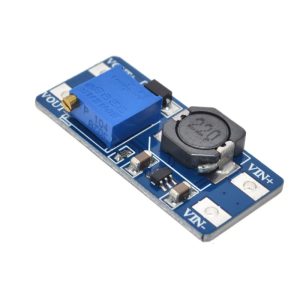
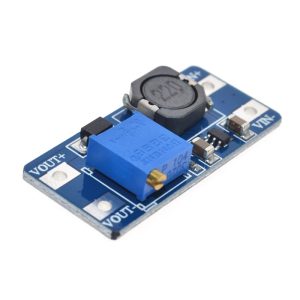
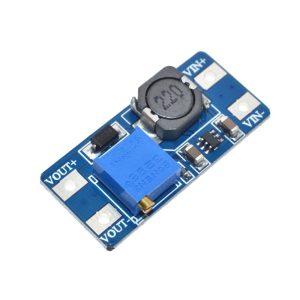
Compact PCB Design – Small footprint (approx. 36mm x 17mm) with clearly labeled input/output pads .
-
Simple Adjustment – Multi-turn potentiometer allows precise voltage tuning with a screwdriver.
-
Low Quiescent Current – Automatic PFM mode at light loads reduces standby current for battery-powered applications .
Technical Parameters
Usage Guide
Pinout Description
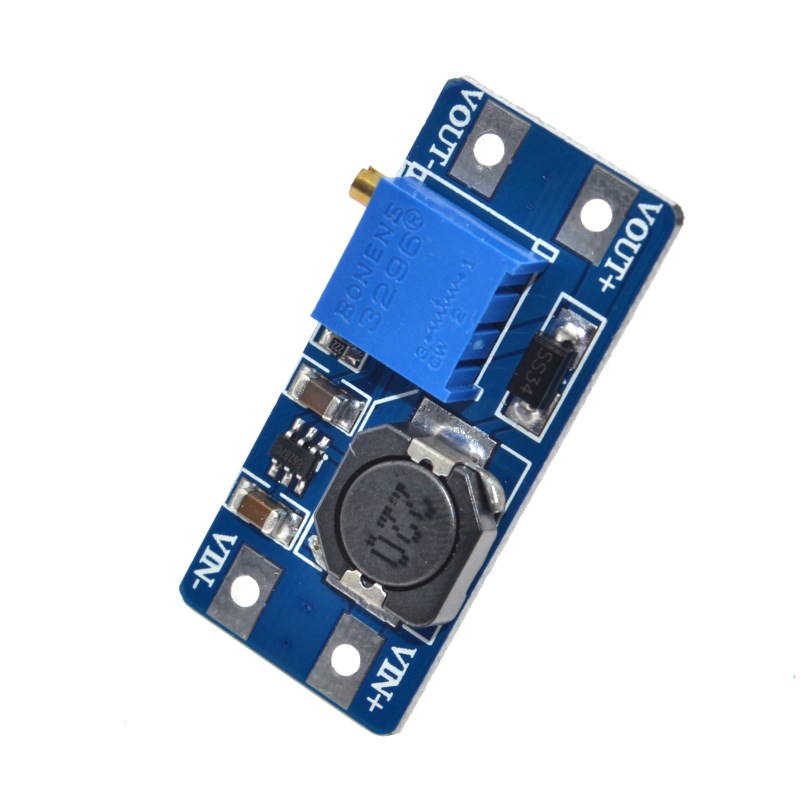
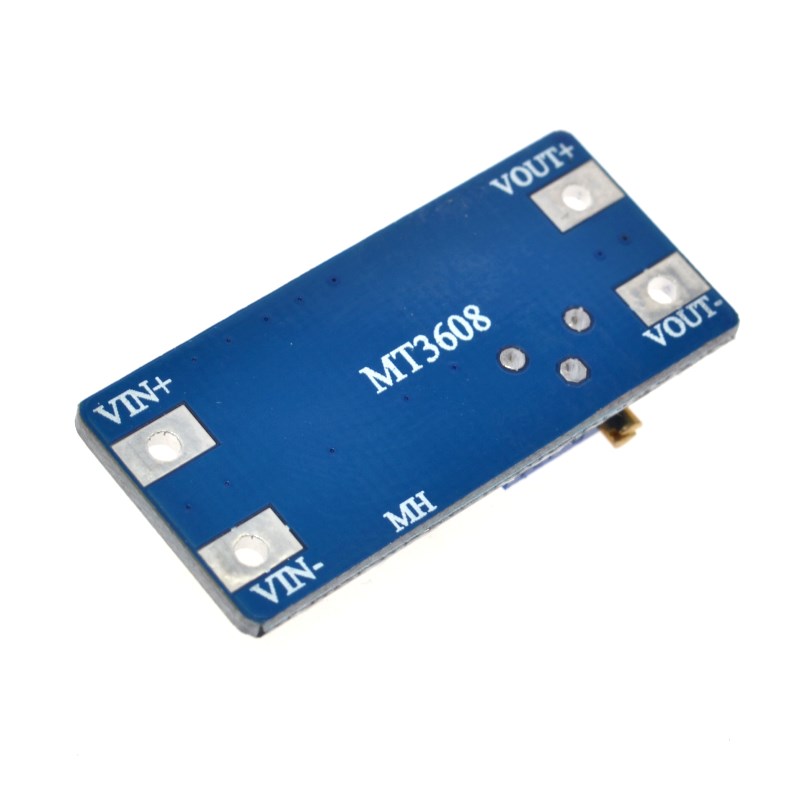
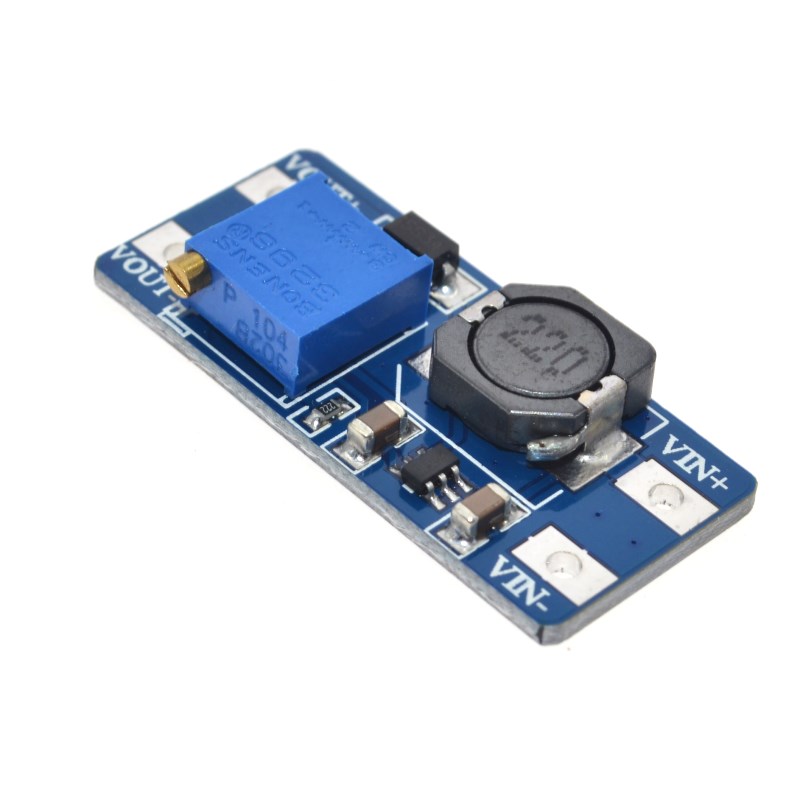
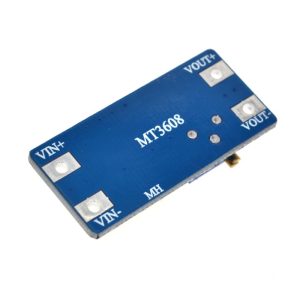
The module features four clearly labeled solder pads:
Wiring Instructions
Step 1 – Connect Power Input
-
Attach the positive (+) wire of your power source (e.g., 3.7V Li-Ion battery, 5V USB, 12V supply) to the VIN+ pad.
-
Attach the negative (-) wire of your power source to the VIN- pad.
Step 2 – Connect Load (Output)
-
Attach the positive (+) wire of your device (e.g., Arduino, LED strip, motor) to the VOUT+ pad.
-
Attach the negative (-) wire of your device to the VOUT- pad.
⚠️ Important: Ensure your load’s negative (ground) is connected to the module’s VOUT- pad. The input and output grounds are common (connected together on the board) .
Adjusting the Output Voltage
Step 1 – Power On
Apply power to the input (VIN+/VIN-).
Step 2 – Monitor Output
Use a digital multimeter to measure the voltage between VOUT+ and VOUT-.
Step 3 – Adjust Potentiometer
Turn the small brass screw on the blue potentiometer counter-clockwise (to the left) to increase the output voltage, or clockwise to decrease it .
The “Endless Turn” Issue (CRITICAL TIP)
This is the most common point of confusion for new users. The potentiometers used on these modules often ship at their maximum resistance. If you turn the screw clockwise and see no change, you need to turn it counter-clockwise for 10-20 full rotations before the voltage begins to increase . Keep turning until you see the voltage on your multimeter start to rise.
Current Limitations and Thermal Management
While the MT3608 is rated for a peak output of 2A, the practical continuous current is limited by heat.
-
Without Heatsink: For reliable continuous operation, it is recommended to keep the output current under 1A .
-
High Current (>1A): If you need to draw more than 1A for extended periods, attach a small heatsink to the MT3608 chip on the back of the board to dissipate heat .
-
Input Current vs. Output Current: Remember that boosting voltage increases current draw from the input source. If you are drawing 1A at 12V output (12W), from a 5V input, the input current will be over 2.4A (plus efficiency losses). Ensure your input source can supply enough current .
Applications
Installation Tips
-
Polarity Check: This module does NOT have reverse polarity protection. Double-check your VIN+ and VIN- connections before applying power. Connecting backwards will instantly destroy the module .
-
Input Capacitor: For stable operation, add a 10µF or larger capacitor near the input terminals if your power source has long wires .
-
Output Capacitor: A 22µF ceramic capacitor at the output helps reduce voltage ripple .
-
Keep Wires Short: Long wires add resistance and inductance, which can reduce efficiency and cause voltage drops under load.
-
Use a Fuse: For critical projects, add a fuse (e.g., 2A) on the input line as a safety precaution against shorts .
Q: Why is my MT3608 output voltage not changing when I turn the screw?
This is the most common issue. The potentiometer usually needs to be turned counter-clockwise for 10-20 full turns before the voltage starts to change . Keep turning while watching your multimeter.
Q: Can I use this module to step down voltage (e.g., 12V to 5V)?
No. The MT3608 is a Boost (Step-Up) converter only. It cannot step down voltage. If your input voltage is higher than your set output, the output will simply equal the input voltage (minus a small diode drop), which may damage your load . For step-down, you need a Buck converter module (e.g., LM2596).
Q: What is the maximum safe current for this module?
The chip is rated for 2A peak, but for continuous use without a heatsink, it is recommended to keep the current under 1A to prevent overheating . At 2A, the module will get very hot and may shut down or fail.
Q: Can I use this with a 3.7V lithium battery to power a 5V Arduino?
Yes, absolutely. This is one of the most popular uses for the MT3608. Connect a single 18650 or Li-Po battery (3.7V-4.2V) to the input, and adjust the output to a stable 5V to power your Arduino or ESP32
Q: Can I use this module for both home and business applications?
Home users: Powering portable speakers, DIY power banks, LED projects, running 12V devices from USB, battery-powered Arduino robots.
Business users: Industrial sensor networks (e.g., boosting 12V to 24V for 485 communication), portable medical device power supplies, prototype power sources, low-power IoT device development
Q: Does this module have short-circuit protection?
Generally, no. Most basic MT3608 modules do not have dedicated short-circuit protection. If you short the output, you risk burning out the module or your battery. Adding a small fuse on the input side is good safety practice . The chip does have over-current limiting, which will cap the current, but it is not a full protection feature.
Q: What is included in the package?
Q: How efficient is the power conversion?
The MT3608 is highly efficient, typically between 93% and 97% . However, efficiency drops when the difference between input and output voltage is very large (e.g., boosting 2V to 24V is less efficient than boosting 5V to 12V)
Q: The module gets very hot. Is this normal?
The MT3608 can run hot, especially near its 2A limit or when boosting a low input voltage to a high output voltage. This is wasted energy dissipated as heat. If it is too hot to touch comfortably, you should:
Q: What is the difference between this module and the MT3608L or other boost converters?
The standard MT3608 is widely available and well-documented. The MT3608L is a newer variant with slightly higher efficiency but at a higher cost . Compared to larger modules like the XL6009, the MT3608 is smaller and more efficient for low-power (<2A) applications, while XL6009 can handle higher currents but is much larger.