Product Overview
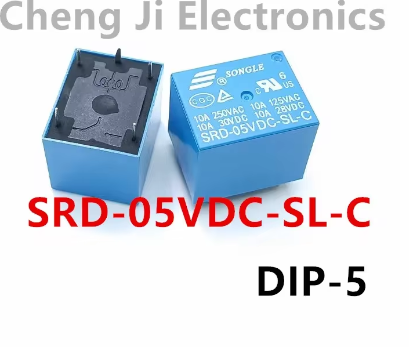
The SRD-05VDC-SL-C is a high-quality, subminiature electromagnetic relay manufactured by Songle Relay (Ningbo Songle Relay Co., Ltd.), one of the most trusted names in the relay industry . This 5-pin, 1 Form C (SPDT – Single Pole Double Throw) relay is designed to switch loads up to 10A at 250V AC or 30V DC, making it an ideal choice for a wide range of applications including home appliances, office equipment, audio systems, automotive electronics, and industrial automation control circuits .
With a 5V DC coil, this relay is perfectly suited for standard 5V microcontroller applications such as Arduino, ESP32, and other 5V logic systems . The relay features a sealed construction that protects the internal contacts from dust, humidity, and environmental contaminants, ensuring long-term reliability even in demanding conditions . It is recognized by major safety agencies including UL, CUL, and TUV, providing confidence for both hobbyist and commercial applications.
The SRD series relay employs a simple magnetic circuit design that enables high-density PCB mounting while maintaining a compact footprint. Its SPDT (Single Pole Double Throw) configuration provides both Normally Open (NO) and Normally Closed (NC) contact options, allowing flexible wiring for your specific application needs .
Key Features
-
SPDT Contact Configuration (1 Form C): Single Pole Double Throw relay with 5 pins, providing both Normally Open (NO) and Normally Closed (NC) contacts for maximum wiring flexibility
-
10A High Switching Capacity: Contacts rated for 10A at 250V AC or 10A at 30V DC, with maximum switching current up to 15A, suitable for controlling lights, fans, pumps, and small motors
-
5V DC Coil Voltage: Standard operating voltage of 5V DC with a coil resistance of approximately 70Ω and power consumption of 360mW (0.36W)
-
Compact Subminiature Design: Small footprint measuring approximately 19.2mm × 15.6mm × 15.8mm, ideal for high-density PCB mounting
-
Sealed Construction: Protects internal contacts from dust, moisture, and environmental contaminants for enhanced reliability
-
Safety Agency Approvals: UL, CUL, and TUV recognized for reliable performance in commercial and industrial applications
-
Fast Switching Time: Typical operate and release time of ≤10ms, suitable for most control applications
-
Wide Operating Temperature: Rated for operation from -40°C to +85°C, suitable for demanding environments
Technical Specifications
Pinout & Interface Guide
The SRD-05VDC-SL-C features 5 pins arranged in a standard configuration :
Contact State Summary
Usage Guide
Driving the Relay
The SRD-05VDC-SL-C requires approximately 71.4mA of current to energize the coil (calculated from I = V/R = 5V / 70Ω) . This exceeds the maximum current rating of most microcontroller pins (typically 20mA–40mA), so a transistor driver circuit is strongly recommended .
Recommended Driver Circuit (with NPN Transistor)
    +5V --------[Relay Coil]----+----- +5V (for logic)
                                  |
                                  |/ C
                     Arduino Pin ----|  2N2222 or BC547
                                  |\ E
                                  |
                                GND

                   [Flyback Diode] (1N4148 or 1N4007)
                        +----|<|----+
                        |           |
                  [Relay Coil]       |
                        |           |
                      GND           |
                        +-----------+
Basic Arduino Control Example
const int relayPin = 7;
void setup() {
pinMode(relayPin, OUTPUT);
digitalWrite(relayPin, LOW);
}
void loop() {
digitalWrite(relayPin, LOW);
delay(5000);
digitalWrite(relayPin, HIGH);
delay(5000);
}
ESP32 / ESP8266 Control Example
Since ESP32 and ESP8266 operate at 3.3V logic, they cannot directly drive the 5V relay coil. Use a transistor driver circuit with a separate 5V supply for the relay coil.
const int relayPin = 5;
void setup() {
pinMode(relayPin, OUTPUT);
digitalWrite(relayPin, LOW);
}
void loop() {
digitalWrite(relayPin, HIGH);
delay(5000);
digitalWrite(relayPin, LOW);
delay(5000);
}
Load Connection Guidelines
For AC Loads (e.g., lights, fans):
-
Connect the Live (L) wire to the COM terminal
-
For OFF-by-default operation (device ON when relay activates), connect the load to the NO terminal
-
For ON-by-default operation (device OFF when relay activates), connect the load to the NC terminal
-
Connect the Neutral (N) wire directly to the load’s neutral
For DC Loads (e.g., motors, solenoids):
-
Connect the positive (+) supply to the COM terminal
-
Connect the load’s positive wire to the NO terminal (or NC as needed)
-
Connect the load’s negative wire directly to the power supply ground
Important: Flyback Diode
Always use a flyback diode (1N4148, 1N4007, or similar) across the relay coil terminals . When the coil is de-energized, it generates a high-voltage inductive kickback (often >50V) that can damage the transistor or microcontroller. The diode should be placed with the cathode (banded end) towards the positive supply and the anode towards the transistor collector
Q: What is the difference between SRD-05VDC-SL-C and SRD-05VDC-SL-A?
The SRD-05VDC-SL-C is a 5-pin SPDT (Single Pole Double Throw) relay with COM, NO, and NC contacts, offering both Normally Open and Normally Closed switching options . The SRD-05VDC-SL-A is a 4-pin SPST-NO (Single Pole Single Throw, Normally Open) relay with only COM and NO contacts. Choose the C version if you need both NO and NC functions (e.g., to switch between two circuits).
Q: What is the maximum load this relay can handle?
The contacts are rated for 10A at 250V AC (resistive) or 10A at 30V DC . The maximum switching current can reach 15A under specific conditions . For inductive loads like motors or solenoids, it is recommended to derate to 5A–7A to account for startup surges.
Q: Can I use this relay directly with an Arduino, ESP32, or ESP8266?
The relay coil draws approximately 71.4mA at 5V , which exceeds the maximum current rating of most microcontroller pins (20mA–40mA). A transistor driver circuit is strongly recommended for reliability . ESP32 and ESP8266 (3.3V logic) cannot directly drive the 5V coil and require a transistor driver with a separate 5V supply.
Q: What is the purpose of the flyback diode?
When the relay coil is de-energized, it generates a high-voltage inductive kickback that can destroy the transistor or microcontroller . A flyback diode (1N4148, 1N4007) placed across the coil protects the driver circuit by providing a safe path for this energy to recirculate.
Q: What is the coil resistance of this relay?
The SRD-05VDC-SL-C has a coil resistance of 70Ω ± 10% . This determines the current draw: I = V / R = 5V / 70Ω = 71.4mA
Q: What is the minimum voltage required to activate the relay?
The pick-up (pull-in) voltage is ≤ 75% of nominal voltage, meaning the relay will reliably activate when the coil voltage reaches 3.75V or higher . For consistent operation, it is recommended to use the full 5V.
Q: What is the drop-out voltage?
The drop-out (release) voltage is ≥ 10% of nominal voltage, so the relay will de-energize when the coil voltage drops below 0.5V
Q: What is the expected lifespan of this relay?
The relay is rated for 10 million mechanical operations (no load) and 100,000 electrical operations at the rated load . Actual lifespan depends on switching frequency and load type.
Q: Does the relay require a heatsink?
No. The relay is designed for PCB mounting with natural cooling. At 10A continuous load, the contacts may warm slightly, but no additional heatsink is required.
Q: Can I use this relay for 220V AC applications?
Yes. The contacts are rated for 10A at 250V AC, which is suitable for 220V/240V systems . Ensure proper insulation and clearance between coil and contact pins for safety.
Q: The relay clicks but my load doesn't turn on. What's wrong?
This indicates the coil is energizing but the load circuit is incomplete . Check:
-
The load’s wiring (COM to power source, NO/NC to load)
-
The load’s neutral/ground is connected correctly
-
The load itself is functional
-
Contact continuity with a multimeter (should show closed when coil energized)
Q: The relay chatters or buzzes. What causes this?
Chatter usually indicates:
-
Insufficient coil voltage (below 3.75V)
-
Unstable power supply
-
Insufficient driver current
-
Loose connections
-
Contact contamination from switching inductive loads without proper suppression
Q: Can I use this relay in high-vibration environments?
The relay is designed for standard industrial environments. For extreme vibration applications, consider using a relay with additional mechanical reinforcement or a solid-state relay (SSR).
Q: What can I build with the SRD-05VDC-SL-C relay?
Popular applications include :
-
Home automation (lighting, fans, appliances)
-
Industrial equipment control
-
IoT projects with 5V microcontrollers (Arduino)
-
Automotive electronics (lights, windows, audio systems)
-
Solar power system switching
-
HVAC system control
-
Security systems and alarms
Q: Can I use this relay with a 5V power supply from an Arduino?
Yes. The 5V pin on an Arduino can supply the necessary current if the relay is driven through a transistor circuit. Driving the coil directly from the 5V pin (without a transistor) is not recommended as it may exceed the board’s total current capacity.
Q: Is this relay suitable for controlling a pump or motor?
Yes, with derating. For inductive loads like motors, it is recommended to operate at 50–70% of the rated contact current (5A–7A) to account for startup surges. Consider adding a snubber circuit (RC network) across the contacts to suppress arcing.
Q: What is the difference between NO and NC contacts?
-
NO (Normally Open): The circuit is open when the relay is OFF. When the relay activates, it closes. Use NO for devices that should be OFF by default .
-
NC (Normally Closed): The circuit is closed when the relay is OFF. When the relay activates, it opens. Use NC for devices that should be ON by default