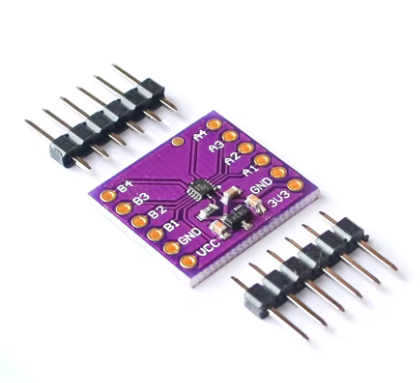
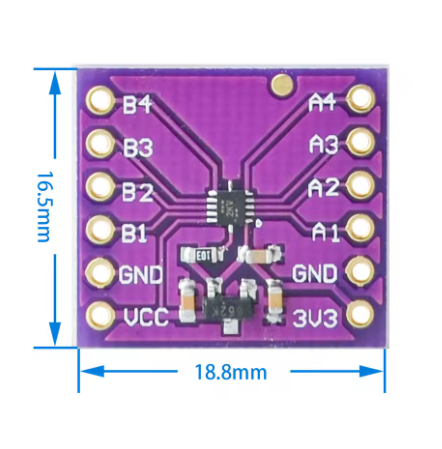
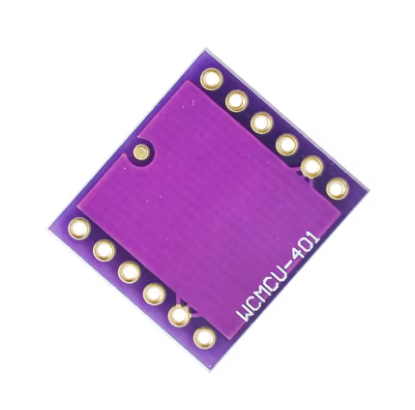
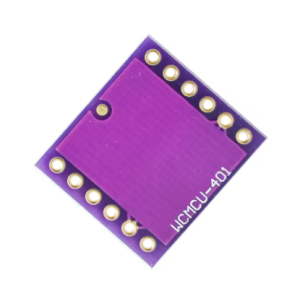
The WCMCU-401 Logic Level Shifter Module is an essential interface tool designed to seamlessly bridge the gap between electronic components operating at different voltage levels, such as connecting a 5V Arduino to a 3.3V Raspberry Pi or sensor. This 4-channel bidirectional voltage converter allows safe and reliable communication without the risk of damaging sensitive low-voltage components.
Product Description
The WCMCU-401 Logic Level Shifter Module (often utilizing the TXB0104 or similar MOSFET-based design) provides a safe and reliable solution for interfacing systems that operate at different logical voltages. In modern DIY electronics, microcontrollers frequently use 5V logic while many modern sensors and single-board computers (like the Raspberry Pi) use 3.3V logic. Directly connecting these can damage the lower- voltage device. The WCMCU-401 module prevents this damage by automatically translating the signals between two voltage domains.
This module features four independent channels that are fully bidirectional, meaning they can convert signals from High Voltage (HV) to Low Voltage (LV), and vice versa, simultaneously and automatically. This makes it highly versatile for common communication protocols like I2C, SPI, and general-purpose input/output (GPIO) lines. Its simple design requires only connecting the respective high and low voltage sources to the board; no manual direction control pins are necessary for basic operation. Whether you are a hobbyist integrating a new sensor into your project or a business prototyping complex multi-voltage systems, the WCMCU-401 ensures your components communicate safely and efficiently.
Features
- Bidirectional Voltage Translation: Automatically converts signals in both directions (HV to LV and LV to HV) across four independent channels.
- Wide Voltage Compatibility: Supports high voltages from 3V to 5.5V and low voltages from 1.8V to 3.6V (specific ranges may vary by exact component, typically 5V/3.3V compatible).
- 4 Independent Channels: Allows simultaneous level shifting for up to four data lines.
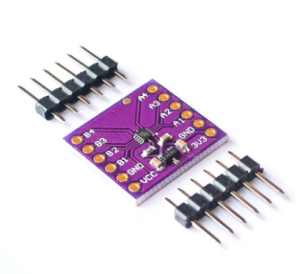
- Easy Integration: Designed with standard 0.1″ (2.54mm) pitch header pins for easy breadboard or PCB mounting.
- No Direction Control Required: The module automatically senses the direction of data flow, simplifying wiring and coding requirements.
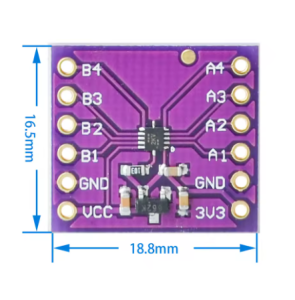
- Compact Design: Small footprint makes it easy to integrate into space-constrained projects.