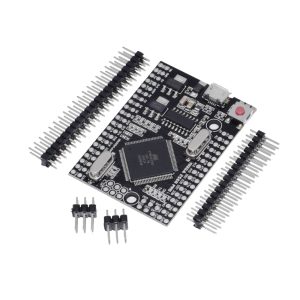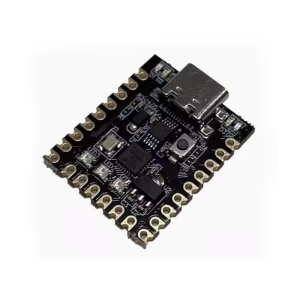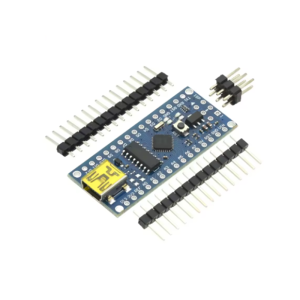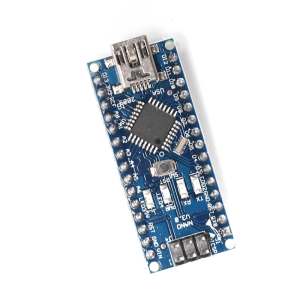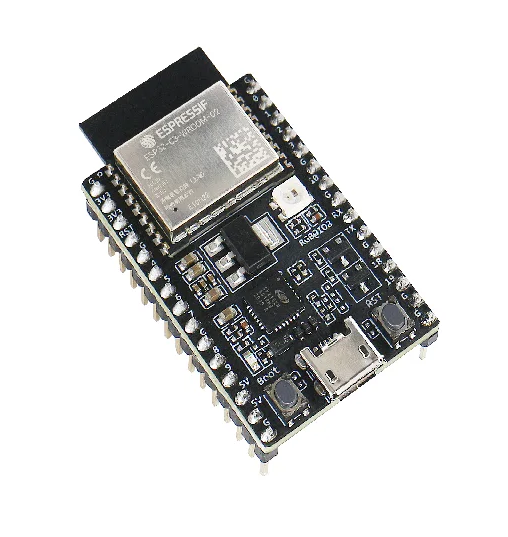
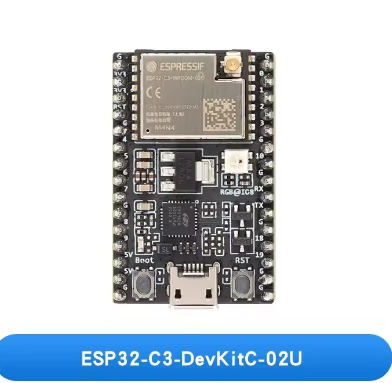
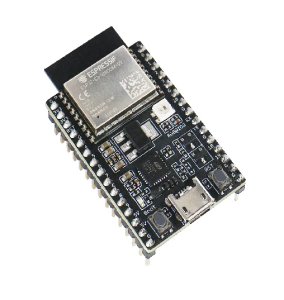
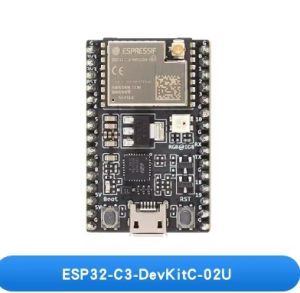
Espressif ESP32-C3-DevKitC-02U Development Board – Featuring ESP32-C3-WROOM-02 Module (Wi-Fi & Bluetooth LE)

SKU: FA1054
Microcontroller

ESP32-C3-WROOM-02U (RISC-V)

Clock Speed

160 MHz

Wireless Protocols

Wi-Fi 802.11 b/g/n, Bluetooth 5.0 (LE)

Memory

4MB SPI Flash, 400KB SRAM

Antenna Interface

U.FL / IPEX Connector (External Antenna Required)

Power Supply

5V via Micro-USB or VIN pin

I/O Logic Level

3.3V

Peripheral Interfaces

UART, SPI, I2C, I2S, ADC, PWM, GPIO

USB-to-Serial

Typically CP2102 or CH340 (model dependent)

The ESP32-C3-DevKitC-02U is a entry-level, highly secure development board powered by the ESP32-C3-WROOM-02U module. Designed for the 2026 IoT market, this board is built around a RISC-V single-core processor and features a specialized U.FL connector for an external antenna, making it the premier choice for projects requiring superior wireless range or installation inside metal enclosures.
Long Description
The ESP32-C3-DevKitC-02U represents the modern standard for secure, low-power IoT. Unlike traditional ESP32 modules that use an onboard PCB antenna, the “02U” variant is equipped with a U.FL (IPEX) connector, allowing users to attach high-gain external antennas to significantly extend Wi-Fi and Bluetooth LE range.
Under the hood, it features a 160MHz RISC-V processor that balances high performance with industry-leading energy efficiency. For business purchasers, the “C3” series is highly attractive due to its advanced security features, including Secure Boot and Flash Encryption, which provide a “Root of Trust” for commercial applications. For individual makers, it offers a cost-effective, breadboard-friendly platform that is fully compatible with the Arduino ecosystem, perfect for smart home sensors and wearable prototypes that require compact, high-range connectivity.
Key Features
  • External Antenna Support: Features a U.FL/IPEX connector for external antenna attachment, ideal for long-range or metal-housed applications.
  • RISC-V Architecture: Powered by a 32-bit RISC-V single-core processor (up to 160MHz).
  • Dual Wireless Stack: Integrated 2.4GHz Wi-Fi and Bluetooth 5 (LE) with long-range support.
  • Advanced Security: Hardware accelerators for AES, SHA, RSA, and a Random Number Generator (RNG), plus Secure Boot and Flash Encryption.
  • Compact Breadboard Design: Most I/O pins are broken out to the pin headers on both sides for easy interfacing and prototyping.
Usage Instructions
  1. Antenna Installation: Crucial: Connect a compatible 2.4GHz external antenna to the U.FL connector before powering the board to avoid damaging the RF circuitry.
  2. Hardware Connection: Plug the board into your PC using a Micro-USB data cable.
  3. Software Setup:
    • Open the Arduino IDE.
    • In Boards Manager, install the “ESP32” package (ensure version 2.0.0 or higher for C3 support).
    • Select “ESP32-C3 Dev Module” from the board list.
  4. Security Features: For business applications, use the ESP-IDF to enable hardware security features like Secure Boot.
  5. Prototyping: Utilize the broken-out GPIOs to connect sensors; the RISC-V core is exceptionally efficient for battery-powered deep-sleep applications.
Q: Does this board work without an external antenna?

No. Because this is the “02U” (U.FL) version, it does not have a PCB antenna. Powering it without an external antenna will result in extremely poor wireless performance and could potentially damage the RF transmitter over time.

Q: What is the main benefit of the RISC-V core in the C3 series?

The RISC-V core is an open-source architecture that provides a highly efficient balance of power consumption and processing speed. It is specifically optimized for low-power IoT “edge” devices.

Q: Can I use 5V sensors with this board?

No. The ESP32-C3 logic is 3.3V only. Connecting a 5V signal to any GPIO pin will damage the module. Please use a logic level shifter for 5V components.

Q: Is this board suitable for commercial/industrial use?

Yes. The ESP32-C3 is designed with industrial-grade security and a wide operating temperature range, making it a standard choice for 2026 commercial IoT deployments.

Q: My computer does not recognize the board via USB. What is wrong?

Ensure you are using a USB data cable, not a “charge-only” cable. Also, check if the USB-to-Serial driver (CH340 or CP2102) is installed on your operating system.