Description
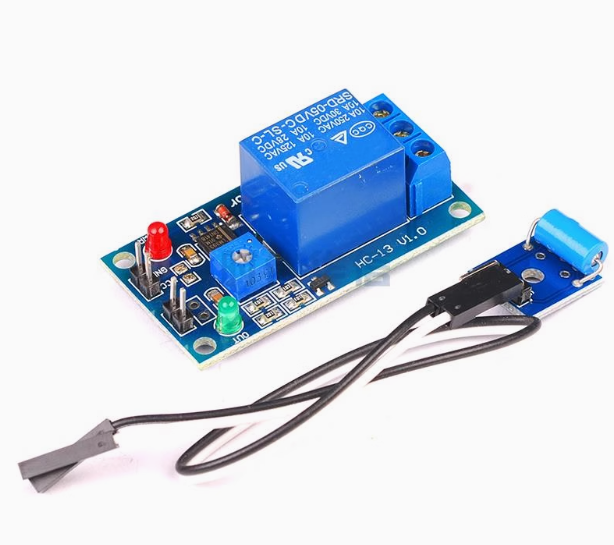
The 5V Normally Closed Shock Sensor Relay Module is a specialized vibration and impact detection device designed for fail-safe industrial equipment protection, security systems, and critical automation applications. Operating on a standard 5V DC supply—compatible with USB power, Arduino, Raspberry Pi, and other microcontroller platforms—this module combines a highly sensitive piezoelectric shock/vibration sensor with a built-in relay that opens (deactivates) when physical impact or excessive vibration is detected.
Unlike Normally Open (NO) modules, this device features a Normally Closed (NC) relay configuration, meaning the relay remains closed (active) under normal conditions and opens (interrupts the circuit) only when a shock event occurs. This is the industry standard for fail-safe applications: if the module loses power, the relay opens, safely shutting down connected equipment. This design is essential for protecting critical machinery, preventing damage, and ensuring operator safety.
The module includes an adjustable sensitivity potentiometer, allowing you to set the precise impact threshold required for triggering, from light taps to heavy shocks. The onboard LM393 comparator processes the sensor signal and provides clean, bounce-free triggering. A green LED indicator confirms normal operation (relay closed), and the LED extinguishes when a shock is detected. The sensor element is compact and can be mounted remotely on vibrating machinery, doors, windows, or structural elements.
Whether you need to shut down a CNC machine upon excessive vibration, protect conveyor systems from jams, detect unauthorized access to equipment cabinets, trigger emergency stops during seismic events, or provide impact detection for industrial robots, the 5V Normally Closed Shock Sensor Relay Module delivers reliable, fail-safe protection without requiring complex programming or PLC integration.
Key Features
-
Normally Closed (NC) Default State – Relay remains closed (active) under normal conditions; opens (shuts down) when shock is detected. Fail-safe design – power loss = safe state (relay opens).
-
Adjustable Sensitivity – Onboard potentiometer allows precise setting of impact/vibration threshold, from light taps to heavy shocks.
-
5V DC Operation – Compatible with USB power, Arduino, Raspberry Pi, and standard 5V power supplies.
-
Piezoelectric Shock Sensor – Fast response to physical impacts and vibrations; solid-state design with no moving parts.
-
LM393 Comparator IC – Provides stable, noise-immune threshold detection with adjustable hysteresis.
-
Built-in SPDT Relay – Controls external devices up to 10A / 250V AC or 10A / 30V DC.
-
Dual Output Terminals – Both NC (Normally Closed) and NO (Normally Open) available for flexible wiring, but NC is the primary fail-safe output.
-
Status Indicator LED – Green LED illuminates when relay is closed (normal operation); turns off when shock is detected.
-
Compact Design – Small footprint for easy installation inside control panels, equipment enclosures, or security housings.
-
Fail-Safe Operation – Relay opens automatically on power failure, ensuring connected equipment stops safely.
Technical Parameters
Usage Guide
How It Works
The piezoelectric sensor continuously monitors for mechanical vibration and impact. Under normal conditions (no shock), the relay remains closed (energized) , allowing current to flow through the NC terminal to your connected equipment. When a shock exceeds the user-adjustable threshold, the sensor generates a voltage spike. The LM393 comparator processes this signal and opens (de-energizes) the relay, interrupting the circuit and stopping your equipment. This is the fail-safe configuration: if power is lost, the relay also opens, safely shutting down the load.
Wiring Instructions
Step 1 – Power Connection
-
Connect a 5V DC power supply to the VCC (+) and GND (-) terminals.
-
Suitable sources: USB charger, 5V power adapter, Arduino 5V pin, or regulated 5V battery pack.
Step 2 – Load (Device) Connection – Primary Fail-Safe Wiring
Wiring Example (Equipment Shutdown – Turns OFF machine on shock – FAIL-SAFE):
-
Connect machine control relay or motor contactor coil positive → NC terminal
-
Connect 5V power supply positive → COM terminal
-
Connect machine control negative → power supply negative directly
Wiring Example (Alarm + Shutdown – Optional):
⚠️ Safety Warning: For AC loads (110V/220V), ensure all connections are properly insulated. Use appropriate gauge wire and mount the module in an enclosure. This module is designed for fail-safe operation—always verify that power loss results in a safe state.
Sensitivity Adjustment
-
Power on the module with the sensor mounted in the target location.
-
Under normal conditions (no shock), the green LED should be ON (relay closed).
-
Use a small screwdriver to adjust the potentiometer on the board:
-
Test by applying controlled taps or vibrations to the sensor.
-
When shock is detected, the relay should click, the green LED should turn OFF, and your connected equipment should stop.
-
Adjust until the desired sensitivity is achieved.
Sensor Mounting Tips
-
Mount the sensor firmly to the equipment or surface being monitored using screws, adhesive, or double-sided tape.
-
For best sensitivity, mount on a rigid, flat surface—not on flexible panels that may dampen vibrations.
-
Avoid mounting near sources of constant vibration (e.g., motors) that may cause false triggering unless intentional.
-
The sensor can be mounted remotely using 2-conductor wire up to 5 meters (16 feet).
-
For outdoor or wet environments, enclose the sensor in a waterproof housing.
Testing the Module
-
Apply 5V power – the green LED should illuminate (normal state), and connected equipment should be powered.
-
Tap the sensor gently with a finger or small tool.
-
The relay should click, the green LED should turn OFF, and connected equipment should stop.
-
After the shock subsides (or after manual reset depending on module version), the relay should re-close and the LED should turn ON again, restoring power to equipment.
Q: What does "Normally Closed" (NC) mean for this module?
Normally Closed (NC) means the relay contacts are closed (electrically connected) under normal, no-shock conditions. Current flows through the NC terminal to your equipment, keeping it powered. When a shock is detected, the relay opens (disconnects) the circuit, stopping your equipment. This is the fail-safe design: if power is lost to the module, the relay also opens, ensuring equipment stops safely.
Q: Why choose Normally Closed (NC) instead of Normally Open (NO) for industrial protection?
For critical equipment protection (CNC machines, conveyors, robots), NC is the industry standard.
Q: What happens if the module loses power?
Fail-safe operation: If the 5V power supply fails, the relay de-energizes and opens the NC circuit. Your connected equipment will stop. This is intentional—it ensures that a power failure does not leave your machinery running unprotected. Always verify this behavior during installation.
Q: Can I use both NC and NO outputs simultaneously?
Yes. The module provides both terminals:
-
NC → Equipment shutdown (primary fail-safe)
-
NO → Alarm siren, warning light, or PLC input (activates only on shock)
Both terminals share the same COM connection. You can wire them independently.
Q: What types of loads can I control with this relay?
The 10A relay can control:
-
AC loads: Motors, contactors, fans, lights, pumps, solenoid valves (up to 250V AC, 10A)
-
DC loads: DC motors, LED lights, buzzers, PLC inputs, control relays (up to 30V DC, 10A)
For inductive loads (motors, contactors), consider adding a snubber or flyback diode to protect relay contacts.
Q: How do I reset the module after a shock is detected?
This depends on the specific module version:
-
Auto-reset (non-latching) version : Relay automatically re-closes (restores power) a few seconds after the shock subsides. No manual reset required.
-
Latching version : Relay remains open (equipment stopped) until manually reset (by power cycling or a separate reset button).
Check your product specifications. For critical applications, a latching version with manual reset is often required for safety.
Q: How do I prevent false triggering from ambient vibrations?
-
Decrease sensitivity: Turn the potentiometer clockwise to require stronger shocks.
-
Mount the sensor securely: Loose mounting can cause false triggers.
-
Use hysteresis: Some module versions include adjustable hysteresis to ignore minor fluctuations.
-
Relocate the sensor: Move away from known vibration sources (motors, pumps).
-
Add time delay: Some applications benefit from a delay circuit that ignores shocks shorter than a set duration.
Q: Can I use this module for both home and business applications?
Home users: Washing machine imbalance shutdown (prevents damage), garage door obstruction detection, sump pump vibration shutdown, aquarium pump protection, workshop tool vibration cutoff.
Business users: CNC machine vibration shutdown, conveyor belt jam detection (stops belt on impact), industrial robot collision detection, pump cavitation shutdown, compressor vibration monitoring, seismic equipment protection, packaging machine jam protection, elevator overspeed safety (secondary).
Q: Does this module meet industrial safety standards?
The module itself is CE and RoHS certified. However, for safety-critical applications (e.g., emergency stops, personnel protection), you must integrate this module into a properly designed safety circuit with redundant monitoring, approved contactors, and risk assessment per local regulations (ISO 13849, IEC 62061, OSHA). This module is suitable for equipment protection, not primary personnel safety.
Q: What is the response time of this module?
The module responds to shocks within approximately 10 milliseconds (0.01 seconds) , making it suitable for high-speed impact detection and real-time equipment protection. For context, a CNC spindle can cause damage within 50–100ms—this module responds fast enough to prevent most damage.